VERILOG HDL INTERVIEW PREP

Write it, predict it, debug it. 580 Verilog questions, fully answered.

From data types and widths to FSMs, FIFOs, CDC, synthesis and gate-level simulation, in 27 chapters. Each answer is written the way you'd say it in the interview, with a tip on what the interviewer will probe next. Includes 20 coding exercises with verified solutions, 25 predict-the-output puzzles and 30 debugging scenarios.

181-PAGE PDF · INSTANT DOWNLOAD · 8 FREE PREVIEW PAGES BELOW
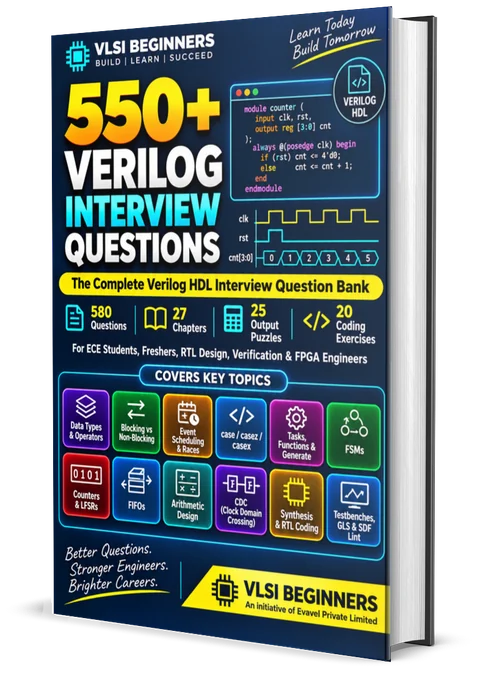
550+ Verilog Interview Questions ebook cover — VLSI Beginners
580
QUESTIONS WITH ANSWERS
27
CHAPTERS IN 5 PARTS
25
PREDICT-THE-OUTPUT PUZZLES
20
CODING EXERCISES WITH SOLUTIONS
THE PROBLEM

Knowing the syntax isn't the same as knowing the hardware

Verilog comes up in almost every RTL design, verification and FPGA interview. It's often the first technical round for freshers, and experienced candidates still get a live coding question in it.

The questions are rarely about syntax. Interviewers ask what a snippet prints, why a register turned into a latch, why RTL simulation passes but the netlist fails, which width an expression is evaluated at, or why two simulators disagree. Then they ask you to write a counter, an FSM or a FIFO on the spot.

The book follows the order you'd learn it on the job: the language, then how the simulator actually runs it, then the RTL patterns every design uses, then synthesis, testbenches and debugging, and finally the interview itself.

WHAT'S INSIDE

From the four logic values to a working FIFO

A Verilog round checks four things: do you know the rules, can you predict what the simulator does, can you write clean synthesisable code, and can you debug it when it breaks? Each has its own part of the book.

ANSWERS

580 answers, each with a tip

Questions are tagged Beginner, Intermediate or Advanced. Each gets a clear spoken-style answer and an Interview Tip: the rule, phrase or follow-up that separates a good answer from a great one.

CODING

20 exercises with verified solutions

Parameterised mux and priority encoder, Gray converters, LFSR, a Mealy sequence detector, synchronous and asynchronous FIFOs, round-robin arbiter, divide-by-3 clock, Hamming decoder, skid buffer and a UART transmitter.

PUZZLES

25 predict-the-output puzzles

Expression widths and lost carries, signed versus unsigned, X in equality and case, blocking and non-blocking chains, fork–join timing, event regions with #0 and $strobe, precedence and multiple drivers.

DIAGRAMS

The pictures behind the rules

The stratified event queue for one time step, the hardware each assignment style implies, a reset synchroniser with waveforms, FIFO pointers with the wrap bit, an FSM state diagram and an annotated lint report.

DEBUGGING

30 real debugging scenarios

RTL passes but the netlist fails, an FPGA counter that skips values, a latch where you expected logic, X for the whole simulation, a stuck FSM, a FIFO that returns data twice and two simulators that disagree.

QUICK REVISION

Built for the last day

Verilog at a glance, a coding-guidelines quick reference, a 40-question rapid-fire round, a glossary, a 7-day plan, interview strategy for live coding and a final readiness checklist.

LOOK INSIDE

Eight pages, straight from the book

Real pages from the PDF, not mock-ups. Tap any page to open it full size.

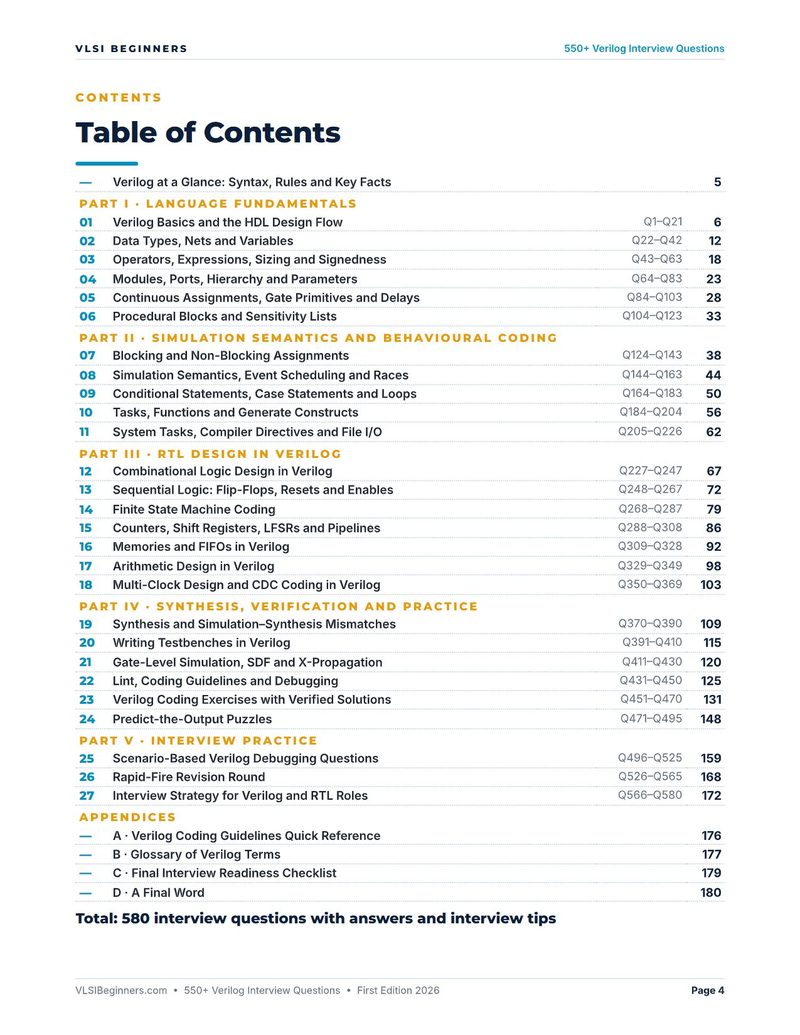
Table of contents listing 27 chapters in five parts with question ranges, plus four appendices
PAGE 4Contents and question ranges
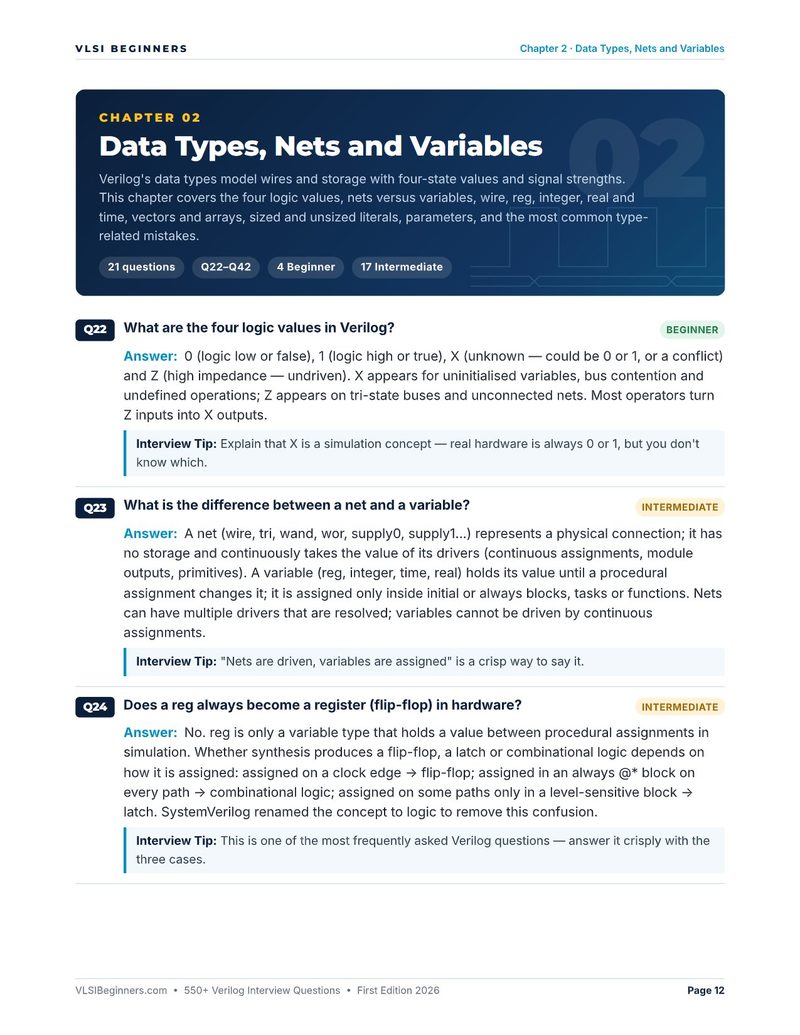
Chapter 2 opener on four-state values, nets versus variables and whether a reg always becomes a flip-flop
CHAPTER 2Nets, variables and reg
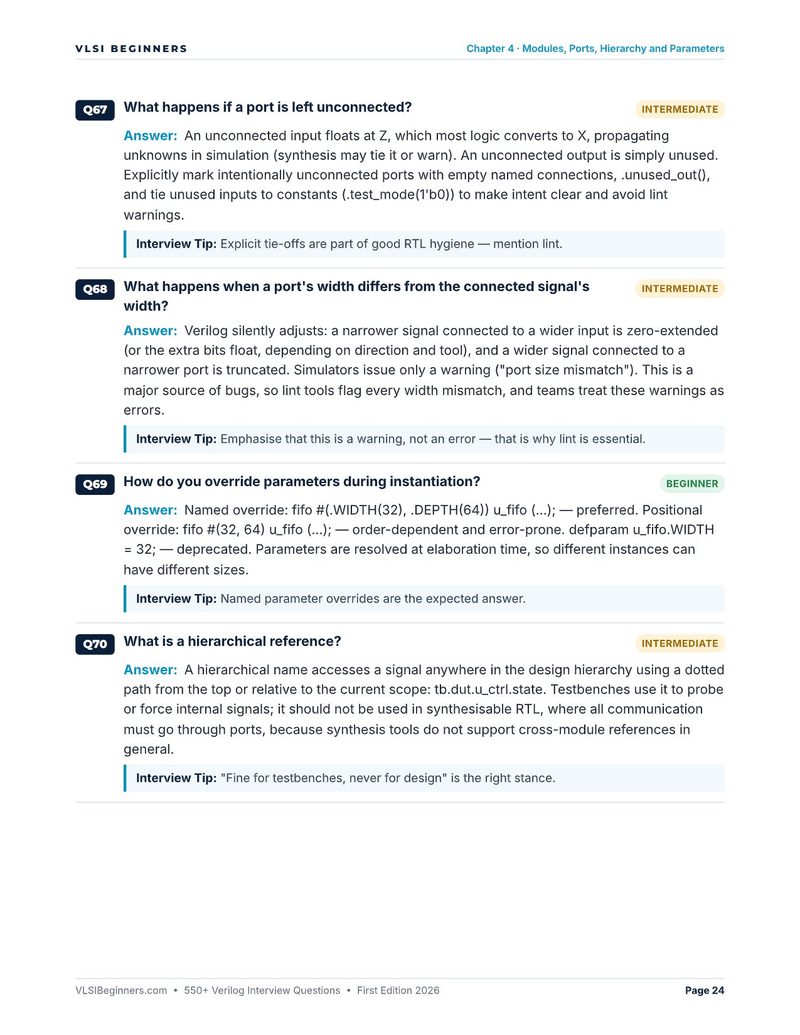
Chapter 4 page on unconnected ports, port width mismatches, parameter overrides and hierarchical references
CHAPTER 4Ports and parameters
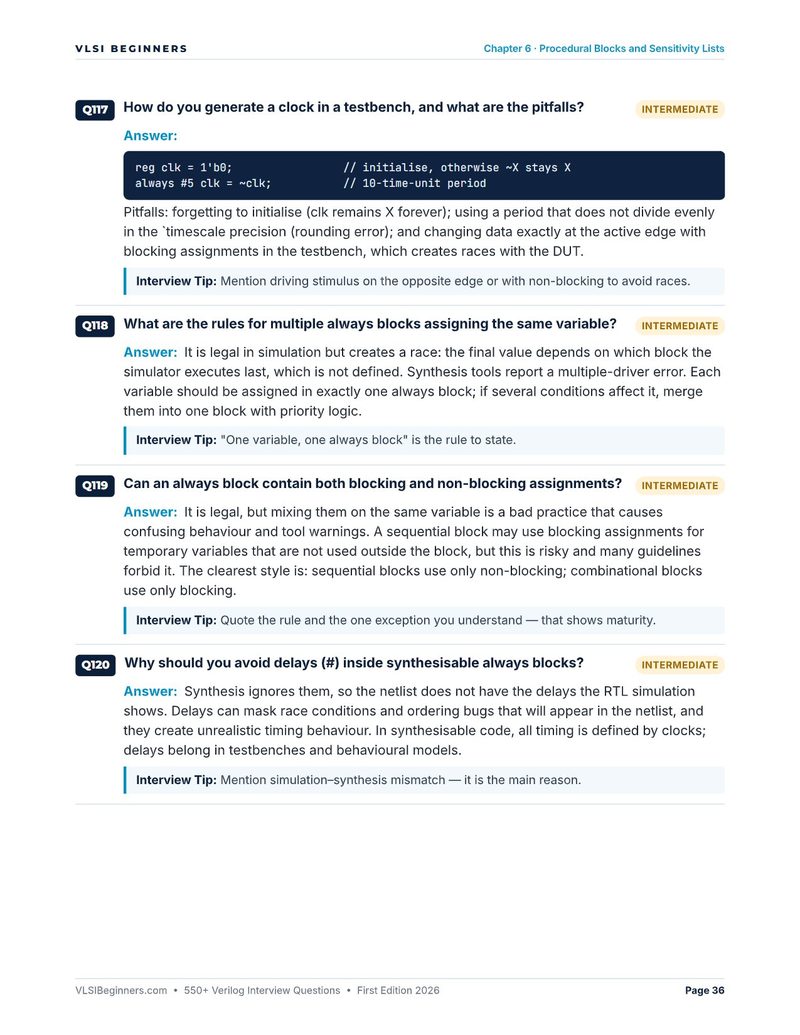
Chapter 6 page on testbench clock generation, multiple always blocks driving one variable and delays in synthesisable code
CHAPTER 6Always blocks and delays
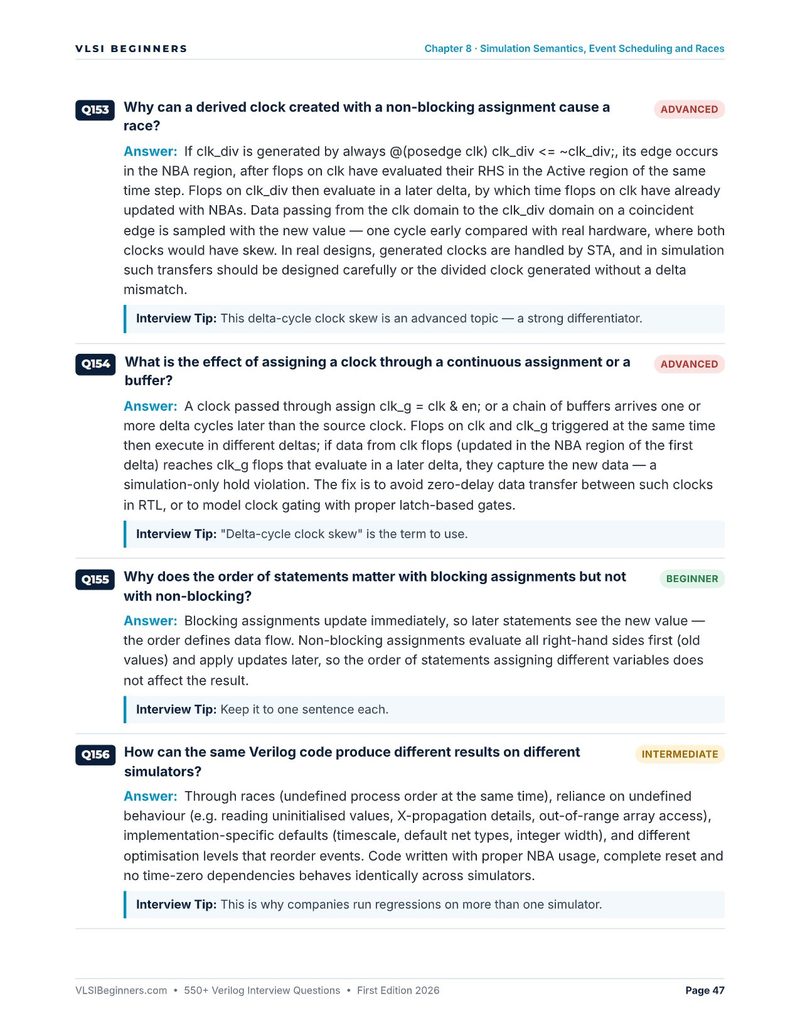
Chapter 8 page on delta-cycle clock skew from derived and gated clocks, and simulator-dependent results
CHAPTER 8Delta cycles and races
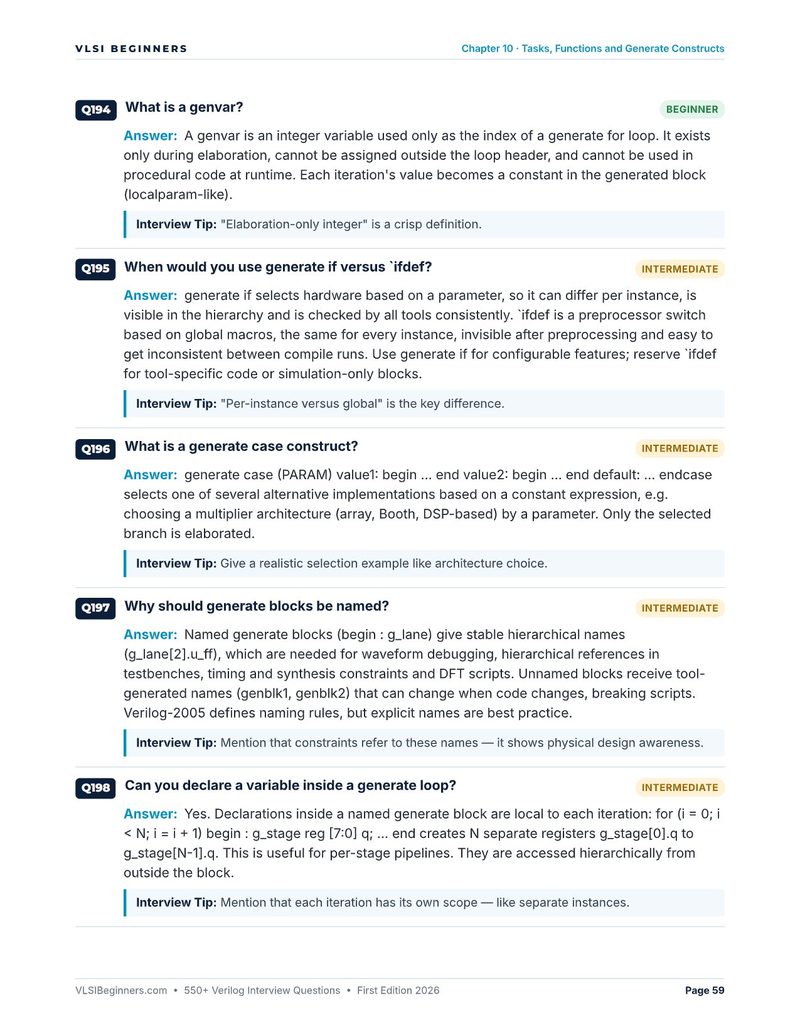
Chapter 10 page on genvar, generate if versus ifdef, generate case and named generate blocks
CHAPTER 10Generate constructs
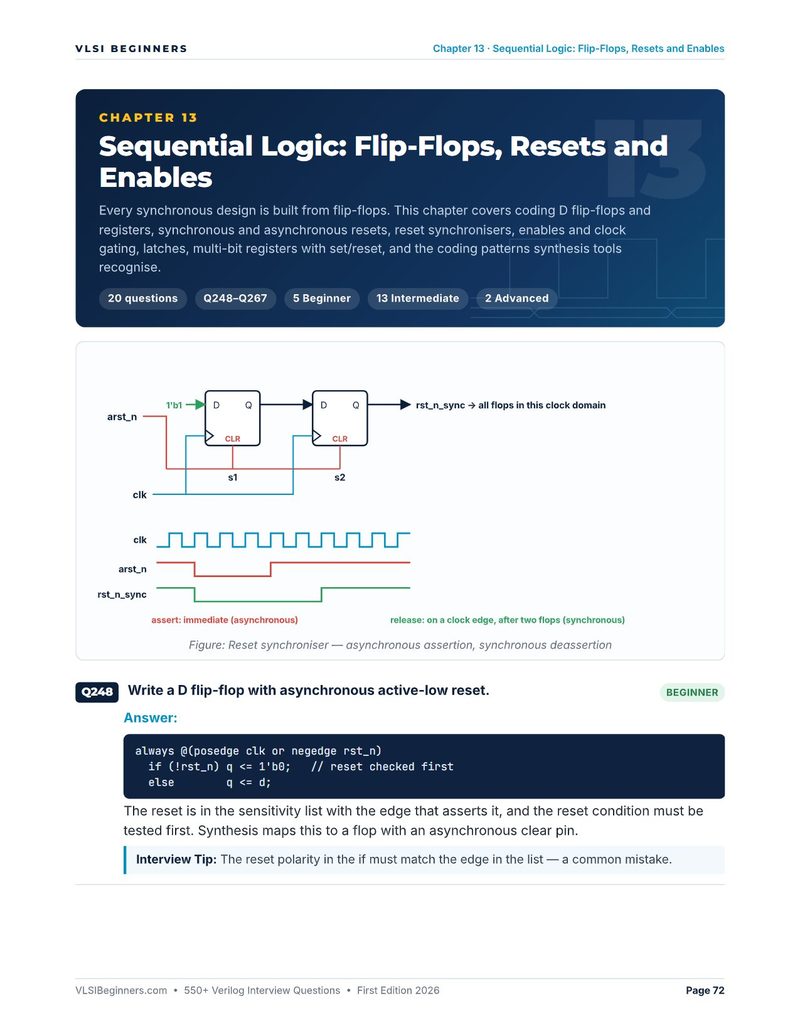
Chapter 13 opener with a reset synchroniser schematic and waveform, and a D flip-flop with asynchronous reset
CHAPTER 13Reset synchroniser
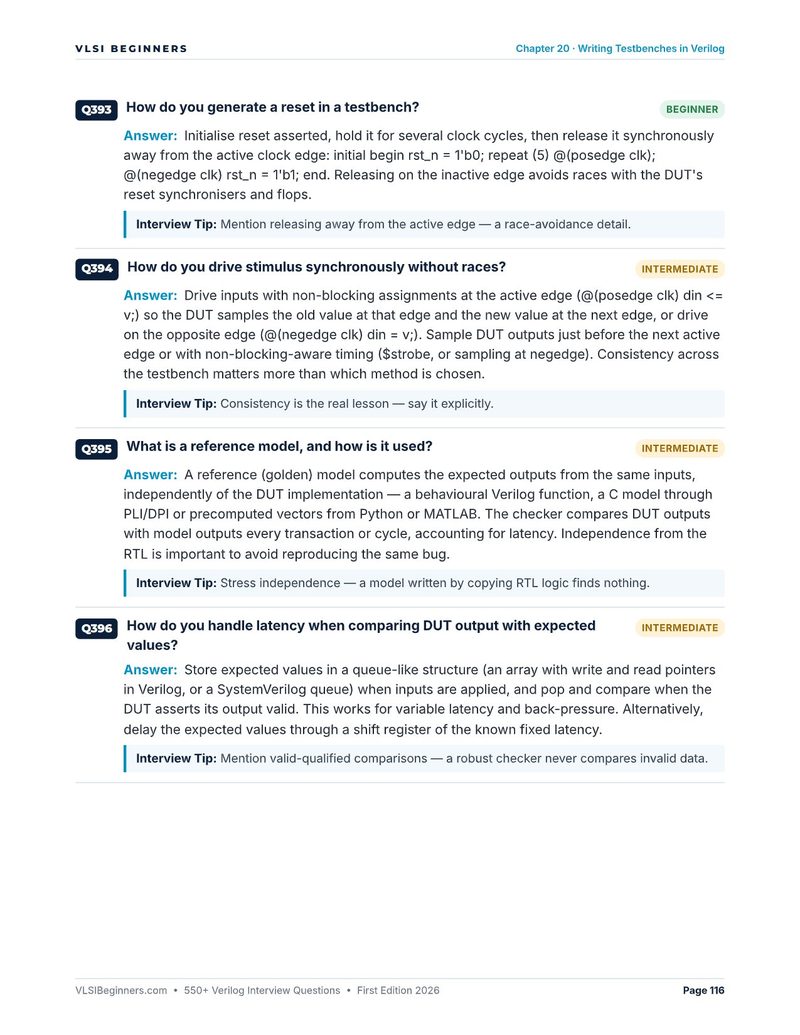
Chapter 20 page on generating reset in a testbench, race-free stimulus, reference models and latency-aware checking
CHAPTER 20Testbench techniques
HOW IT'S STRUCTURED

Five parts, from the first module to the final round

First the language, then how a simulator schedules it, then the RTL patterns built from it. After that come synthesis, testbenches, gate-level simulation and lint, with exercises and puzzles to practise on, and finally debugging under interview conditions.

PART I — LANGUAGE FUNDAMENTALS
The rules every answer rests on
CH 1–6Verilog basics and the design flow, data types, nets and variables, operators, sizing and signedness, modules, ports and parameters, continuous assignments and delays, procedural blocks and sensitivity lists
123QUESTIONS
PART II — SIMULATION SEMANTICS & BEHAVIOURAL CODING
How the simulator really runs your code
CH 7–11Blocking and non-blocking assignments, the event queue and races, if, case, casez, casex and loops, tasks, functions and generate, system tasks, compiler directives and file I/O
103QUESTIONS
PART III — RTL DESIGN IN VERILOG
The patterns you'll be asked to write
CH 12–18Combinational logic, flip-flops, resets and enables, FSM coding, counters, shift registers, LFSRs and pipelines, memories and FIFOs, arithmetic, multi-clock design and CDC coding
143QUESTIONS
PART IV — SYNTHESIS, VERIFICATION & PRACTICE
From code that simulates to code that ships
CH 19–24Synthesis and simulation–synthesis mismatches, testbenches, gate-level simulation, SDF and X-propagation, lint and coding guidelines, 20 coding exercises with verified solutions, 25 predict-the-output puzzles
126QUESTIONS
PART V — INTERVIEW PRACTICE
Answering under pressure
CH 25–2730 scenario-based debugging questions, a 40-question rapid-fire round, and interview strategy for Verilog and RTL roles, including how to approach live coding
85QUESTIONS
TOTAL ACROSS 27 CHAPTERS + 4 APPENDICES 580 questions
DIFFICULTY SPLIT
120 Beginner: rules every candidate must know405 Intermediate: project-level coding and debugging55 Advanced: simulator internals, sign-off and senior depth
SEE ALL 27 CHAPTERS
#CHAPTERQUESTIONS
PART I · LANGUAGE FUNDAMENTALS
01Verilog Basics and the HDL Design FlowQ1–Q21
02Data Types, Nets and VariablesQ22–Q42
03Operators, Expressions, Sizing and SignednessQ43–Q63
04Modules, Ports, Hierarchy and ParametersQ64–Q83
05Continuous Assignments, Gate Primitives and DelaysQ84–Q103
06Procedural Blocks and Sensitivity ListsQ104–Q123
PART II · SIMULATION SEMANTICS AND BEHAVIOURAL CODING
07Blocking and Non-Blocking AssignmentsQ124–Q143
08Simulation Semantics, Event Scheduling and RacesQ144–Q163
09Conditional Statements, Case Statements and LoopsQ164–Q183
10Tasks, Functions and Generate ConstructsQ184–Q204
11System Tasks, Compiler Directives and File I/OQ205–Q226
PART III · RTL DESIGN IN VERILOG
12Combinational Logic Design in VerilogQ227–Q247
13Sequential Logic: Flip-Flops, Resets and EnablesQ248–Q267
14Finite State Machine CodingQ268–Q287
15Counters, Shift Registers, LFSRs and PipelinesQ288–Q308
16Memories and FIFOs in VerilogQ309–Q328
17Arithmetic Design in VerilogQ329–Q349
18Multi-Clock Design and CDC Coding in VerilogQ350–Q369
PART IV · SYNTHESIS, VERIFICATION AND PRACTICE
19Synthesis and Simulation–Synthesis MismatchesQ370–Q390
20Writing Testbenches in VerilogQ391–Q410
21Gate-Level Simulation, SDF and X-PropagationQ411–Q430
22Lint, Coding Guidelines and DebuggingQ431–Q450
23Verilog Coding Exercises with Verified SolutionsQ451–Q470
24Predict-the-Output PuzzlesQ471–Q495
PART V · INTERVIEW PRACTICE
25Scenario-Based Verilog Debugging QuestionsQ496–Q525
26Rapid-Fire Revision RoundQ526–Q565
27Interview Strategy for Verilog and RTL RolesQ566–Q580
APPENDICES
AVerilog Coding Guidelines Quick Referencep. 176
BGlossary of Verilog Termsp. 177
CFinal Interview Readiness Checklistp. 179
DA Final Wordp. 180
FROM THE BOOK

Five questions, unedited

The most-asked data-type question, a must-write flop, a race rule, a senior-level simulator subtlety and a testbench habit. All 580 follow the same format: the answer, then the tip that makes it stick.

Get the ebook now
Q24INTERMEDIATE · DATA TYPES Does a reg always become a register (flip-flop) in hardware? No. reg is only a variable type that holds a value between procedural assignments in simulation. Whether synthesis produces a flip-flop, a latch or combinational logic depends on how it is assigned: assigned on a clock edge → flip-flop; assigned in an always @* block on every path → combinational logic; assigned on some paths only in a level-sensitive block → latch. SystemVerilog renamed the concept to logic to remove this confusion. Tip: This is one of the most frequently asked Verilog questions — answer it crisply with the three cases.
Q248BEGINNER · SEQUENTIAL LOGIC Write a D flip-flop with asynchronous active-low reset. always @(posedge clk or negedge rst_n) if (!rst_n) q <= 1'b0; // reset checked first else q <= d; The reset is in the sensitivity list with the edge that asserts it, and the reset condition must be tested first. Synthesis maps this to a flop with an asynchronous clear pin. Tip: The reset polarity in the if must match the edge in the list — a common mistake.
Q118INTERMEDIATE · PROCEDURAL BLOCKS What are the rules for multiple always blocks assigning the same variable? It is legal in simulation but creates a race: the final value depends on which block the simulator executes last, which is not defined. Synthesis tools report a multiple-driver error. Each variable should be assigned in exactly one always block; if several conditions affect it, merge them into one block with priority logic. Tip: “One variable, one always block” is the rule to state.
Q153ADVANCED · EVENT SCHEDULING Why can a derived clock created with a non-blocking assignment cause a race? If clk_div is generated by always @(posedge clk) clk_div <= ~clk_div;, its edge occurs in the NBA region, after flops on clk have evaluated their RHS in the Active region of the same time step. Flops on clk_div then evaluate in a later delta, by which time flops on clk have already updated with NBAs. Data passing from the clk domain to the clk_div domain on a coincident edge is sampled with the new value — one cycle early compared with real hardware, where both clocks would have skew. In real designs, generated clocks are handled by STA, and in simulation such transfers should be designed carefully or the divided clock generated without a delta mismatch. Tip: This delta-cycle clock skew is an advanced topic — a strong differentiator.
Q393BEGINNER · TESTBENCHES How do you generate a reset in a testbench? Initialise reset asserted, hold it for several clock cycles, then release it synchronously away from the active clock edge. Releasing on the inactive edge avoids races with the DUT's reset synchronisers and flops. initial begin rst_n = 1'b0; repeat (5) @(posedge clk); @(negedge clk) rst_n = 1'b1; end Tip: Mention releasing away from the active edge — a race-avoidance detail.
SEVEN DAYS LEFT?

The revision plan from the book

Answer aloud before reading. Type the Chapter 23 exercises and Chapter 24 puzzles into a simulator, write down the expected output before you run each one, and work through the Chapter 22 lint walk-through.

DAY 1Ch 1–3Basics, data types, operators, widths and signedness
DAY 2Ch 4–6Modules and parameters, continuous assigns and delays, procedural blocks
DAY 3Ch 7–11Blocking and non-blocking, the event queue, case and loops, tasks, generate, system tasks
DAY 4Ch 12–15Combinational and sequential RTL, FSMs, counters and pipelines
DAY 5Ch 16–18Memories and FIFOs, arithmetic, multi-clock design and CDC
DAY 6Ch 19–23Synthesis, testbenches, GLS and lint, then write every exercise
DAY 7Ch 24–27Puzzles, debugging scenarios, rapid-fire round and interview strategy
WHO THIS IS FOR

For anyone who'll be asked to write Verilog on the spot

ECE students and freshers

Campus drives, written HDL tests and the first technical round. Parts I and II turn lab-course Verilog into answers you can defend.

RTL design engineers

FSMs, pipelines, FIFOs, arithmetic, CDC coding, synthesis results and the simulation–synthesis mismatches that catch experienced designers.

Verification engineers

Event scheduling and races, testbench techniques, gate-level simulation and X-propagation: the Verilog that sits under every SystemVerilog and UVM bench.

FPGA engineers

Synthesisable coding style, resets and enables, memories, clock division, CDC and the debugging scenarios that show up on real boards.

550+ RTL Design Interview Questions ebook cover
THE NEXT LEVEL UP

550+ RTL Design Interview Questions

This book teaches the language. The RTL Design ebook turns it into design rounds: 550 questions on FSMs, timing, CDC, synthesis and debugging, including 100 coding problems to solve on your own.

See the RTL Design ebook

550+ Verilog Interview Questions

580 answered questions in 27 chapters, with coding exercises, output puzzles and debugging scenarios. Download the PDF straight after checkout.

Get the ebook now
QUESTIONS ABOUT THE BOOK
Are all 580 questions answered?

Yes. Every question has a full answer, phrased the way you would explain it in an interview, plus an interview tip. The 20 coding exercises come with complete Verilog solutions, and each of the 25 predict-the-output puzzles has the printed result and the reason for it.

What format is it, and how fast do I get it?

A 181-page PDF. Checkout is on Topmate and the download is available right after payment.

Which roles is this book for?

RTL design, design verification and FPGA roles, plus ECE students and freshers preparing for campus drives and their first HDL round. Anyone who will be asked to write, read or debug Verilog in an interview will find it useful.

Is it Verilog or SystemVerilog?

Verilog, as defined by IEEE 1364-2005, which is still what most design interviews test. Where SystemVerilog fixes a Verilog pitfall, such as logic replacing reg or always_ff replacing always, the answer says so. For classes, constraints and assertions, see the SystemVerilog ebook.

Do I need prior experience?

No. Part I starts from the language basics and 120 questions are marked Beginner. Parts III and IV then move to the RTL patterns, synthesis and debugging questions that experienced candidates are asked.

Can I preview it?

Yes. Eight real pages are on this page, and the free Verilog Interview Questions page has 90+ sample questions with worked answers, output puzzles, the event queue explained step by step and a literal decoder.

What's your refund policy?

Because this is a digital product delivered instantly, sales are generally final. If you hit a technical issue with your download, contact us within 7 days. See our Refund Policy for details.

Preparing for another round too? Browse all ebooks →