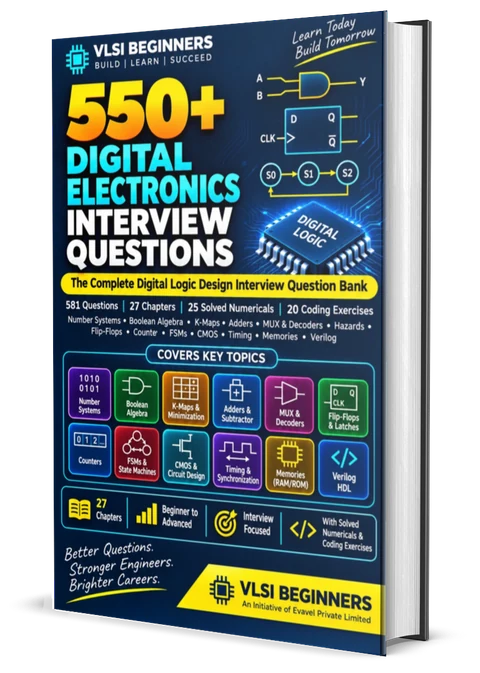
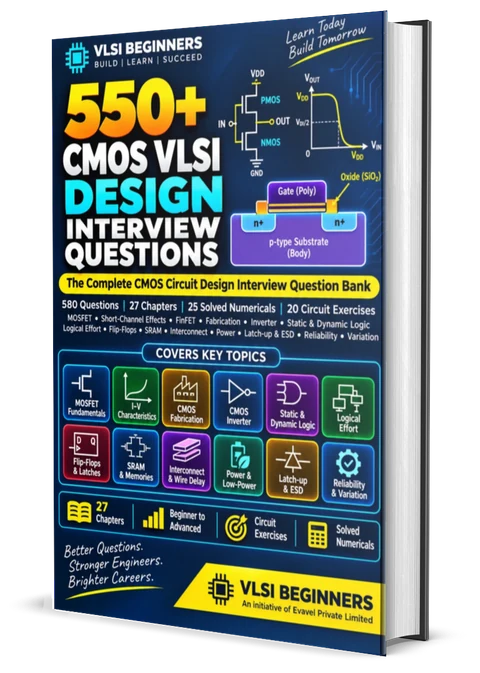
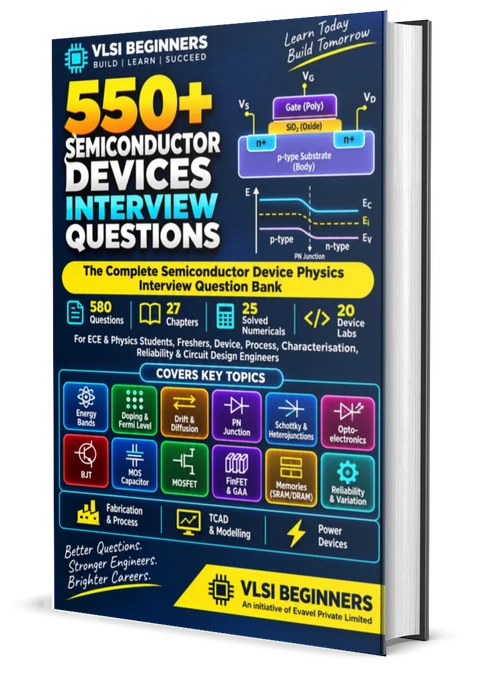
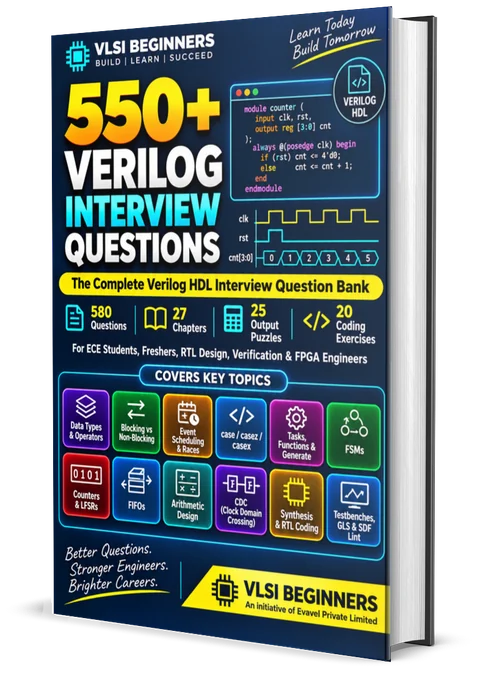
Four are questions-only, by design — the goal is to build the habit of working through a problem yourself. Eleven (ASIC Design, Physical Design, STA, DFT, FPGA, CDC, Digital Electronics, CMOS, Semiconductor Devices, Verilog and Analog VLSI) include full answers and interview tips for self-study without a mentor. Every ebook has a free preview before you buy.
An interviewer doesn't hand you the answer and ask you to recognize it — they ask a question and wait. Reading answers trains recognition. Working through a blank question trains recall, which is the actual skill being tested.
Reading a solved answer feels like learning, but it's passive. Struggling to produce your own answer — even a wrong one — is what actually builds interview-ready recall.
No interviewer reads you a model answer first. Practicing without one closes the gap between how you study and how you're actually evaluated.
ASIC Design, Physical Design, STA, DFT, FPGA, CDC, Digital Electronics, CMOS, Semiconductor Devices, Verilog and Analog VLSI are deep enough, and specialized enough, that most self-learners need worked explanations, code and solved numericals, not just prompts — so those eleven include full answers and interview tips.
Every cover is a real preview — click to zoom in and read it before you decide. Each ebook page also has free sample pages from inside the book.
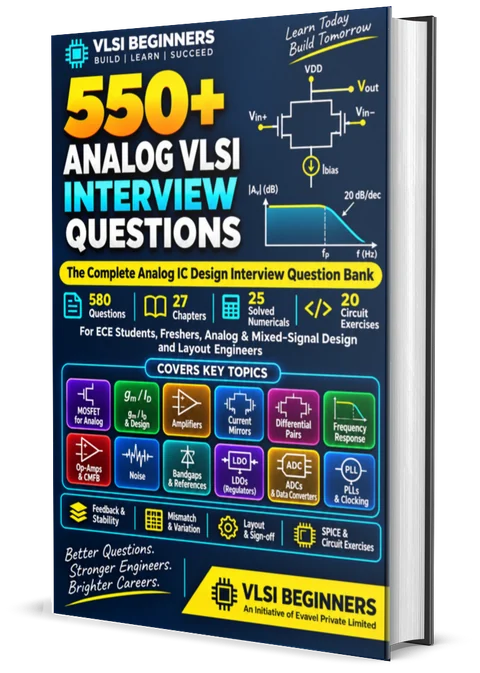
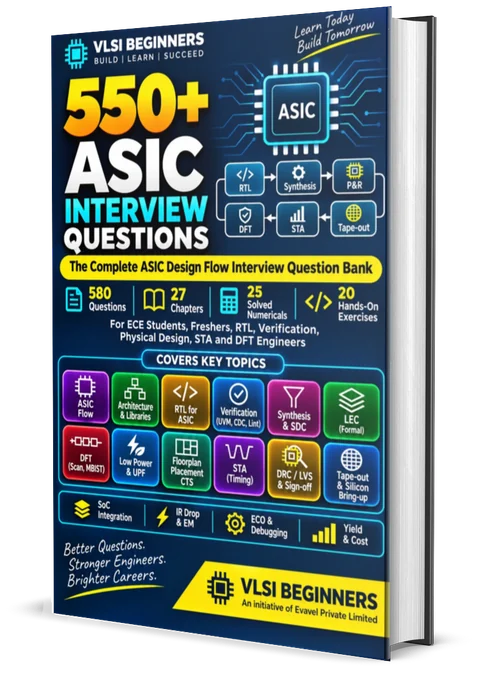
Every question has an interview-ready answer and an interview tip. STA, DFT, FPGA, CDC, Digital Electronics, CMOS and Semiconductor Devices also include solved numericals; FPGA, CDC and Digital Electronics add coding exercises, CMOS adds SPICE circuit exercises, Semiconductor Devices adds Python and SPICE device labs, Verilog adds 20 coding exercises and 25 predict-the-output puzzles, Analog VLSI adds 20 SPICE exercises and 25 solved numericals, and ASIC Design adds 20 open-source flow exercises and 25 numericals.
Big question banks with no answers printed, so you practise producing the answer yourself, the way an interview works.
Every ebook includes a free preview before you buy. Prefer to sample the format first? Check our free downloads page.
Most candidates only need one or two of these, matched to the track they're actually interviewing for.
General VLSI adds 10 company-specific sets — the widest starting point if you're not sure of your track. Digital Electronics (fully answered) covers the first technical round almost every role faces.
See General VLSI → See Digital Electronics →Start with Verilog (fully answered, with coding exercises and output puzzles) for the language itself, then RTL Design for FSMs, timing and CDC in design roles; FPGA adds clocking, BRAM, AXI and lab debug.
See Verilog → See RTL Design → See FPGA → See CDC →SystemVerilog covers the language and OOP; UVM goes deep on testbench architecture once the language is solid.
See SystemVerilog →All three are fully answered, for self-study without a mentor. PD covers the flow, STA goes deep on timing, and DFT covers scan, ATPG, BIST and test access. Add CMOS for the transistor-level questions behind delay, leakage and wires, or Semiconductor Devices for device and process roles.
See Physical Design → See STA → See DFT → See CMOS → See Semiconductor →| Ebook | Questions | Structure | Answers | Best for | |
|---|---|---|---|---|---|
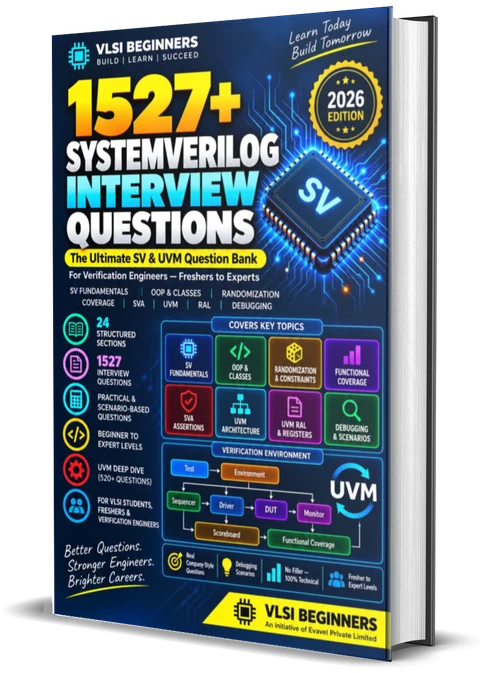
| SystemVerilog | 1,527 | 24 sections | Questions only | Verification freshers & DV engineers | View → |
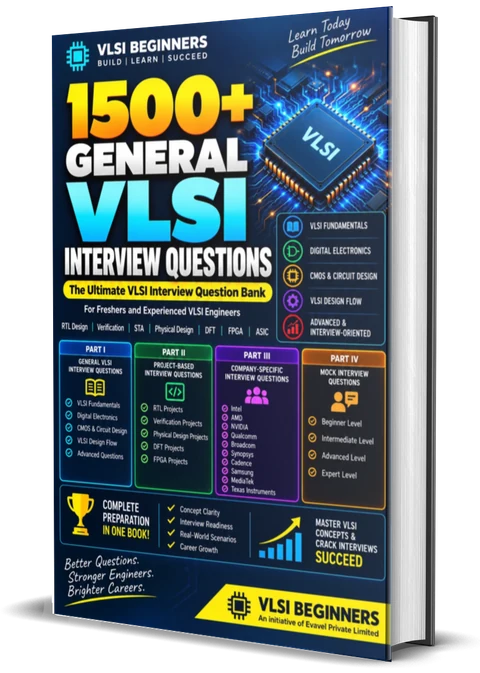
| General VLSI | 1,455 | 6 parts + 10 company sets | Questions only | Broad prep, any track, company rounds | View → |
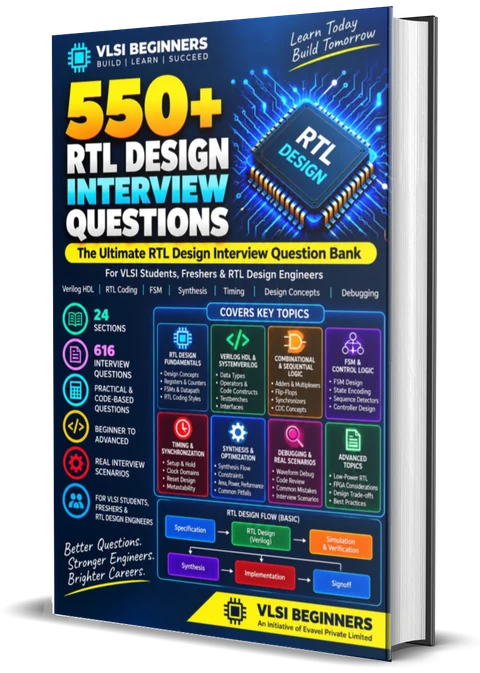
| RTL Design | 550 | 11 chapters | Questions only | Design engineers, Verilog coding rounds | View → |
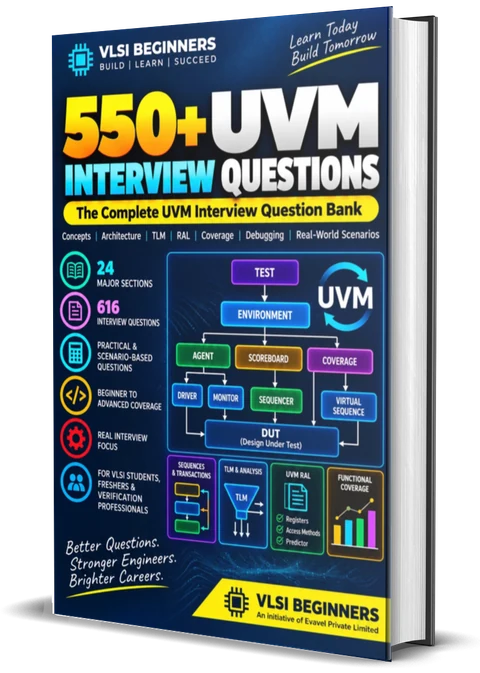
| UVM | 616 | 24 chapters | Questions only | Verification engineers going deep on UVM | View → |
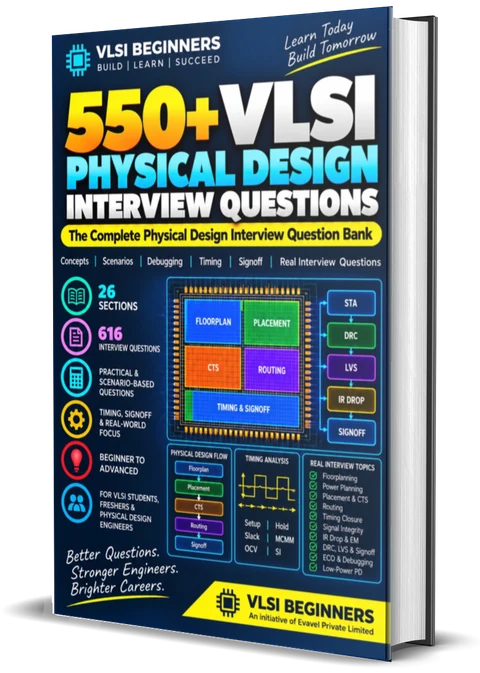
| Physical Design | 616 | 26 sections | Full answers + tips | Physical design engineers, self-study | View → |
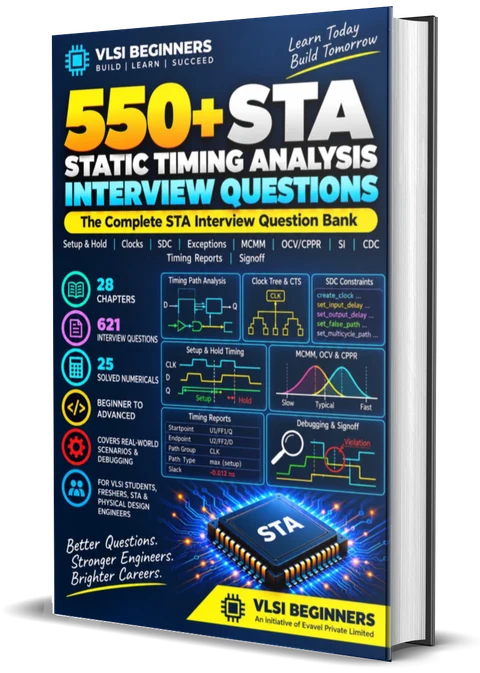
| STA | 621 | 28 chapters | Full answers + tips | STA, PD & signoff roles; numericals and reports | View → |
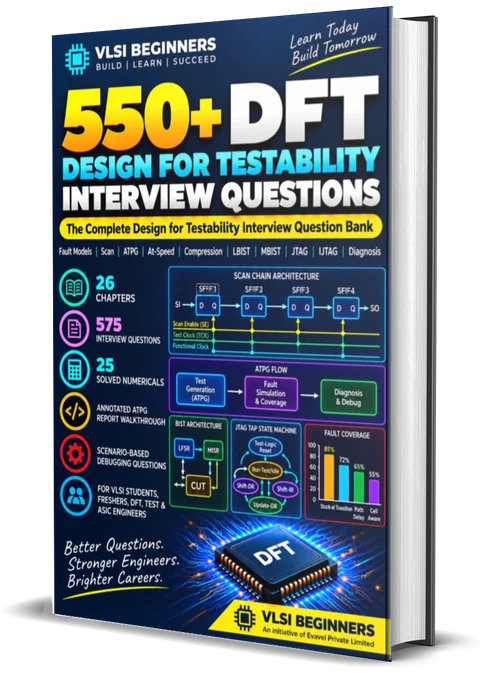
| DFT | 575 | 26 chapters | Full answers + tips | DFT roles: scan, ATPG, compression, BIST, JTAG | View → |
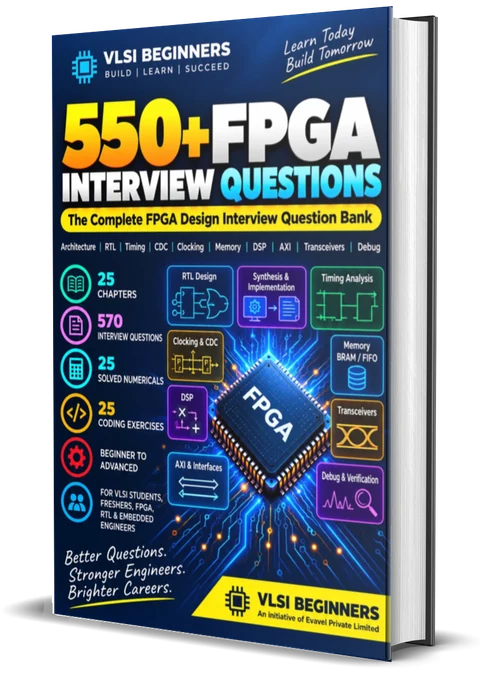
| FPGA | 570 | 25 chapters | Full answers + tips | FPGA roles: RTL, timing, CDC, memories, AXI, debug | View → |
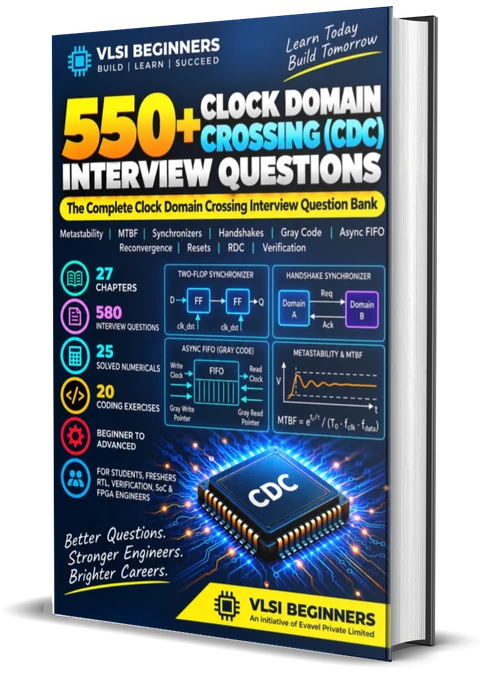
| CDC | 580 | 27 chapters | Full answers + tips | RTL, DV, SoC and FPGA roles: synchronizers, FIFOs, RDC | View → |
| Digital Electronics | 581 | 27 chapters | Full answers + tips | First technical round: logic, flip-flops, timing, FSMs | View → |
| CMOS | 580 | 27 chapters | Full answers + tips | Circuit, memory, PD and STA roles: devices, sizing, power | View → |
| Semiconductor Devices | 580 | 27 chapters | Full answers + tips | Device, process, TCAD and reliability roles: device physics | View → |
| Verilog | 580 | 27 chapters | Full answers + tips | RTL, DV and FPGA roles: language rules, coding and debug | View → |
| Analog VLSI | 580 | 27 chapters | Full answers + tips | Analog, mixed-signal and analog layout roles: circuits, stability and noise | View → |
| ASIC Design | 580 | 27 chapters | Full answers + tips | RTL, DV, PD, STA and DFT roles: the full flow from spec to silicon | View → |
ASIC Design, Physical Design, STA, DFT, FPGA, CDC, Digital Electronics, CMOS, Semiconductor Devices, Verilog and Analog VLSI do — every question includes a full answer and interview tip; STA, DFT, FPGA, CDC, Digital Electronics, CMOS and Semiconductor Devices add 25 solved numericals each, FPGA, CDC and Digital Electronics add coding exercises, CMOS adds SPICE circuit exercises and Semiconductor Devices adds Python and SPICE device labs Verilog adds 20 coding exercises and 25 output puzzles, Analog VLSI adds 20 SPICE exercises and 25 numericals, and ASIC Design adds 20 flow exercises and 25 numericals, all with solutions. The other four (SystemVerilog, General VLSI, RTL Design, and UVM) are questions-only by design, so you build the habit of working through a problem yourself instead of recognizing a written answer. See "Two kinds of ebook" above for the reasoning.
Yes — every ebook's own page has a free preview with real pages from the actual document, not mockups. If you'd rather sample the format first without committing to a specific topic, our free downloads page has complete free resources too.
If you're not sure which track you're interviewing for yet, General VLSI is the broadest starting point. Otherwise, match it to your track — see the "Pick by track" section above for a quick recommendation by specialization.
Ebooks are delivered digitally and instantly after purchase through Topmate — no waiting, no shipping.
Because ebooks are digital products delivered instantly, sales are generally final — which is exactly why we put a free preview on every single one, so you know what you're getting first. If you hit a genuine technical issue (wrong file, broken download), contact us within 7 days and we'll resolve it. Full details are on our refund policy page.
Not currently — each ebook is sold individually on its own page, so you only pay for the track you actually need.
Pair any ebook with a 1:1 mock interview from a working semiconductor professional.
Talk to a mentor