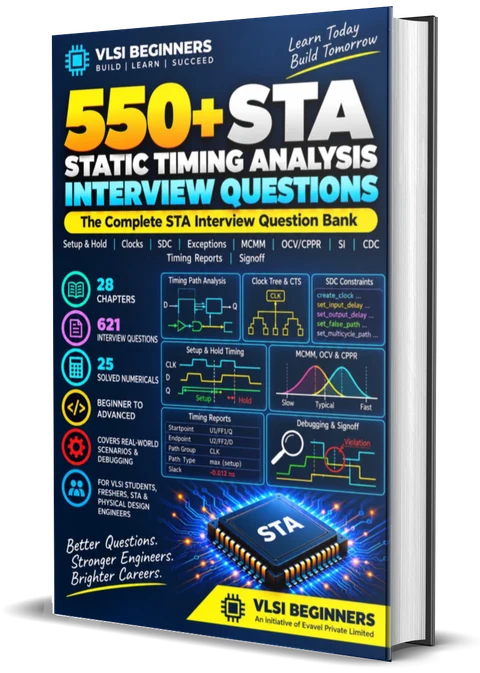
Setup and hold to signoff in 28 chapters. Every answer is written the way you'd say it in an interview, with a tip for the follow-up. 25 solved numericals, an annotated timing report and 30 debugging scenarios are included.
STA comes up in almost every PD, STA, synthesis and ASIC interview. Candidates rarely lose marks for not knowing what setup time is. They lose marks when the interviewer gives them numbers, a timing report or a failing path and asks "so what would you do?"
Typical STA prep material doesn't train that. Forum threads and slide decks give one-line definitions at uneven depth, with no numbers to work through, no report to read and no way to tell whether you've covered OCV, CPPR, MCMM, crosstalk and exceptions properly.
This book is organised as a learning path. Chapters 1–7 build the core for any fresher interview. Chapters 8–20 cover what every working STA and PD engineer is expected to know. Chapters 21–28 train you to read reports, debug real problems and present your answers like an engineer.
STA interviews test four skills: explaining a concept, working out a number, reading a report and debugging a path. The book trains each one.
Each of the 621 questions has a difficulty level, an interview-ready answer, and an Interview Tip: the follow-up question or common mistake the interviewer is listening for.
fmax with positive and negative skew, setup and hold slack, half-cycle paths, I/O delay budgets, multicycle paths, clock ratios, useful skew, CPPR credit, latch borrowing and MTBF.
A real-format setup report with ten numbered callouts, then 20 questions on reading it: skew, the stage that dominates the path, GBA vs PBA, and how a hold report reads differently.
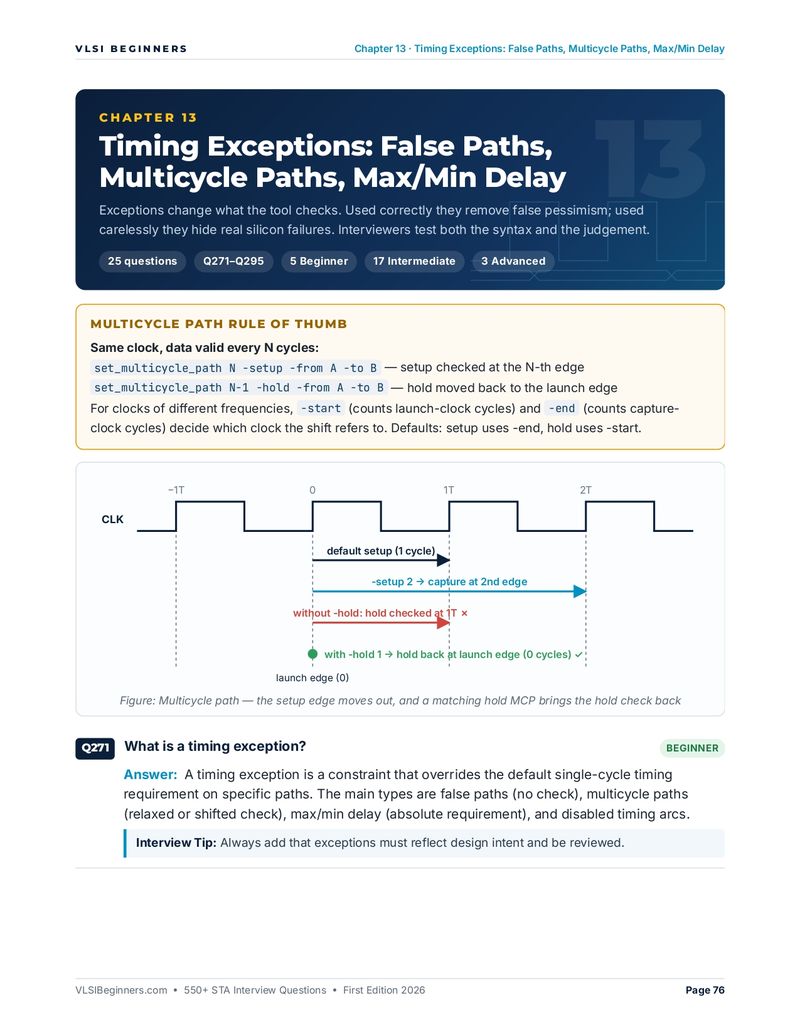
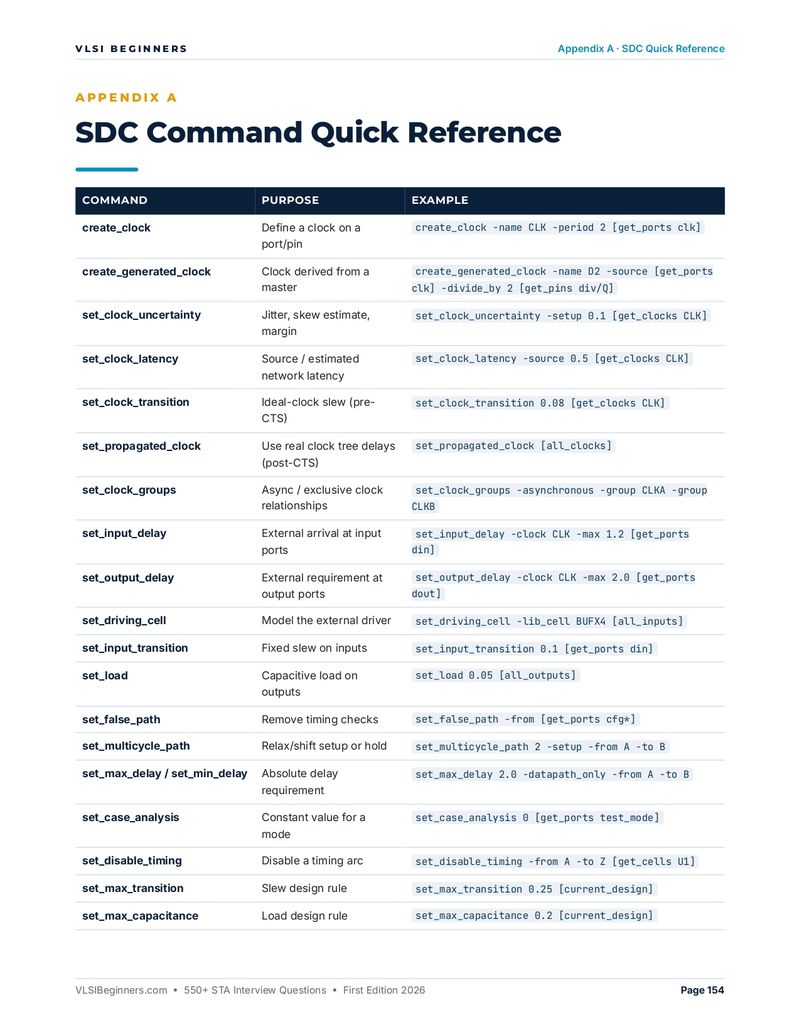
Clocks, generated clocks, muxes and gating, I/O constraints, false paths, multicycle paths and set_max_delay, plus a two-page SDC command quick reference.
MCMM, OCV/AOCV/POCV, CPPR, crosstalk, recovery/removal, latch timing, CDC and metastability, ECO and signoff, low-power STA and Tcl scripting.
A one-page formula sheet, a 30-question rapid-fire round, a glossary, a 7-day revision plan and a readiness checklist you can only tick once you can explain each item aloud.
These are pages from the actual PDF, not mockups. Click any page to zoom in and read it in full.
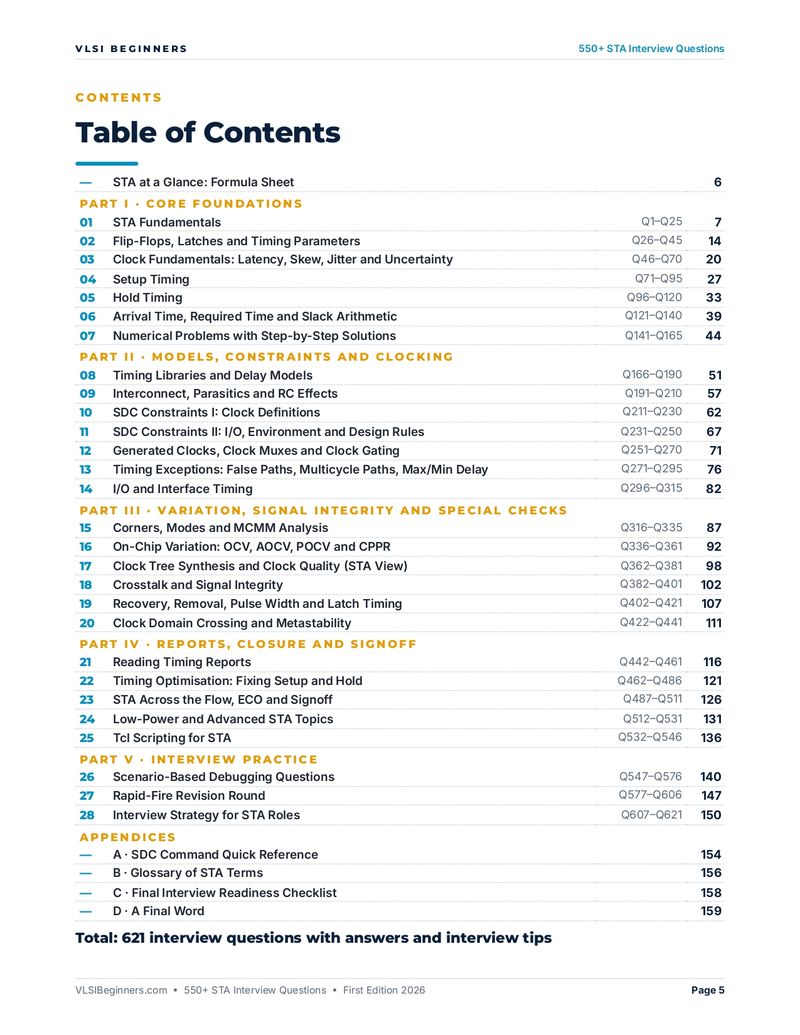
The chapters follow the order you'd learn STA on a real project: fundamentals first, then the constraints and models behind them, then variation and special checks, and finally reports, closure and the interview itself.
| # | CHAPTER | QUESTIONS |
|---|---|---|
| PART I · CORE FOUNDATIONS | ||
| 01 | STA Fundamentals | Q1–Q25 |
| 02 | Flip-Flops, Latches and Timing Parameters | Q26–Q45 |
| 03 | Clock Fundamentals: Latency, Skew, Jitter and Uncertainty | Q46–Q70 |
| 04 | Setup Timing | Q71–Q95 |
| 05 | Hold Timing | Q96–Q120 |
| 06 | Arrival Time, Required Time and Slack Arithmetic | Q121–Q140 |
| 07 | Numerical Problems with Step-by-Step Solutions | Q141–Q165 |
| PART II · MODELS, CONSTRAINTS AND CLOCKING | ||
| 08 | Timing Libraries and Delay Models | Q166–Q190 |
| 09 | Interconnect, Parasitics and RC Effects | Q191–Q210 |
| 10 | SDC Constraints I: Clock Definitions | Q211–Q230 |
| 11 | SDC Constraints II: I/O, Environment and Design Rules | Q231–Q250 |
| 12 | Generated Clocks, Clock Muxes and Clock Gating | Q251–Q270 |
| 13 | Timing Exceptions: False Paths, Multicycle Paths, Max/Min Delay | Q271–Q295 |
| 14 | I/O and Interface Timing | Q296–Q315 |
| PART III · VARIATION, SIGNAL INTEGRITY AND SPECIAL CHECKS | ||
| 15 | Corners, Modes and MCMM Analysis | Q316–Q335 |
| 16 | On-Chip Variation: OCV, AOCV, POCV and CPPR | Q336–Q361 |
| 17 | Clock Tree Synthesis and Clock Quality (STA View) | Q362–Q381 |
| 18 | Crosstalk and Signal Integrity | Q382–Q401 |
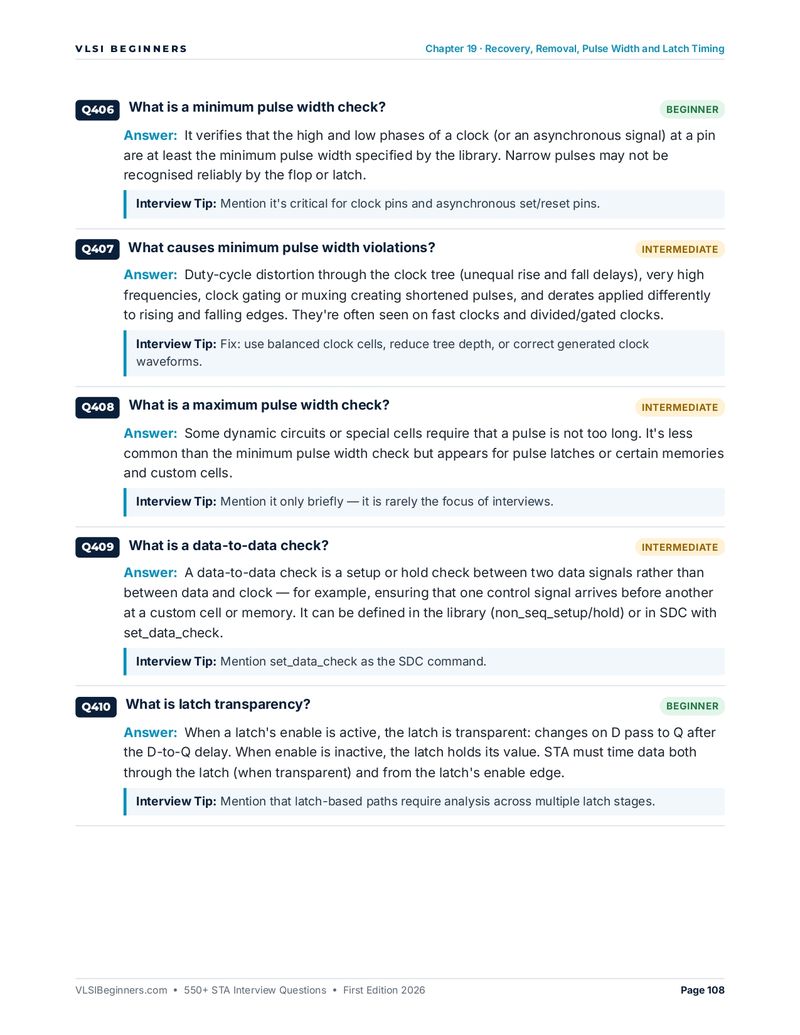
| 19 | Recovery, Removal, Pulse Width and Latch Timing | Q402–Q421 |
| 20 | Clock Domain Crossing and Metastability | Q422–Q441 |
| PART IV · REPORTS, CLOSURE AND SIGNOFF | ||
| 21 | Reading Timing Reports | Q442–Q461 |
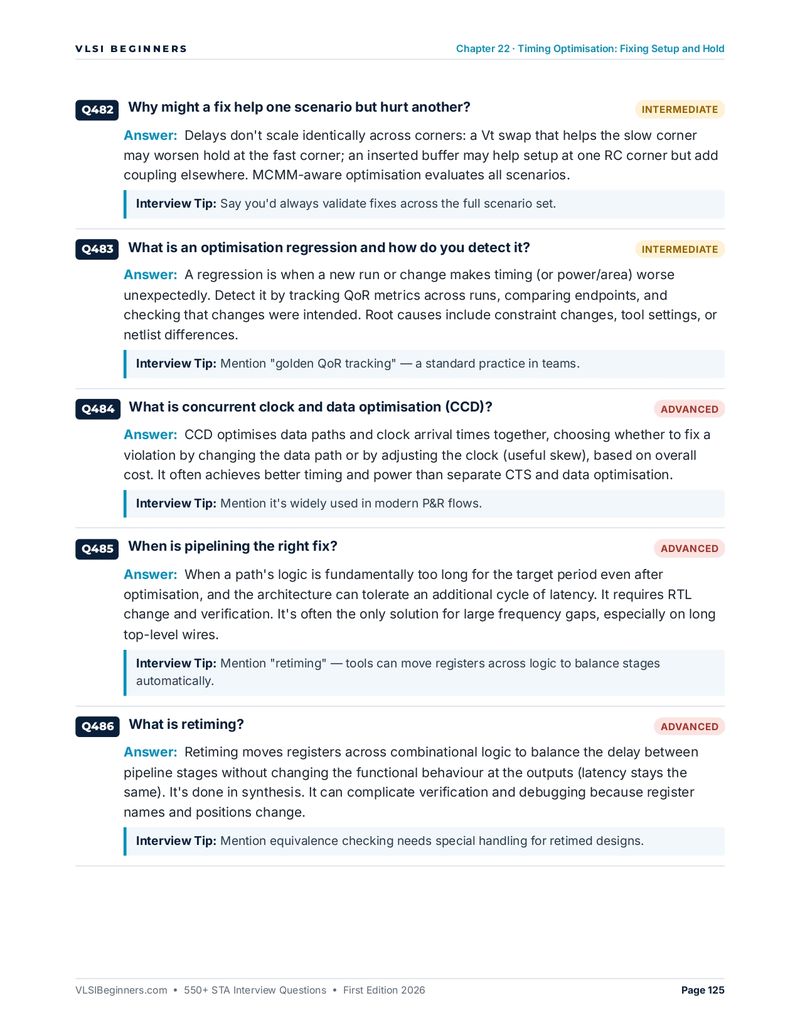
| 22 | Timing Optimisation: Fixing Setup and Hold | Q462–Q486 |
| 23 | STA Across the Flow, ECO and Signoff | Q487–Q511 |
| 24 | Low-Power and Advanced STA Topics | Q512–Q531 |
| 25 | Tcl Scripting for STA | Q532–Q546 |
| PART V · INTERVIEW PRACTICE | ||
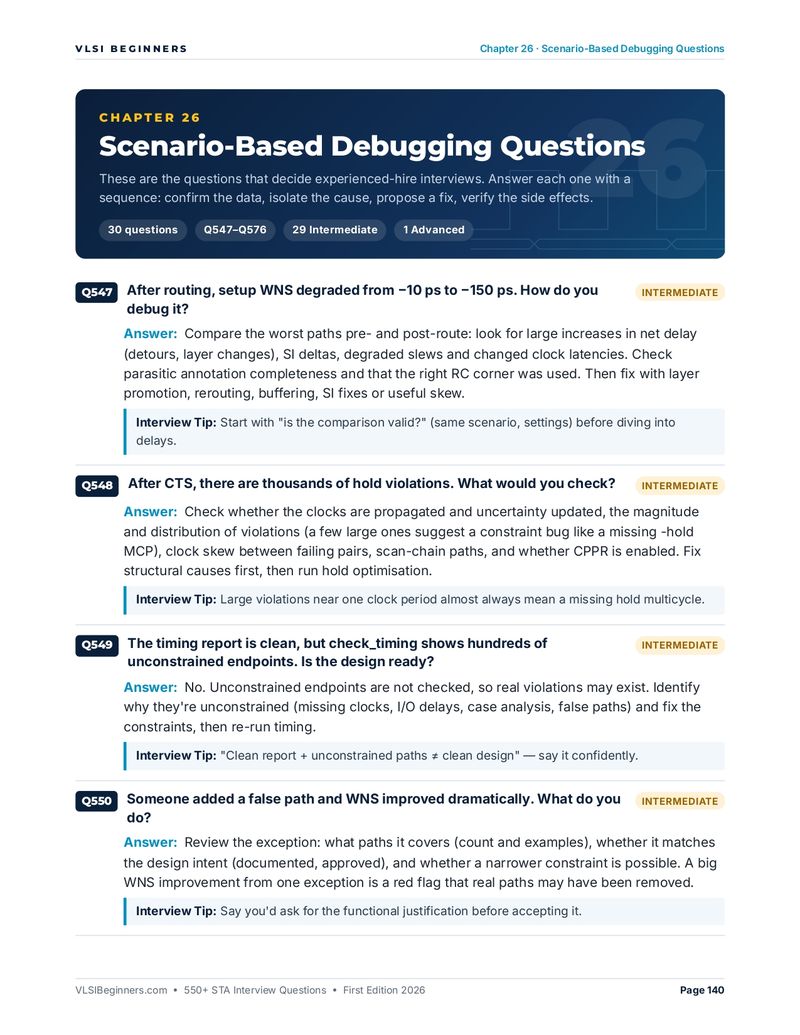
| 26 | Scenario-Based Debugging Questions | Q547–Q576 |
| 27 | Rapid-Fire Revision Round | Q577–Q606 |
| 28 | Interview Strategy for STA Roles | Q607–Q621 |
| APPENDICES | ||
| A | SDC Command Quick Reference | p. 154 |
| B | Glossary of STA Terms | p. 156 |
| C | Final Interview Readiness Checklist | p. 158 |
| D | A Final Word | p. 159 |
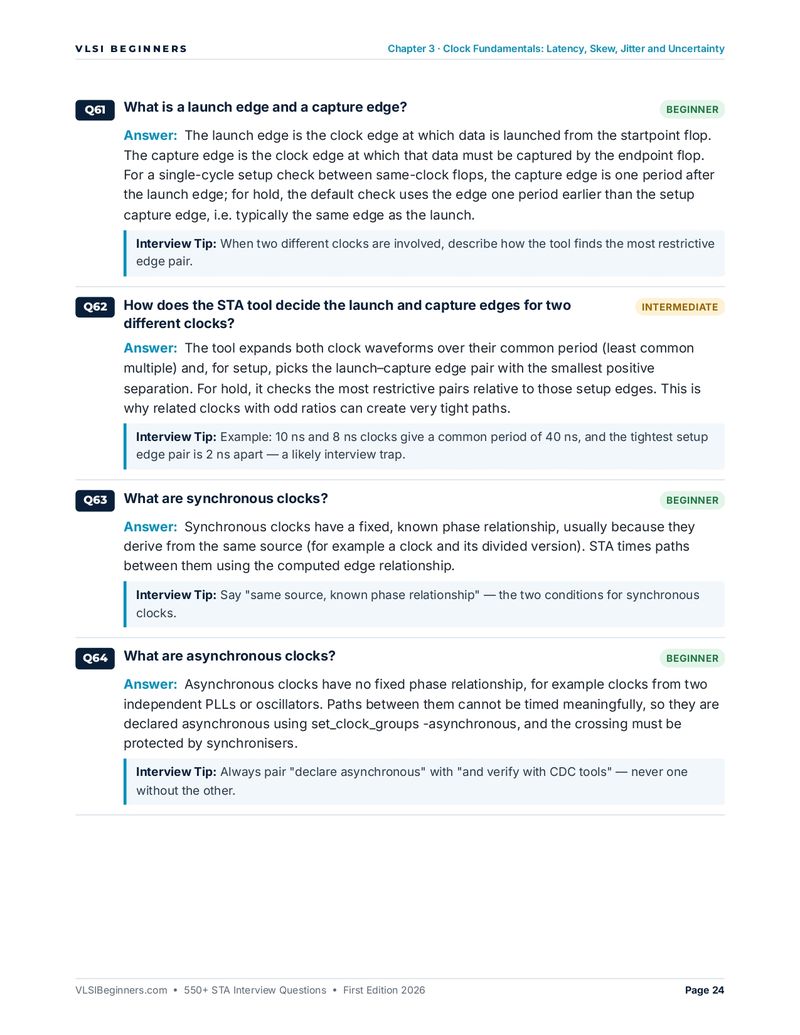
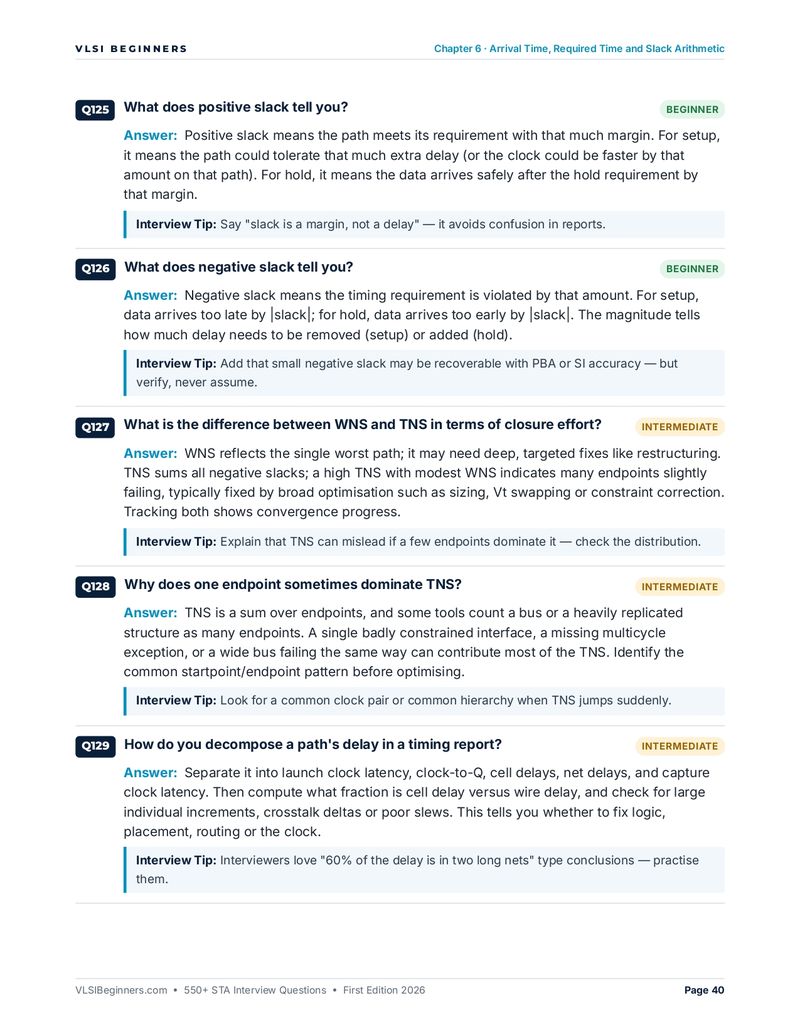
One concept question, a numerical, a report-reading question, a debugging scenario and the hold question interviewers ask most. Every question in the book has the same parts: a direct answer and an interview tip.
Get the ebook nowAnswer each question aloud before reading the answer. Sketch the clock edges for every setup, hold, skew and multicycle question. Solve each Chapter 7 numerical on paper, then make up your own variations.
Preparing for a first PD, STA or ASIC interview. Start with Part I and the numericals; that's what fresher rounds test hardest.
Moving into a timing-focused role and need depth on SDC, exceptions, OCV/CPPR, MCMM and signoff, beyond what the flow alone teaches.
Revising before a job change or promotion round. Parts IV and V have the report-reading, debugging and experienced-hire questions.
Studying without a mentor? Every question is answered, with a tip for the follow-up, so you can check your own reasoning.
616 answered questions on the rest of the back-end flow: floorplan, power planning, placement, CTS, routing, IR drop and EM, physical verification, ECO and signoff. PD rounds often include a separate STA section, so the two books are written to be used together.
621 questions, 28 chapters, every one answered. Instant PDF download.
Get the ebook nowYes. All 621 questions come with an answer written the way you should say it in an interview, plus a specific interview tip: the follow-up or common mistake that separates a good answer from a great one.
A 160-page PDF, delivered as an instant download through Topmate right after checkout.
No. Chapters 1 to 7 build the core every fresher interview needs: STA basics, flip-flop parameters, clocks, setup, hold, slack and numericals. 191 of the 621 questions are marked Beginner, and the difficulty rises gradually from there.
The Physical Design ebook covers the whole implementation flow, from floorplan to tapeout. This ebook goes deep on timing only: equations, numericals, SDC, exceptions, OCV and CPPR, MCMM, crosstalk, timing reports and signoff. Many PD and STA candidates use both together.
None in particular. Commands follow standard SDC and widely used signoff-tool conventions, and the timing report is in a generic format, so the concepts transfer to any STA tool, including open-source ones like OpenSTA.
Yes. 550+ DFT Interview Questions has 575 answered questions on scan, ATPG, at-speed test, compression, BIST, MBIST, JTAG and diagnosis, with 25 solved numericals. DFT rounds often ask about shift hold and test-mode timing, so it pairs well with this book.
Yes. Eight real pages are on this page, and the free STA Interview Questions page has 60+ sample questions, worked answers, solved numericals and a formula sheet.
Because this is a digital product delivered instantly, sales are generally final. If you hit a technical issue with your download, contact us within 7 days. See our Refund Policy for details.
Looking for something else? Browse all ebooks →