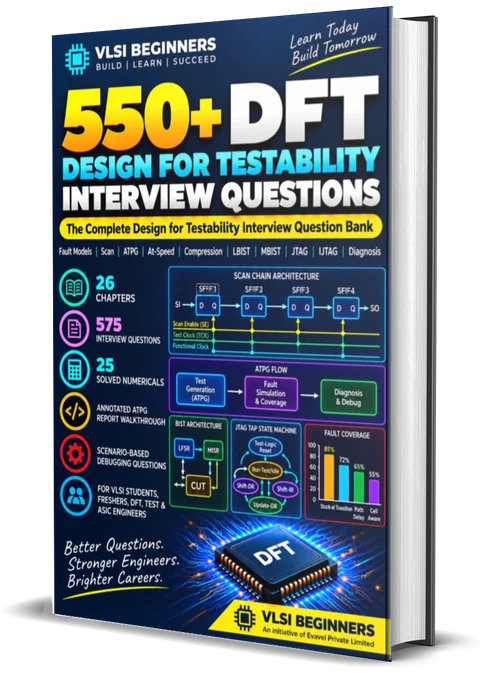
Fault models to first silicon in 26 chapters. Every answer is written the way you'd say it in an interview, with a tip for the follow-up. Includes 25 solved numericals, an annotated ATPG report and 30 debugging scenarios.
DFT is one of the most in-demand VLSI tracks, and the interviews are practical. You'll be asked to compute test time, explain why coverage is stuck at 94%, choose between LOC and LOS, trace the JTAG TAP state machine, or say why the scan chain fails on every die in first silicon.
Most DFT prep material stops at definitions. Scattered notes cover scan and stuck-at faults, then thin out exactly where interviews get harder: compression and X-masking, OCCs, MBIST repair, IJTAG, hierarchical test, diagnosis and the numbers behind test cost.
This book is organised as a learning path. Chapters 1–7 build the fresher core. Chapters 8–14 cover at-speed test, compression, BIST, memory test and IEEE test access. Chapters 15–23 cover SoC architecture, implementation and production. Chapters 24–26 train debugging and how to deliver your answers.
DFT interviews test four skills: explaining a structure, working out a number, reading a coverage report and debugging a failure. The book trains each one.
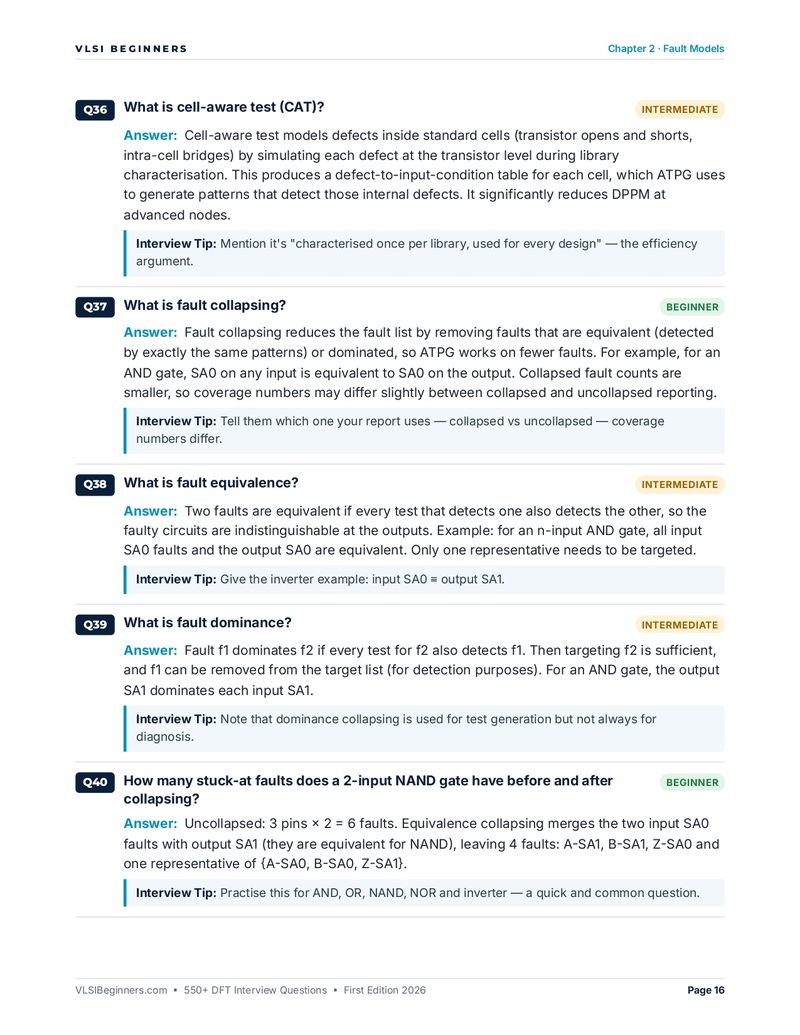
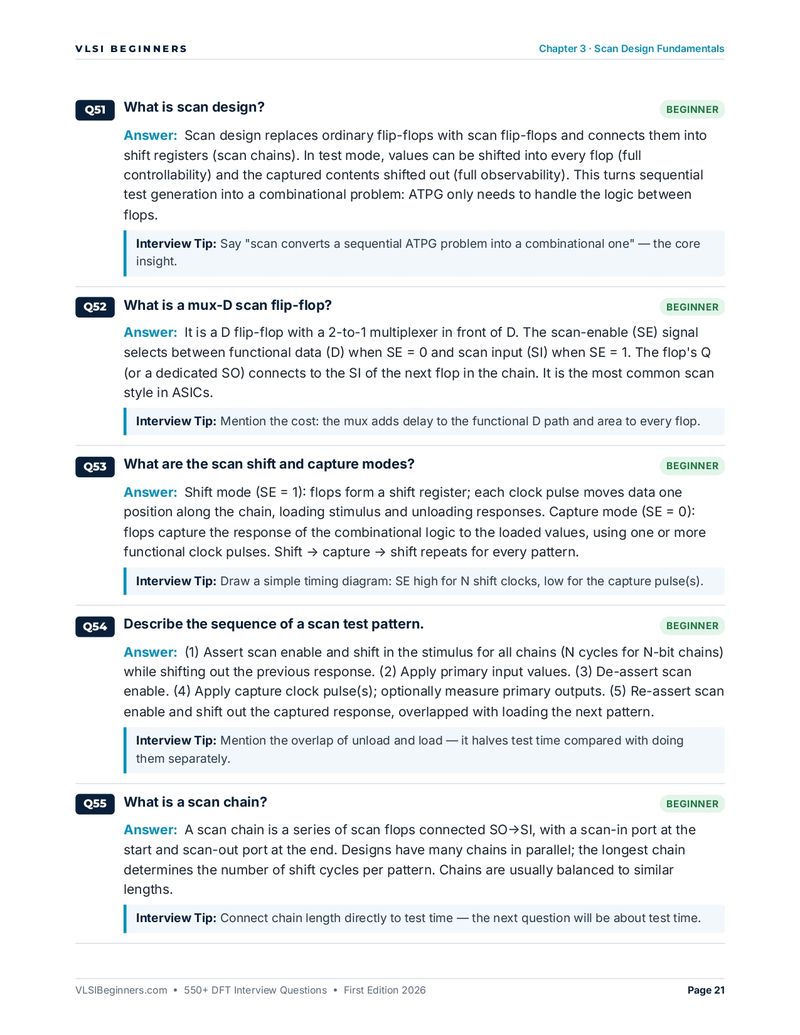
Each of the 575 questions has a difficulty level, an interview-ready answer, and an Interview Tip: the follow-up question or common mistake the interviewer is listening for.
Scan test time with and without compression, tester data volume, coverage from fault classes, Williams–Brown DPPM, yield, LFSR sequences, MISR aliasing, March test time, JTAG chain lengths and memory repair.
A real-format statistics report with eight numbered callouts, then 20 questions on fault classes (DT, PD, UD, AU, ND) and a systematic way to close coverage gaps.
Mux-D scan, OCCs and LOC/LOS, decompressors and compactors, PRPG–MISR LBIST, MBIST collars and BIRA/BISR, the TAP controller, SIBs and IEEE 1500 wrappers.
Hierarchical DFT and streaming scan, test power, test-mode STA, pattern simulation, chain and volume diagnosis, yield learning and ISO 26262 in-system test.
A formula sheet with a fault-model table, a 30-question rapid-fire round, an IEEE standards quick reference, a glossary, a 7-day plan and a readiness checklist.
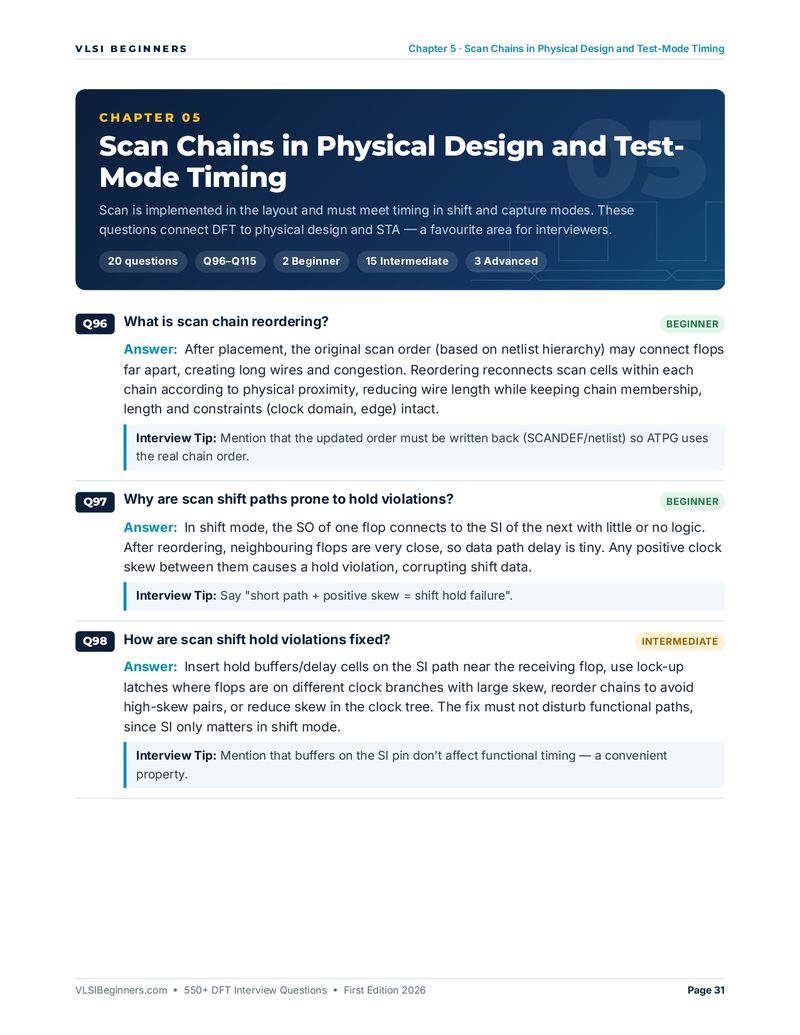
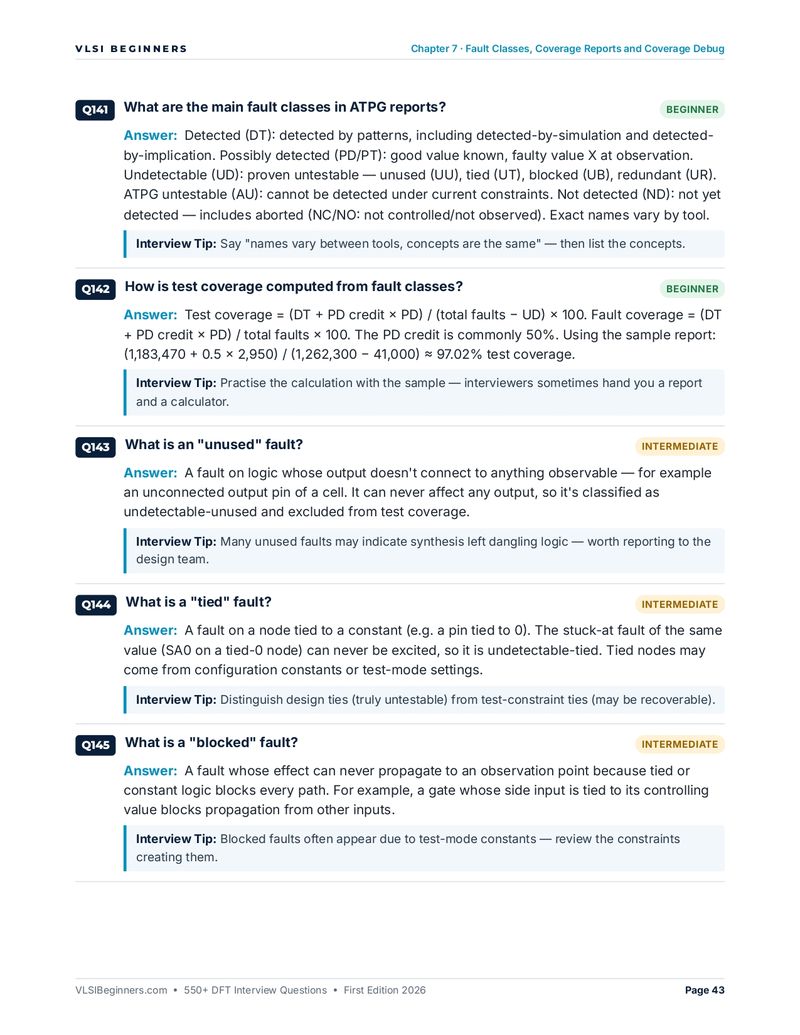
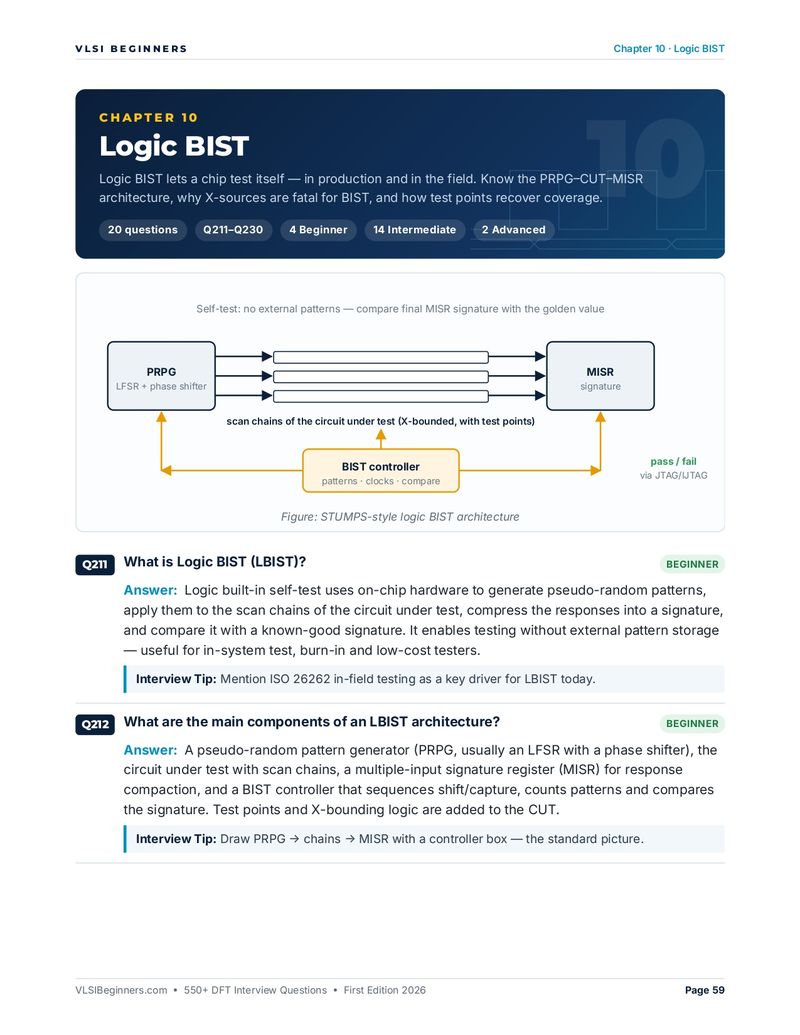
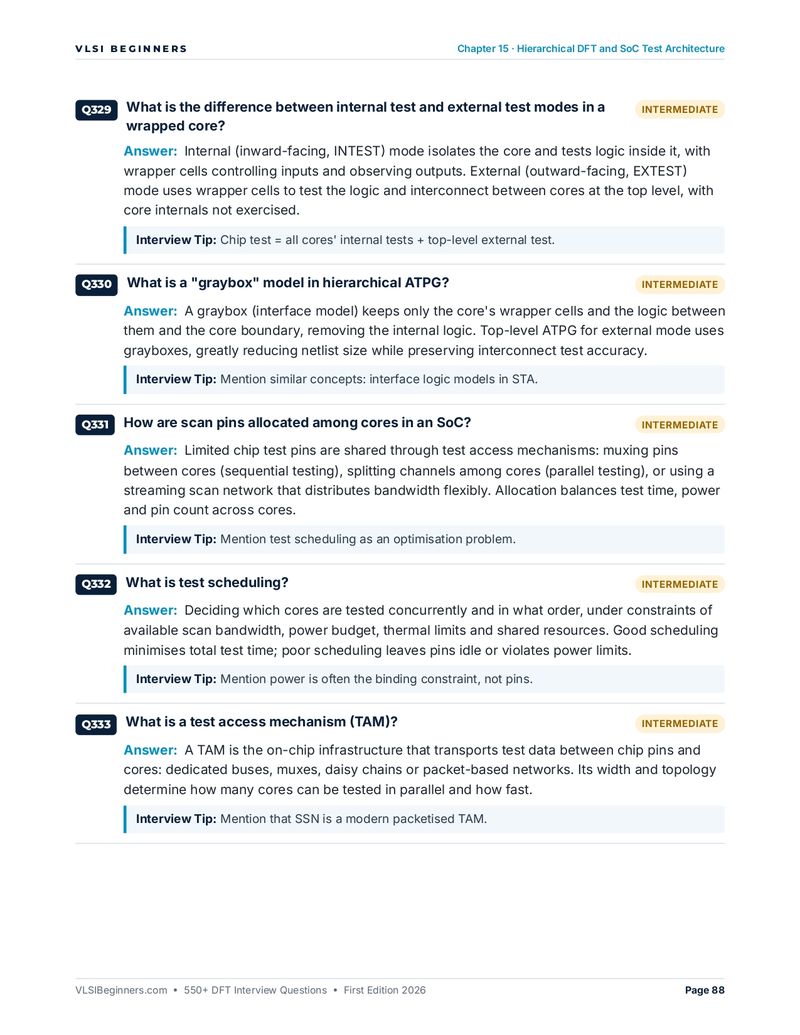
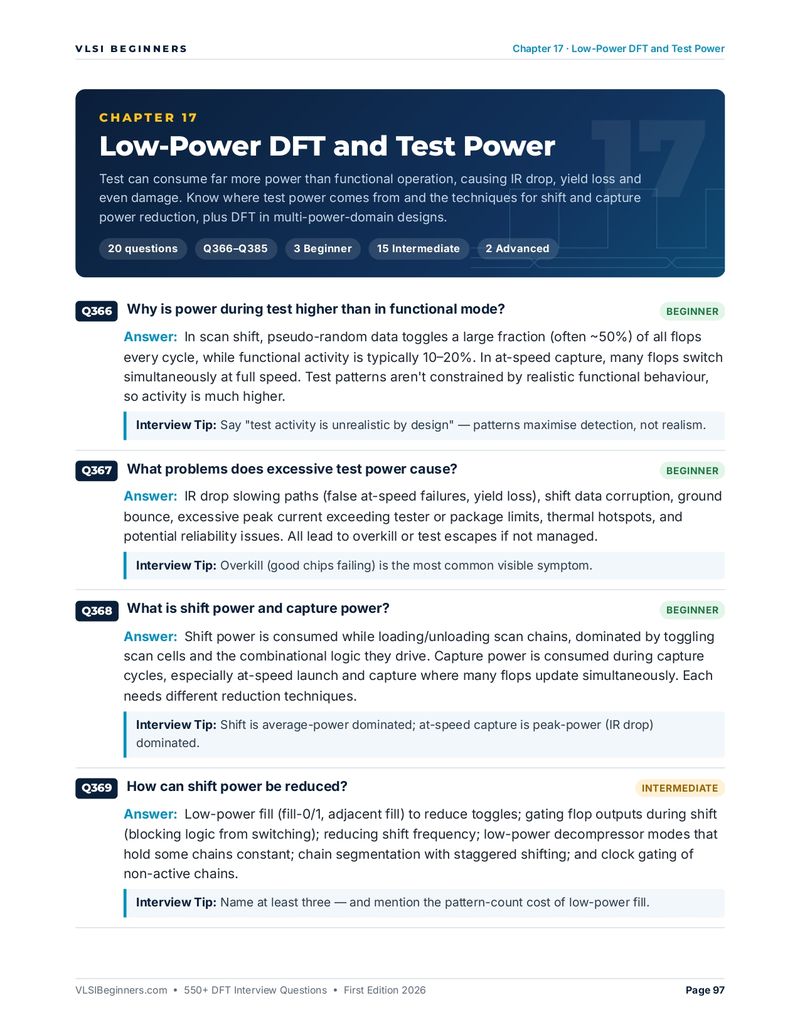
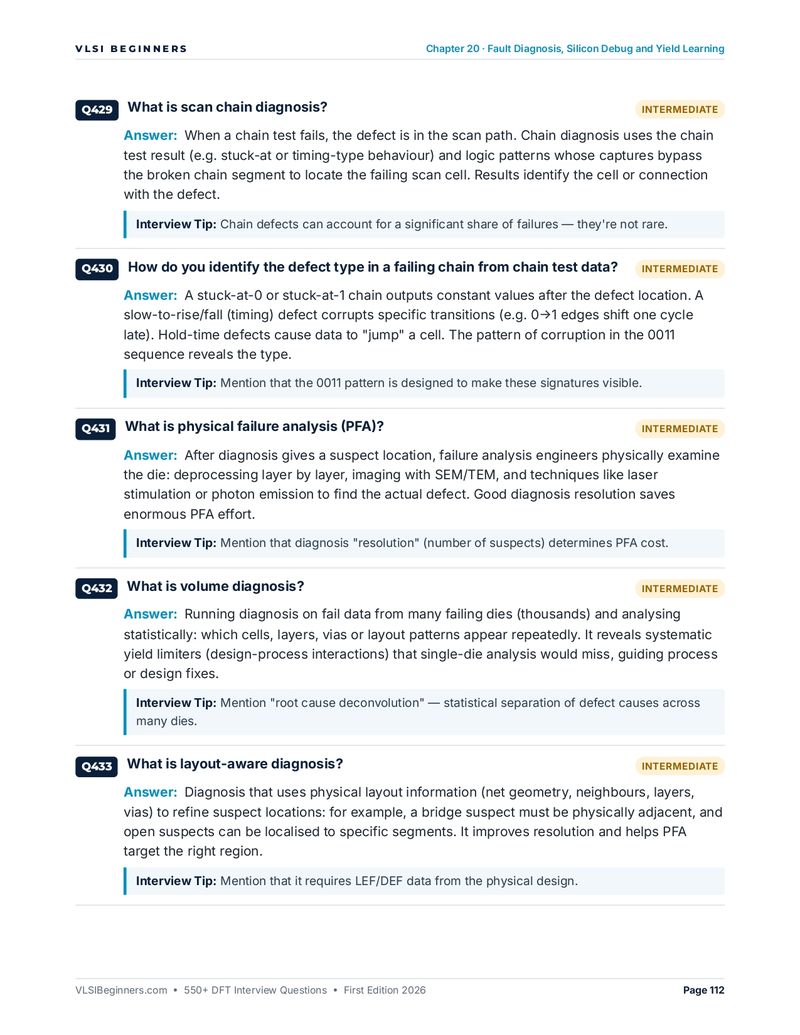
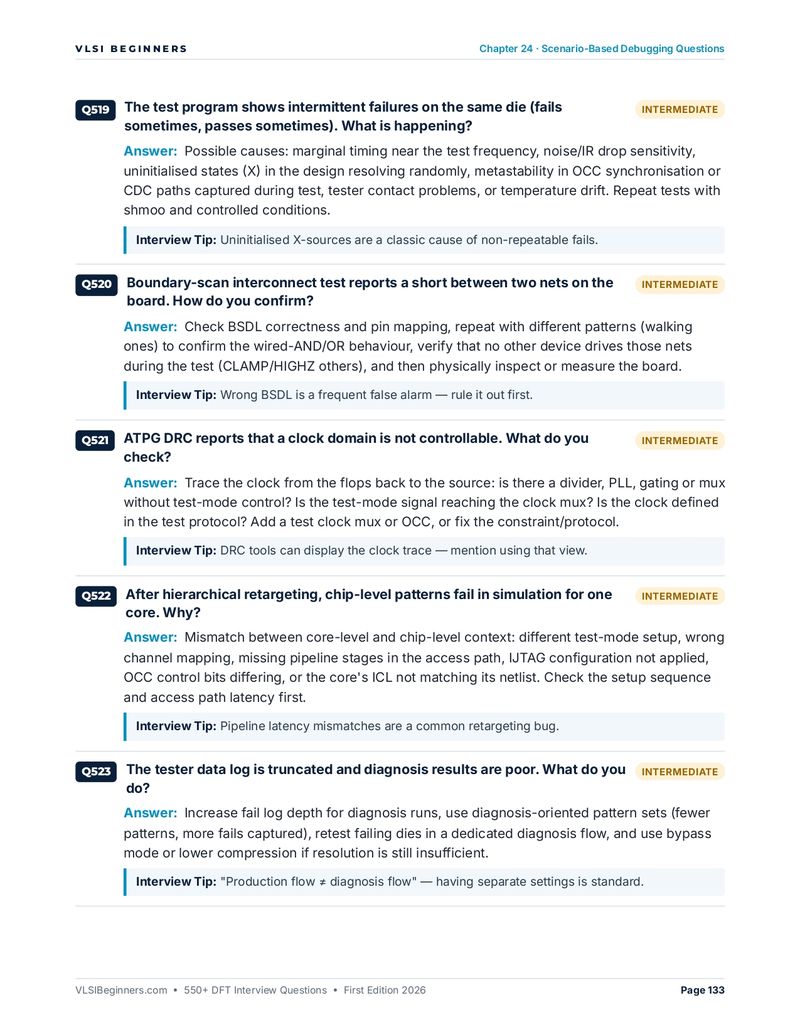
These are pages from the actual PDF, not mockups. Click any page to zoom in and read it in full.
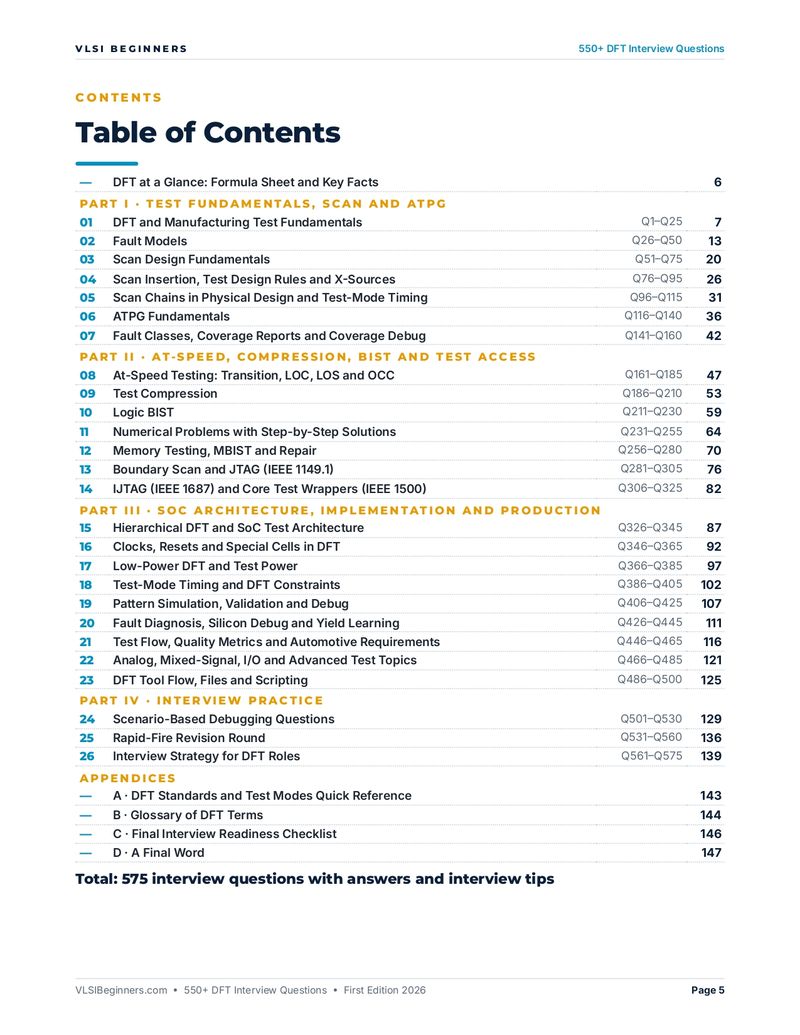
The chapters follow the order DFT is built on a real chip: the fundamentals of scan and ATPG first, then at-speed test, compression, BIST and test access, then SoC architecture and production, and finally the interview itself.
| # | CHAPTER | QUESTIONS |
|---|---|---|
| PART I · TEST FUNDAMENTALS, SCAN AND ATPG | ||
| 01 | DFT and Manufacturing Test Fundamentals | Q1–Q25 |
| 02 | Fault Models | Q26–Q50 |
| 03 | Scan Design Fundamentals | Q51–Q75 |
| 04 | Scan Insertion, Test Design Rules and X-Sources | Q76–Q95 |
| 05 | Scan Chains in Physical Design and Test-Mode Timing | Q96–Q115 |
| 06 | ATPG Fundamentals | Q116–Q140 |
| 07 | Fault Classes, Coverage Reports and Coverage Debug | Q141–Q160 |
| PART II · AT-SPEED, COMPRESSION, BIST AND TEST ACCESS | ||
| 08 | At-Speed Testing: Transition, LOC, LOS and OCC | Q161–Q185 |
| 09 | Test Compression | Q186–Q210 |
| 10 | Logic BIST | Q211–Q230 |
| 11 | Numerical Problems with Step-by-Step Solutions | Q231–Q255 |
| 12 | Memory Testing, MBIST and Repair | Q256–Q280 |
| 13 | Boundary Scan and JTAG (IEEE 1149.1) | Q281–Q305 |
| 14 | IJTAG (IEEE 1687) and Core Test Wrappers (IEEE 1500) | Q306–Q325 |
| PART III · SOC ARCHITECTURE, IMPLEMENTATION AND PRODUCTION | ||
| 15 | Hierarchical DFT and SoC Test Architecture | Q326–Q345 |
| 16 | Clocks, Resets and Special Cells in DFT | Q346–Q365 |
| 17 | Low-Power DFT and Test Power | Q366–Q385 |
| 18 | Test-Mode Timing and DFT Constraints | Q386–Q405 |
| 19 | Pattern Simulation, Validation and Debug | Q406–Q425 |
| 20 | Fault Diagnosis, Silicon Debug and Yield Learning | Q426–Q445 |
| 21 | Test Flow, Quality Metrics and Automotive Requirements | Q446–Q465 |
| 22 | Analog, Mixed-Signal, I/O and Advanced Test Topics | Q466–Q485 |
| 23 | DFT Tool Flow, Files and Scripting | Q486–Q500 |
| PART IV · INTERVIEW PRACTICE | ||
| 24 | Scenario-Based Debugging Questions | Q501–Q530 |
| 25 | Rapid-Fire Revision Round | Q531–Q560 |
| 26 | Interview Strategy for DFT Roles | Q561–Q575 |
| APPENDICES | ||
| A | DFT Standards and Test Modes Quick Reference | p. 143 |
| B | Glossary of DFT Terms | p. 144 |
| C | Final Interview Readiness Checklist | p. 146 |
| D | A Final Word | p. 147 |
A fault-collapsing count, a coverage calculation, a compression numerical, an at-speed comparison and a first-silicon debugging scenario. Every question in the book has the same parts: a direct answer and an interview tip.
Get the ebook nowAnswer each question aloud before reading the answer. Sketch the scan flop, the LOC waveform and the TAP state machine. Solve every Chapter 11 numerical on paper, then make up your own variations.
Preparing for a first DFT interview. Start with Part I and the Chapter 11 numericals; fresher rounds test scan, ATPG and coverage hardest.
Moving into DFT and need the test view of clocks, timing and layout: OCCs, shift hold, test-mode STA, scan reordering and test power.
Revising before a job change or promotion round. Parts III and IV have the hierarchical, diagnosis, silicon-debug and experienced-hire questions.
Studying without a mentor? Every question is answered, with a tip for the follow-up, so you can check your own reasoning.
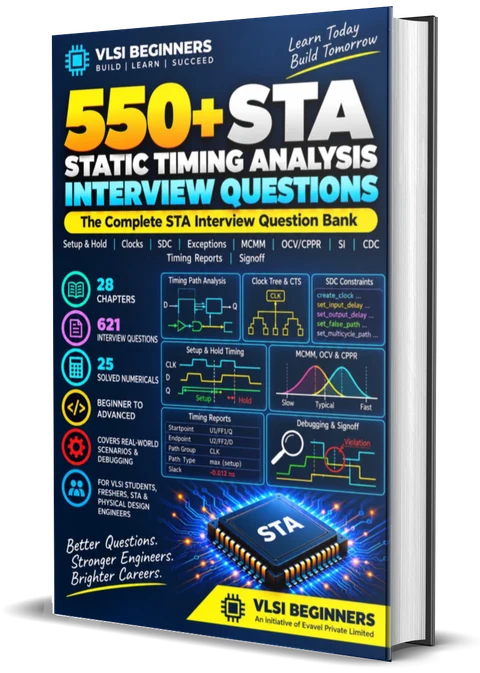
621 answered questions on timing: setup and hold, SDC, exceptions, OCV and CPPR, MCMM and timing reports. DFT rounds keep coming back to timing (shift hold, OCC launch-to-capture, test-mode constraints), so the two books work well together.
575 questions, 26 chapters, every one answered. Instant PDF download.
Get the ebook nowYes. All 575 questions come with an answer written the way you should say it in an interview, plus a specific interview tip: the follow-up or common mistake that separates a good answer from a great one.
A 147-page PDF, delivered as an instant download through Topmate right after checkout.
No. Chapters 1 to 7 build the fresher core: test fundamentals, fault models, scan design, scan rules, ATPG and coverage. The difficulty rises gradually from there, and the rapid-fire round in Chapter 25 is all beginner level.
None in particular. Fault-class names and command syntax differ between EDA vendors, so the book uses tool-neutral terms and a generic ATPG report format. The concepts transfer to any commercial DFT flow.
All of them. There are full chapters on MBIST and memory repair, IEEE 1149.1 boundary scan, IEEE 1687 IJTAG and IEEE 1500 core wrappers, logic BIST, compression, hierarchical SoC test, low-power test, diagnosis and automotive test.
Yes. Ten real pages are on this page, and the free DFT Interview Questions page has 90+ sample questions, worked answers, solved numericals and a test-time calculator.
Because this is a digital product delivered instantly, sales are generally final. If you hit a technical issue with your download, contact us within 7 days. See our Refund Policy for details.
Looking for something else? Browse all ebooks →