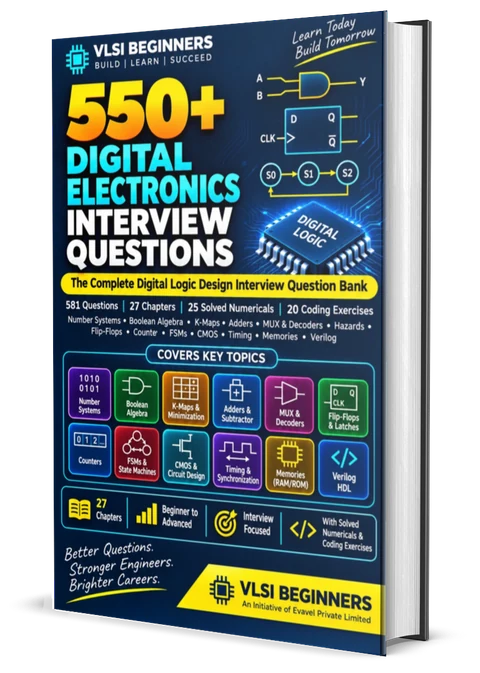
The full digital logic round in 27 chapters: number systems, gates, K-maps, adders, flip-flops, timing, counters, FSMs, CMOS and memories. Each answer is written to be said out loud, with a tip for where the interviewer goes next. Also inside: 20 Verilog exercises, 25 solved numericals and 30 debugging scenarios.
Digital electronics is usually the first technical round for VLSI, RTL, verification, FPGA and embedded-hardware jobs. Because it feels like second-year coursework, many candidates revise it last and walk in with definitions instead of reasoning.
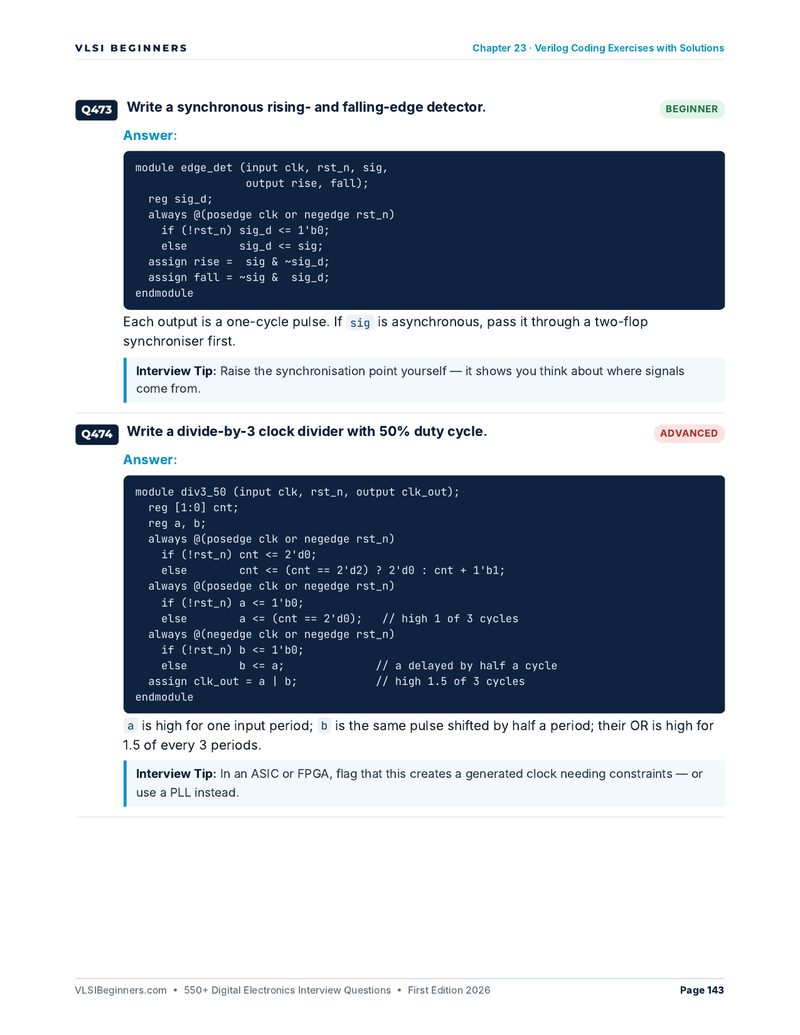
Interviewers don't stop at the definition. They ask you to convert a number in your head, build an XOR from four NANDs, find the corner quad on a K-map, divide a clock by 3 with a 50% duty cycle, explain why a negative hold time is possible, or fix a sequence detector that misses overlapping patterns.
This book is arranged the way the subject builds up: numbers and Boolean logic, then combinational blocks, then flip-flops, timing and state machines, then CMOS, memories and Verilog, and finally the interview itself.
A digital round checks whether you can explain a concept, design a block, calculate a number and debug a circuit. Each of those has its own part of the book.
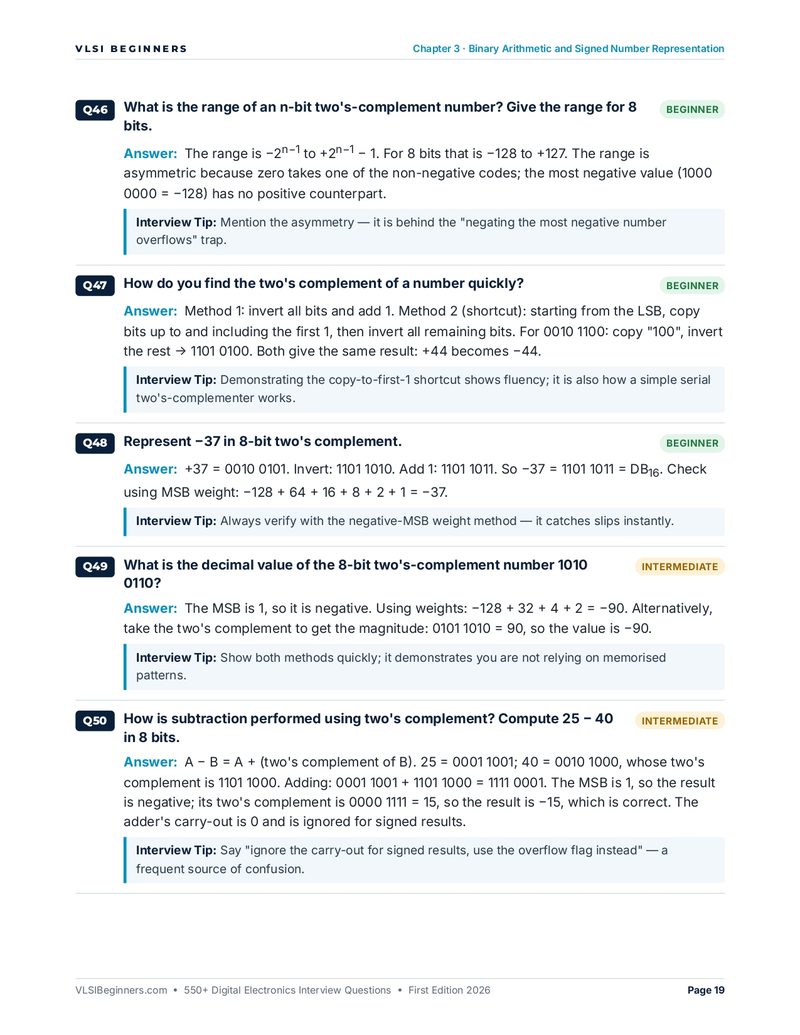
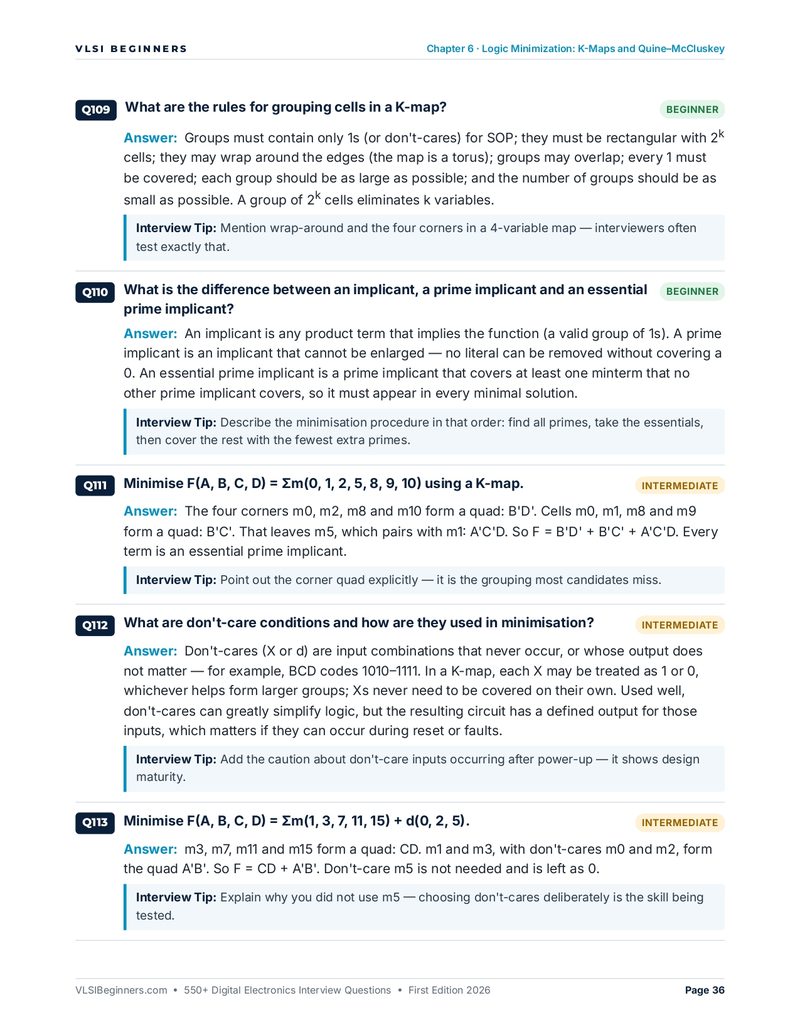
All 581 questions are tagged Beginner, Intermediate or Advanced. Each has a concise answer and an Interview Tip: the extra point, follow-up or common slip that turns a good answer into a strong one.
Parameterised MUX, priority encoder, Gray converters, universal shift register, self-correcting Johnson counter, LFSR, edge detector, divide-by-3 at 50%, a 1011 Mealy detector, debouncer, synchronous FIFO, ALU flags and a toggle synchroniser.
Fractions in binary, signed overflow, fixed-point multiply, fmax and hold checks, ripple-counter speed, MTBF, dynamic power, pipelining, memory expansion, ADC/DAC steps, Hamming codes, UART timing, 555 and PLL dividers.
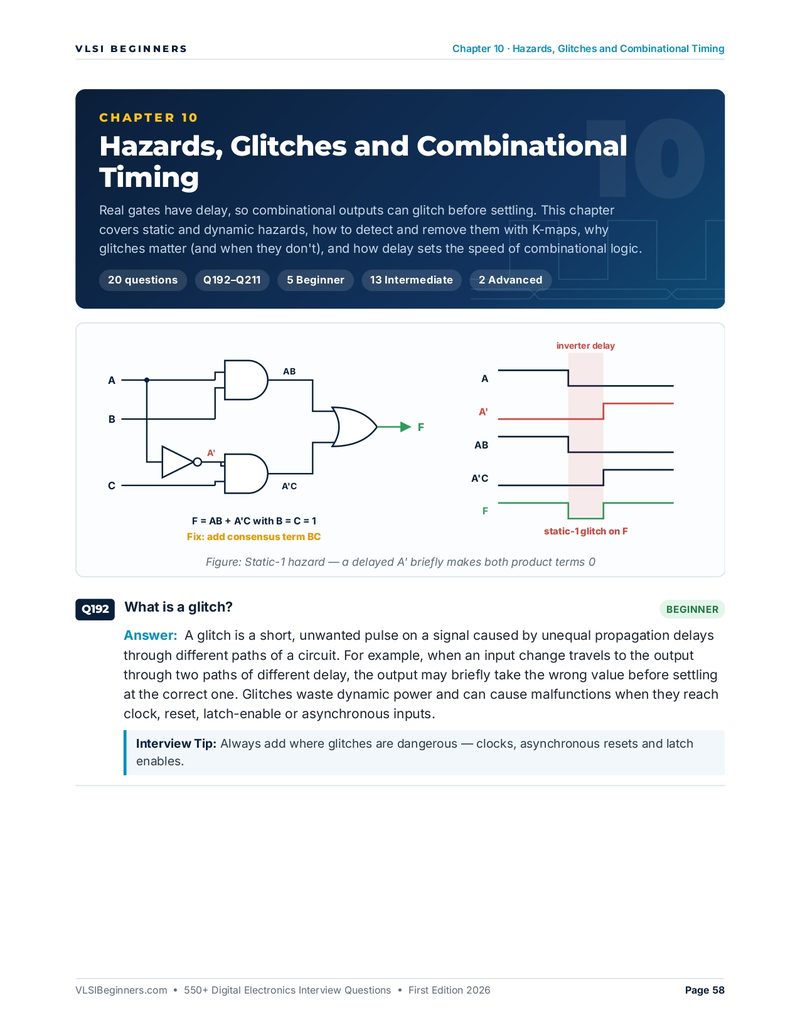
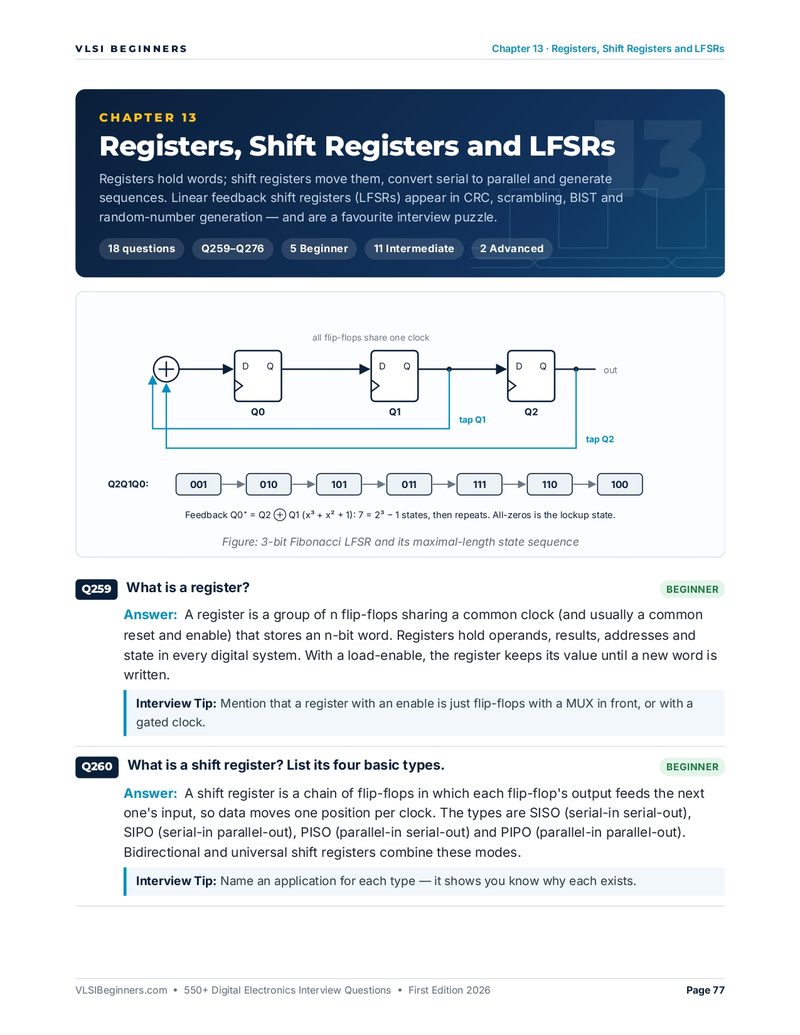
A static-1 hazard with its waveform, a 3-bit LFSR and its state sequence, an overlapping FSM detector, counter waveforms, and a setup timing report annotated term by term.
Fails only when hot, a push-button counted three times, an LFSR stuck at zero, an inferred latch, an (a + b) >> 1 width bug, X after reset in gate-level sim, and a bus that dies at 100 MHz.
A one-page formula sheet, a flip-flop table, a building-block selection guide, 30 rapid-fire questions, a glossary, a 7-day plan and a final readiness checklist.
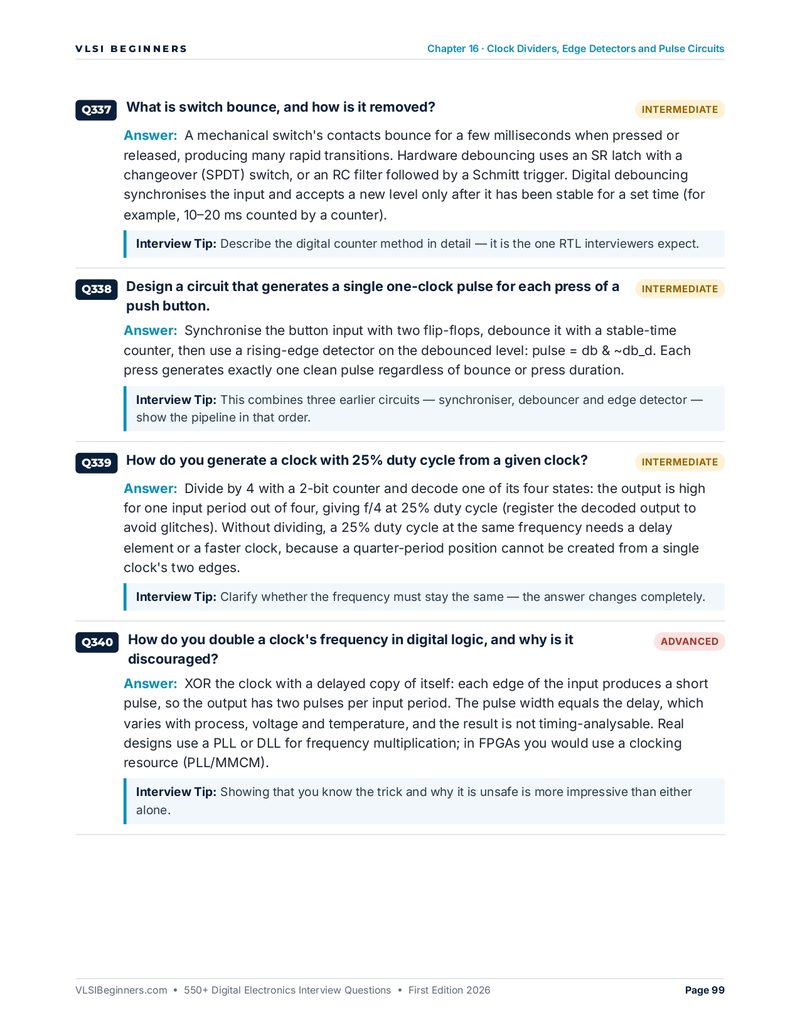
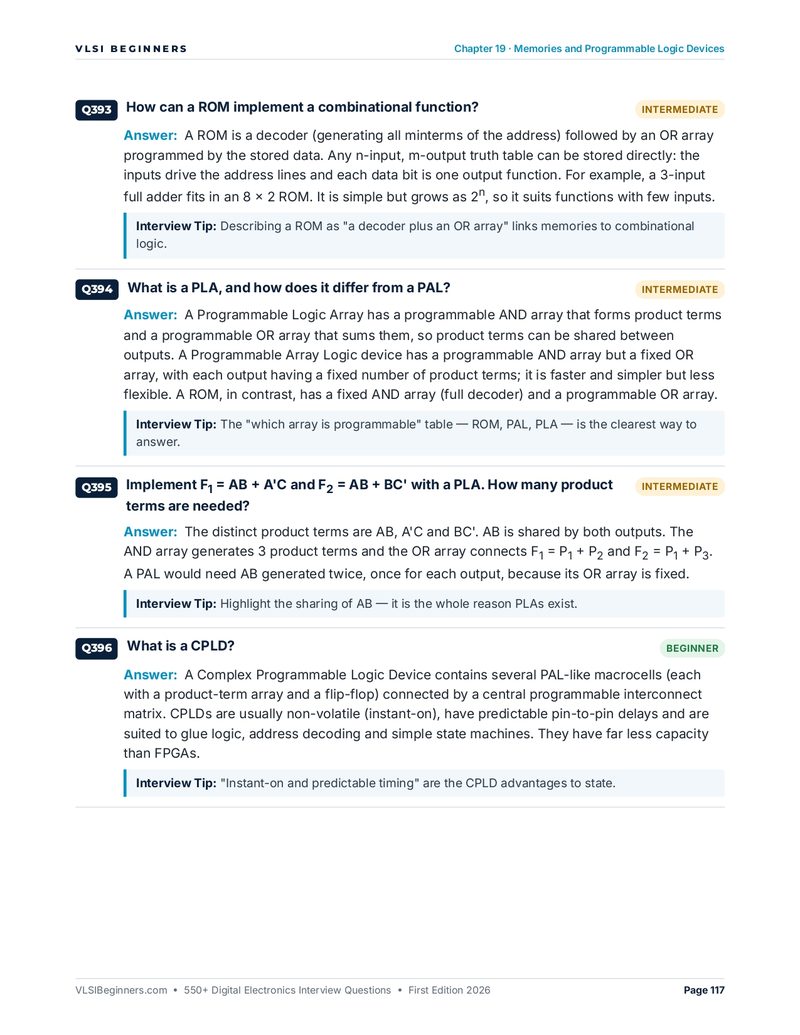
Nothing here is a mock-up. Tap a page to open it full size and read every line.
Each part assumes the one before it. Numbers and logic come first, then blocks built from gates, then circuits with memory and timing, then the technology and HDL that make them real, and last, practice under interview conditions.
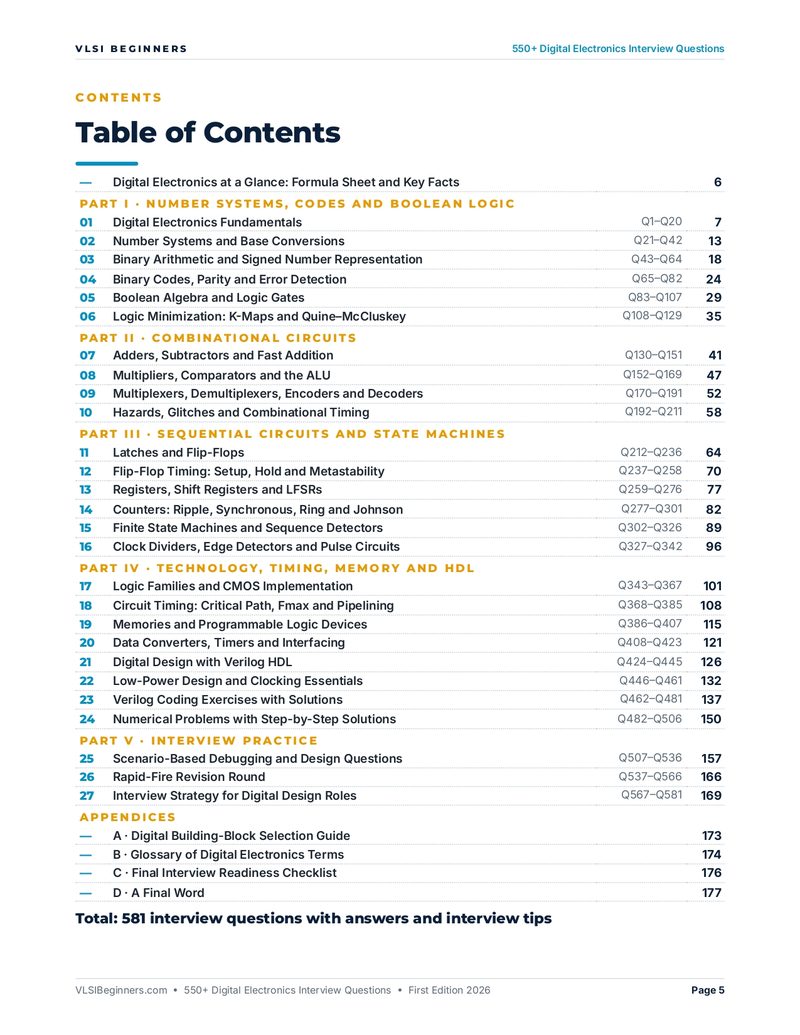
| # | CHAPTER | QUESTIONS |
|---|---|---|
| PART I · NUMBER SYSTEMS, CODES AND BOOLEAN LOGIC | ||
| 01 | Digital Electronics Fundamentals | Q1–Q20 |
| 02 | Number Systems and Base Conversions | Q21–Q42 |
| 03 | Binary Arithmetic and Signed Number Representation | Q43–Q64 |
| 04 | Binary Codes, Parity and Error Detection | Q65–Q82 |
| 05 | Boolean Algebra and Logic Gates | Q83–Q107 |
| 06 | Logic Minimization: K-Maps and Quine–McCluskey | Q108–Q129 |
| PART II · COMBINATIONAL CIRCUITS | ||
| 07 | Adders, Subtractors and Fast Addition | Q130–Q151 |
| 08 | Multipliers, Comparators and the ALU | Q152–Q169 |
| 09 | Multiplexers, Demultiplexers, Encoders and Decoders | Q170–Q191 |
| 10 | Hazards, Glitches and Combinational Timing | Q192–Q211 |
| PART III · SEQUENTIAL CIRCUITS AND STATE MACHINES | ||
| 11 | Latches and Flip-Flops | Q212–Q236 |
| 12 | Flip-Flop Timing: Setup, Hold and Metastability | Q237–Q258 |
| 13 | Registers, Shift Registers and LFSRs | Q259–Q276 |
| 14 | Counters: Ripple, Synchronous, Ring and Johnson | Q277–Q301 |
| 15 | Finite State Machines and Sequence Detectors | Q302–Q326 |
| 16 | Clock Dividers, Edge Detectors and Pulse Circuits | Q327–Q342 |
| PART IV · TECHNOLOGY, TIMING, MEMORY AND HDL | ||
| 17 | Logic Families and CMOS Implementation | Q343–Q367 |
| 18 | Circuit Timing: Critical Path, Fmax and Pipelining | Q368–Q385 |
| 19 | Memories and Programmable Logic Devices | Q386–Q407 |
| 20 | Data Converters, Timers and Interfacing | Q408–Q423 |
| 21 | Digital Design with Verilog HDL | Q424–Q445 |
| 22 | Low-Power Design and Clocking Essentials | Q446–Q461 |
| 23 | Verilog Coding Exercises with Solutions | Q462–Q481 |
| 24 | Numerical Problems with Step-by-Step Solutions | Q482–Q506 |
| PART V · INTERVIEW PRACTICE | ||
| 25 | Scenario-Based Debugging and Design Questions | Q507–Q536 |
| 26 | Rapid-Fire Revision Round | Q537–Q566 |
| 27 | Interview Strategy for Digital Design Roles | Q567–Q581 |
| APPENDICES | ||
| A | Digital Building-Block Selection Guide | p. 173 |
| B | Glossary of Digital Electronics Terms | p. 174 |
| C | Final Interview Readiness Checklist | p. 176 |
| D | A Final Word | p. 177 |
A whiteboard classic, a timing subtlety, a clocking design, an FSM bug and a Verilog trap. Every one of the 581 questions follows the same pattern: a direct answer, then the tip that earns extra credit.
Get the ebook nowassign y = (a + b) >> 1; with 8-bit a, b and y, and gets wrong averages for large values. Why?
The expression width comes from its context, so the sum is computed in 8 bits and the carry out of a + b is lost before the shift. For a = b = 200 the sum wraps to 144 and the result is 72 instead of 200. Fix it with a 9-bit intermediate: wire [8:0] s = a + b; assign y = s[8:1];
Tip: Width-propagation bugs come up often. Explain the context-determined width rule.
Cover each answer and say yours first. Redraw K-maps, adders, flip-flop timing and FSMs from memory, write the Chapter 23 code by hand, and solve every problem in Chapters 2, 3 and 24 on paper before checking.
Campus drives and written tests lean heavily on this subject. Parts I to III turn your coursework into quick, confident spoken answers.
Before anyone asks about SystemVerilog or UVM, they check flip-flops, timing, FSMs and counters. Get those right first.
Clock dividers, debouncers, memories, data converters, UART, SPI and I2C interfacing, low-power clocking and Verilog you can write live.
No teacher to check your work? Every answer, coding solution and numerical is in the book, so you can mark yourself honestly.
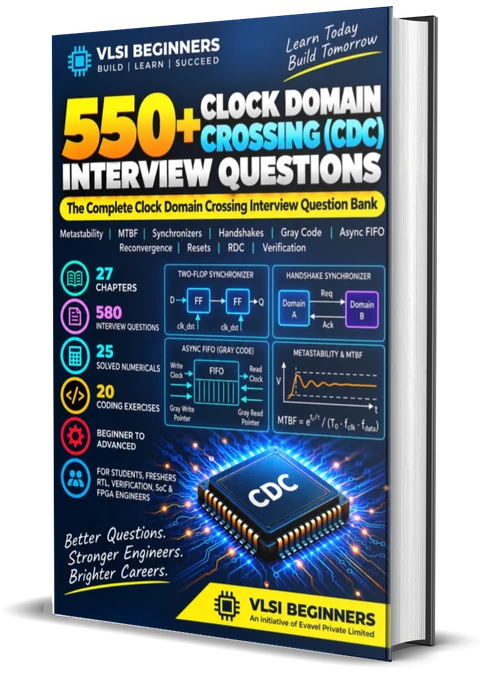
Chapter 12 of this book introduces metastability and the two-flop synchroniser. The CDC ebook takes it all the way: 580 answered questions on handshakes, Gray code, async FIFOs, reconvergence and reset crossings.
581 answered questions in 27 chapters, plus Verilog, numericals and debugging. Download the PDF right after checkout.
Get the ebook nowYes. All 581 questions have a full answer, phrased the way you would explain it to an interviewer, and an interview tip. The 20 coding exercises come with complete Verilog solutions and the 25 numericals are solved step by step.
As a 177-page PDF. Checkout is on Topmate and the download is available immediately after payment.
Exams reward derivations; interviews reward fast, correct reasoning out loud and the follow-up after the definition. The book is organised around what interviewers actually ask, such as building XOR from NANDs, odd clock dividers with 50% duty cycle, hazard removal, overlapping sequence detectors and fmax from setup and hold.
Yes. 131 questions are marked Beginner and Chapters 1 to 6 start from analog versus digital, number systems and Boolean algebra. Difficulty rises gradually, so you can stop at the depth your interviews need.
One chapter on Verilog for digital design, one chapter of 20 coding exercises with solutions, and one chapter on logic families and CMOS implementation, plus low-power design and clocking. It is enough for the digital round of RTL, verification, FPGA and embedded-hardware interviews.
Yes. Eight real pages are on this page, and the free Digital Electronics Interview Questions page has 90+ sample questions with worked answers, solved numericals and a number converter.
Because this is a digital product delivered instantly, sales are generally final. If you hit a technical issue with your download, contact us within 7 days. See our Refund Policy for details.
Preparing for another round too? Browse all ebooks →