RTL DESIGN INTERVIEW PREP

550 RTL questions. No answer key, on purpose.

From "what does register transfer level mean" to "simulation passes but synthesis fails timing", in 11 chapters that follow how RTL is actually learned. 100 of the questions ask you to write the Verilog yourself, the way a whiteboard round does.

37-PAGE PDF · INSTANT DOWNLOAD · 8 FREE PREVIEW PAGES BELOW
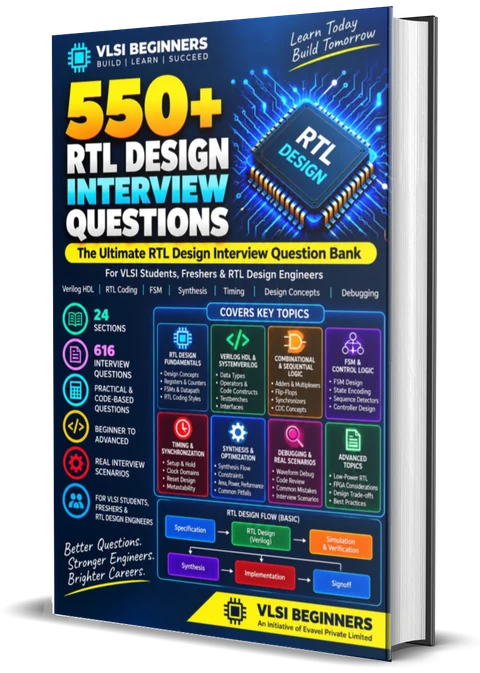
550+ RTL Design Interview Questions ebook cover — VLSI Beginners
550
QUESTIONS, NO ANSWERS
11
CHAPTERS, 86 TOPICS
100
WRITE-THE-RTL PROBLEMS
50
DEBUG & SCENARIO QUESTIONS
THE PROBLEM

Reading answers feels like preparing. It isn't.

An RTL interview is mostly you producing something: a flop with the right reset, a FIFO with correct full and empty flags, an FSM that doesn't glitch, an explanation of why a latch appeared. Recognising a good answer on a page is a different skill from producing one with someone watching.

So this book only asks. Every question is a prompt to answer aloud, sketch, or code in a simulator. If you can't, you've found a gap before the interviewer does.

The order matters too: language and fundamentals first, then the circuits you'll be asked to build, then the timing, synthesis and debugging questions that decide whether an answer sounds junior or senior.

WHAT'S INSIDE

A checklist of everything an RTL round can reach

Use it as a coverage map. If you can answer a chapter end to end without notes, move on; if not, that's where your next evening goes.

QUESTIONS ONLY

550 prompts, no answer key

No pre-written answers to skim. You answer aloud or in code, then check yourself against a textbook, a simulator or the free worked answers.

VERILOG IN DEPTH

100 questions on the language

Modules, ports and parameters, data types, operators, always blocks, continuous and procedural assignment, control statements, generate, tasks and functions, coding guidelines.

CODING ROUND

100 "write the RTL" problems

Flops and registers, decoders and encoders, adders and ALUs, counters, shift registers, FSMs, FIFOs, memories, clock dividers, arbiters, parameterised and optimised RTL.

BUILDING BLOCKS

Sequential, combinational, FSM

150 questions on flip-flops, counters, clock enables and reset strategy; MUXes, priority encoders, comparators and ALUs; Moore, Mealy, state encoding and FSM coding styles.

TIMING & SYNTHESIS

Where RTL meets hardware

Setup, hold, slack, skew, jitter, CDC and metastability, then synthesis: technology mapping, RTL inference, RAM and ROM inference, resource sharing and optimisation.

SENIOR ROUNDS

Debugging and scenarios

Coding, simulation, timing, reset and CDC bugs, then 25 open scenarios: two-clock data transfer, area and power reduction, latches after synthesis, legacy RTL you've inherited.

LOOK INSIDE

Eight pages from the real PDF

Not mock-ups. Tap any page to open it full size.

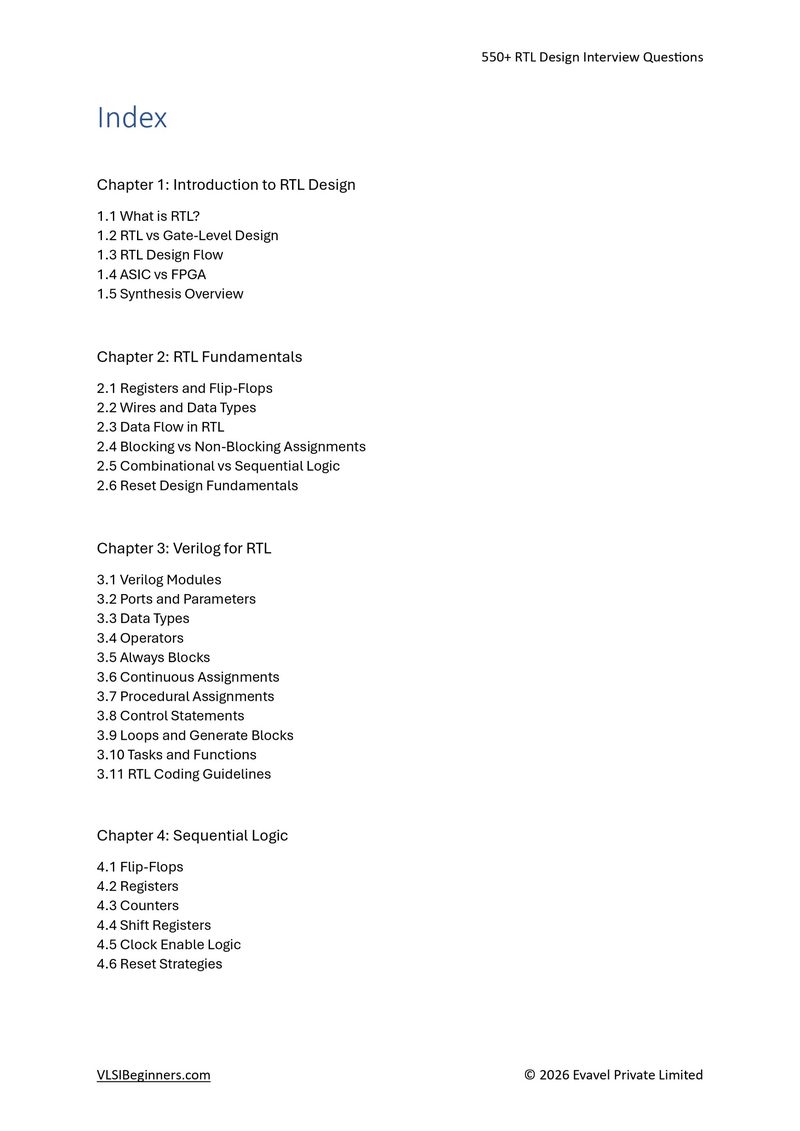
Index page listing topics for chapters 1 to 4: introduction to RTL, RTL fundamentals, Verilog for RTL and sequential logic
INDEX · 1/2Chapters 1–4 by topic
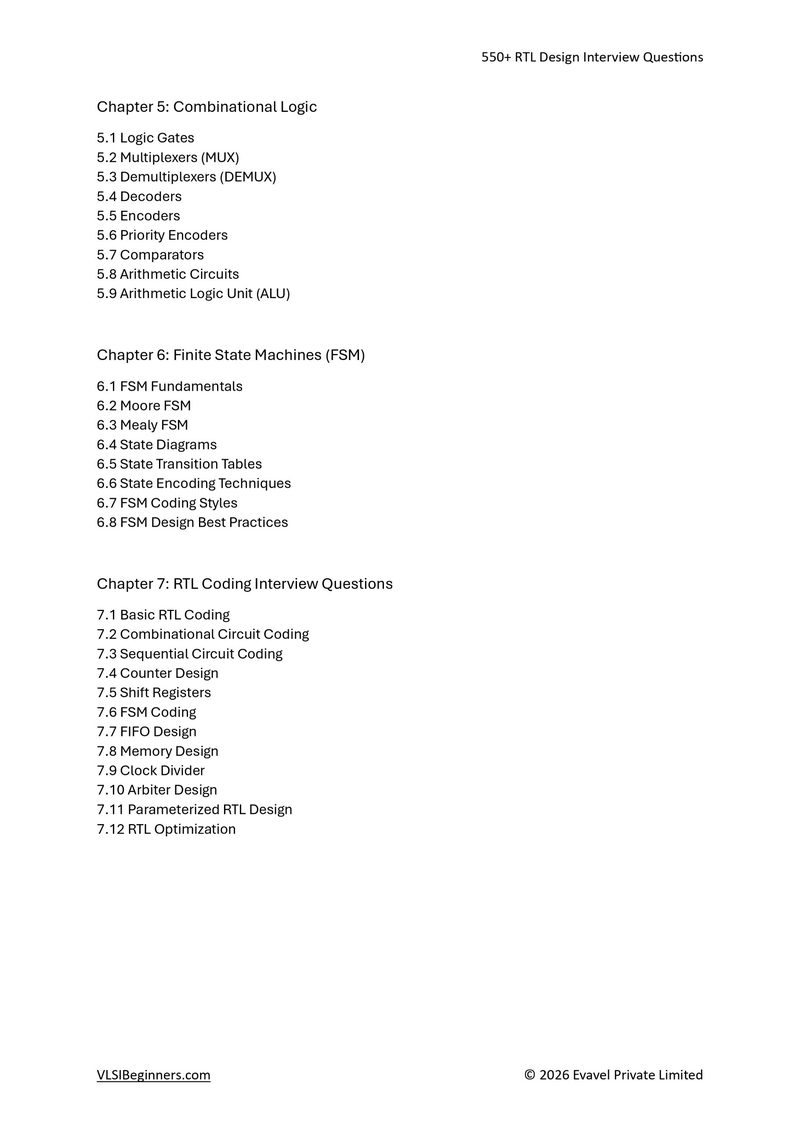
Index page listing topics for chapters 5 to 7: combinational logic, finite state machines and RTL coding
INDEX · 2/2Chapters 5–7 by topic
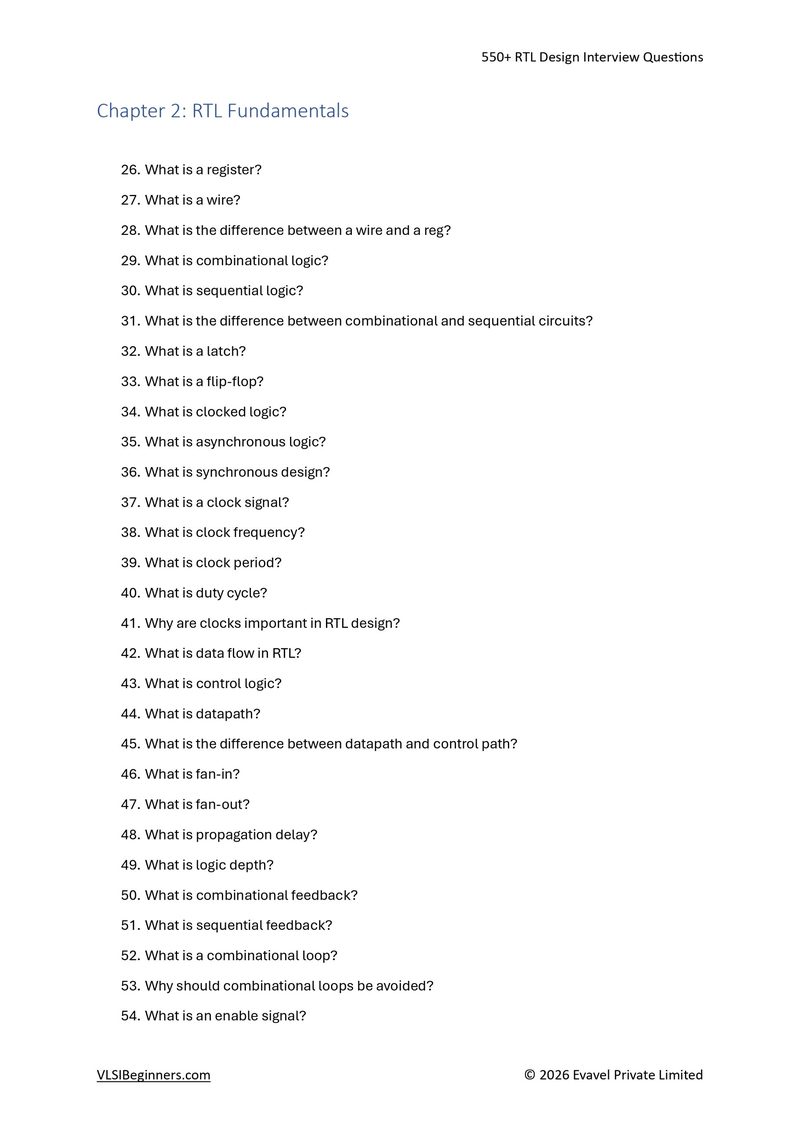
Chapter 2 page with questions 26 to 54 on registers, flip-flops, wires and data types
CHAPTER 2Registers, wires, data types
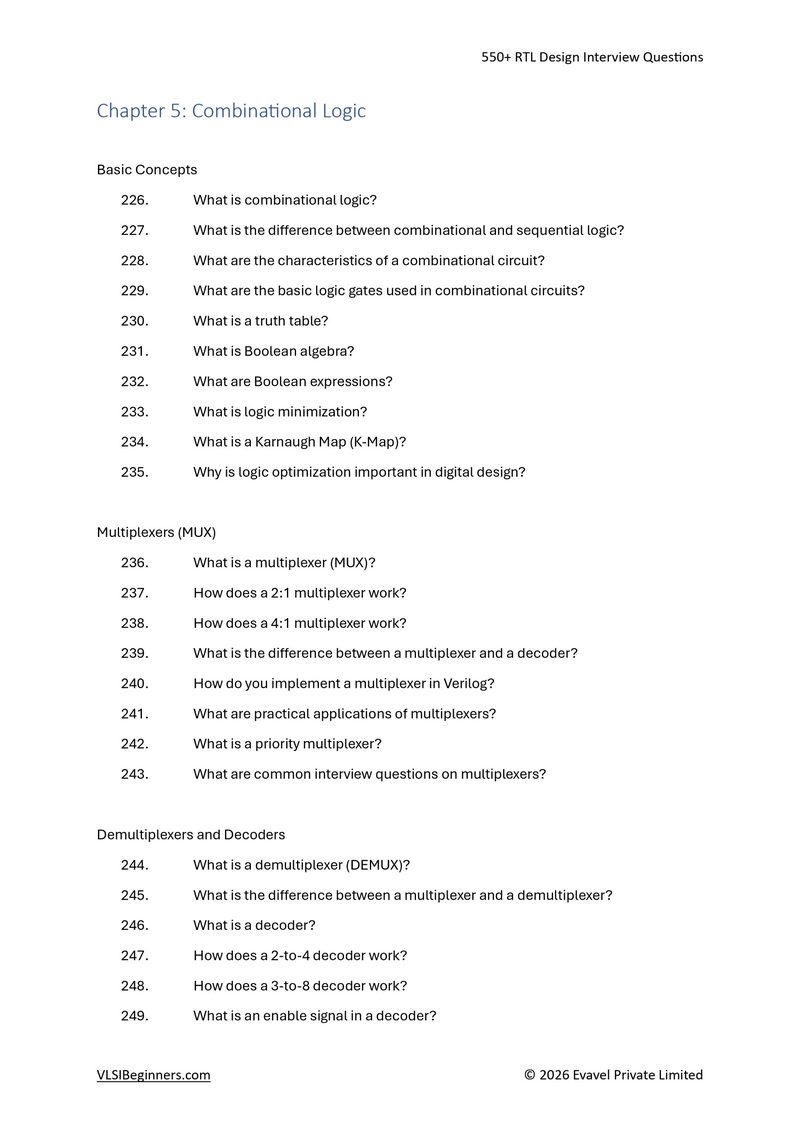
Chapter 5 page with questions 226 to 249 on logic gates, multiplexers and demultiplexers
CHAPTER 5Gates, MUX and DEMUX
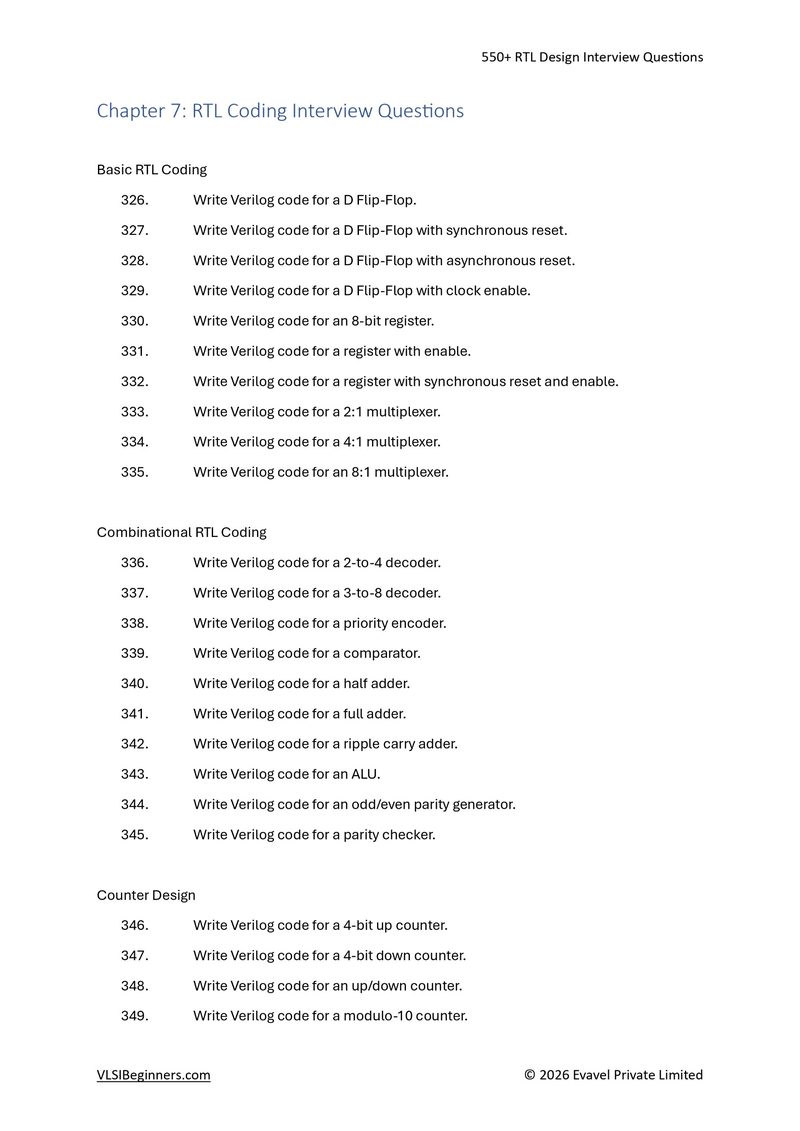
Chapter 7 page with coding questions 326 to 349: flip-flops, registers, multiplexers, decoders, adders and counters
CHAPTER 7Write-the-Verilog problems
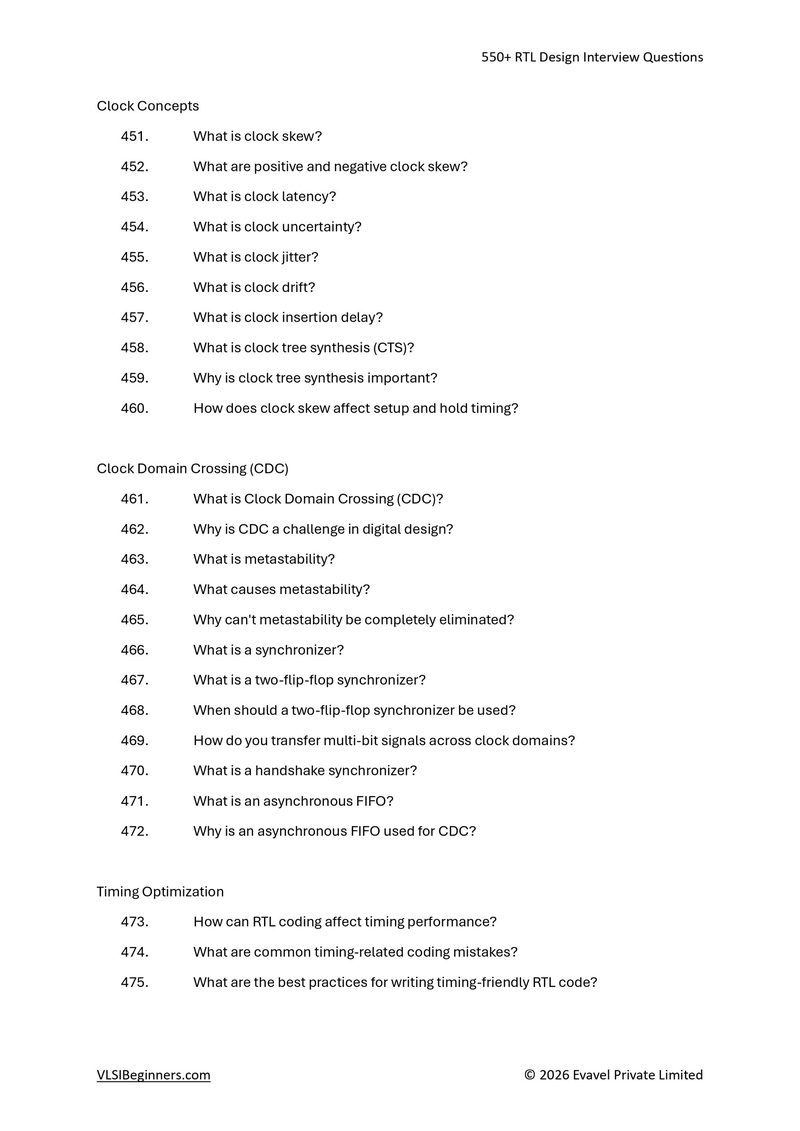
Chapter 8 page with questions 451 to 475 on clock concepts, clock domain crossing, metastability and timing optimization
CHAPTER 8Clocks, CDC, metastability
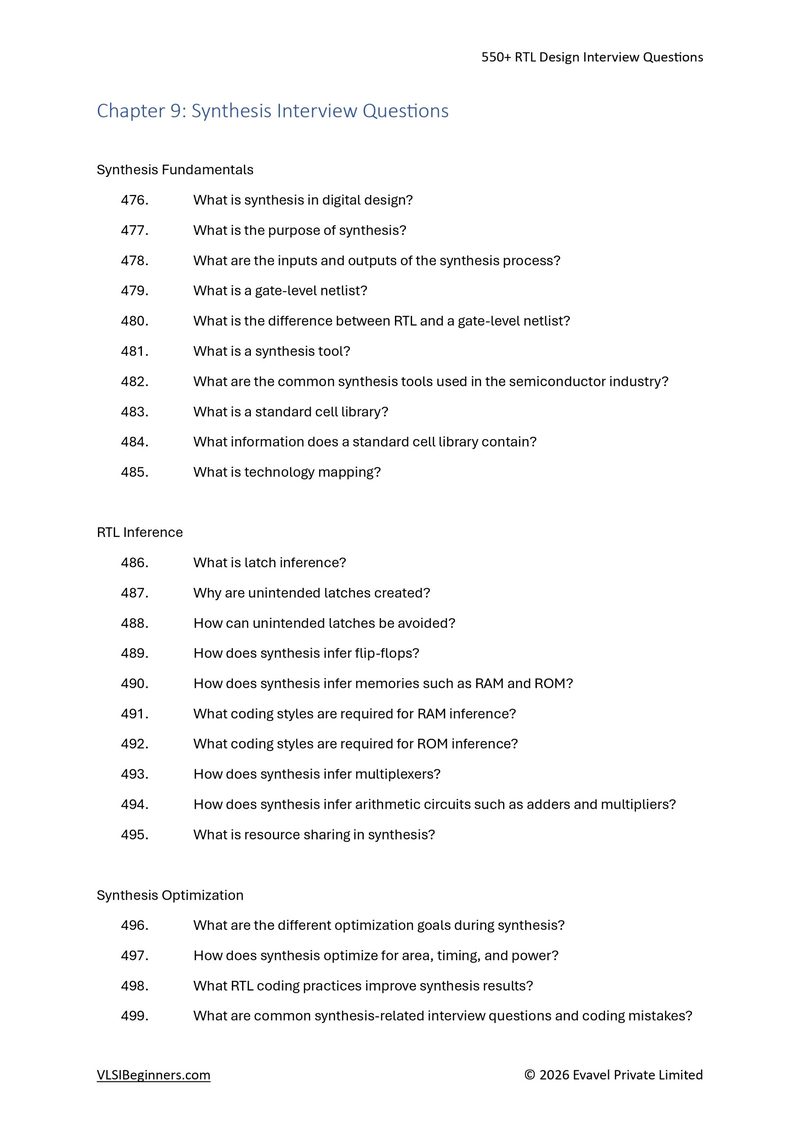
Chapter 9 page with synthesis questions 476 to 499
CHAPTER 9Synthesis and inference
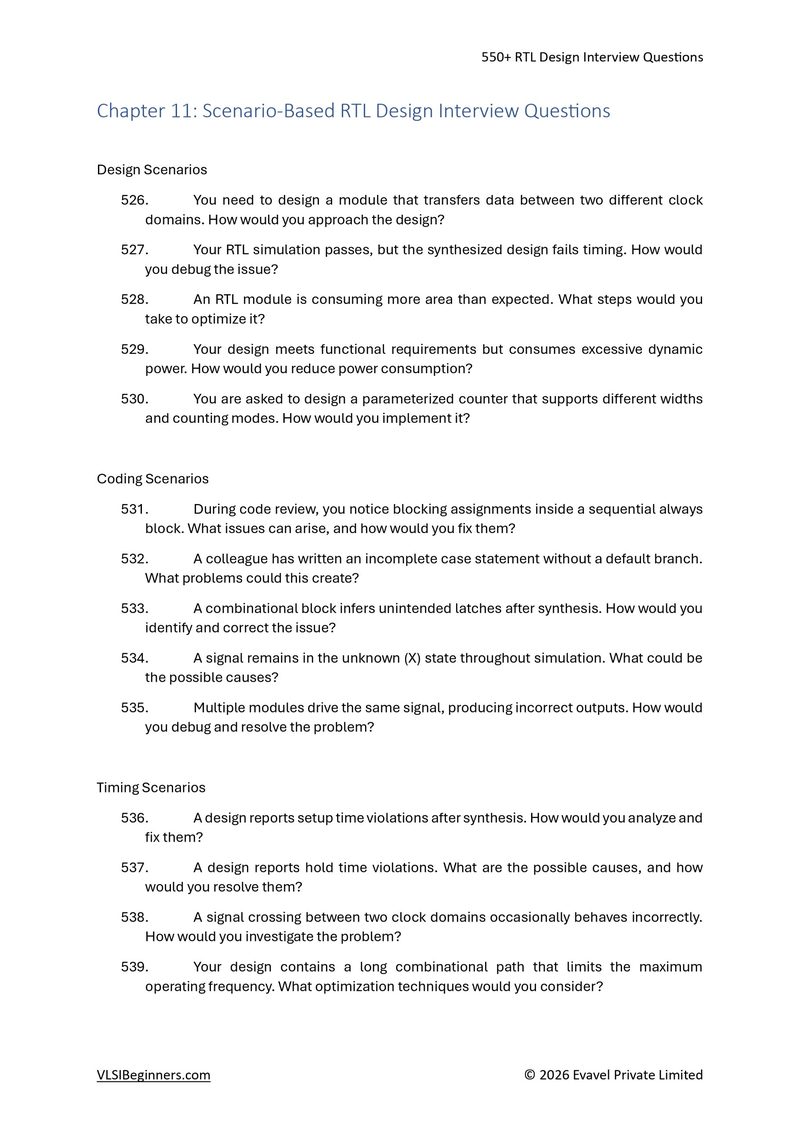
Chapter 11 page with design, coding and timing scenarios, questions 526 to 539
CHAPTER 11Design, coding, timing scenarios
HOW IT'S STRUCTURED

Five parts, from the language to the hard rounds

Learn to describe hardware, learn the blocks every design is made of, write them under pressure, see what timing and synthesis do to them, then debug them.

PART I — RTL & THE LANGUAGE
Describing hardware, not writing software
CH 1–3What RTL is, RTL vs gate level, ASIC vs FPGA, registers and wires, blocking vs non-blocking, reset basics, then Verilog for RTL in eleven topics
175QUESTIONS
PART II — BUILDING BLOCKS
The circuits every design is made of
CH 4–6Flip-flops, registers, counters, shift registers, clock enables, reset strategies; gates, MUX, decoders, encoders, comparators, arithmetic, ALUs; Moore and Mealy FSMs, encoding and coding styles
150QUESTIONS
PART III — THE CODING ROUND
"Write it on the whiteboard"
CH 7Basic, combinational and sequential coding, counters, shift registers, FSMs, FIFOs, memories, clock dividers, arbiters, parameterised RTL and RTL optimisation
100QUESTIONS
PART IV — TIMING & SYNTHESIS
What your RTL turns into
CH 8–9Setup, hold, slack, skew, jitter, CDC, metastability, timing optimisation; synthesis fundamentals, technology mapping, inference, resource sharing, best practices
75QUESTIONS
PART V — DEBUGGING & SCENARIOS
Where senior answers stand out
CH 10–11Coding, simulation, timing, reset and CDC bugs; design, coding, timing, FSM and debugging scenarios, plus real interview prompts
50QUESTIONS
TOTAL ACROSS 11 CHAPTERS 550 questions
SEE ALL 11 CHAPTERS
#CHAPTERQUESTIONS
PART I · RTL AND THE LANGUAGE
01Introduction to RTL DesignQ1–Q25
02RTL FundamentalsQ26–Q75
03Verilog for RTLQ76–Q175
PART II · BUILDING BLOCKS
04Sequential LogicQ176–Q225
05Combinational LogicQ226–Q275
06Finite State Machines (FSM)Q276–Q325
PART III · THE CODING ROUND
07RTL Coding Interview QuestionsQ326–Q425
PART IV · TIMING AND SYNTHESIS
08Timing Concepts (incl. CDC and metastability)Q426–Q475
09Synthesis Interview QuestionsQ476–Q500
PART V · DEBUGGING AND SCENARIOS
10RTL Debugging Interview QuestionsQ501–Q525
11Scenario-Based RTL Design Interview QuestionsQ526–Q550
FROM THE BOOK

Five questions to try right now

Straight from the book, one from each part. The book doesn't answer them; the one-line nudge under each is ours, so you know what a complete answer has to cover.

Get the ebook now
Q14CH 1 · INTRODUCTION Can all Verilog code be considered RTL? Cover: synthesisable vs testbench-only constructs, and why delays and initial blocks don't make hardware.
Q199CH 4 · SEQUENTIAL LOGIC What are the disadvantages of clock gating? Cover: glitches without an ICG cell, extra skew and CTS work, DFT/scan handling, and timing on the enable path.
Q378CH 7 · RTL CODING Write Verilog code for a pulse generator. Cover: register the input, output in & ~in_d for one cycle, and say what happens if the input is asynchronous.
Q469CH 8 · TIMING & CDC How do you transfer multi-bit signals across clock domains? Cover: why per-bit two-flop synchronisers fail, then handshake, mux-recirculation, Gray-coded counters and async FIFOs.
Q531CH 11 · CODING SCENARIO During code review, you notice blocking assignments inside a sequential always block. What issues can arise, and how would you fix them? Cover: order-dependent results, simulation/synthesis mismatch, races between blocks, and the fix: non-blocking for registers.
ONE WEEK LEFT?

A 7-day plan through the book

Our suggested pace. Answer every question aloud, and for anything in Chapter 7, write and simulate the code instead of just picturing it. Mark the ones you stumble on and redo them on day 7.

DAY 1Ch 1–2What RTL is, the design flow, registers vs wires, blocking vs non-blocking, resets
DAY 2Ch 3Verilog for RTL: always blocks, assignments, generate, tasks and functions
DAY 3Ch 4–5Sequential and combinational blocks, from flops and counters to ALUs
DAY 4Ch 6 + 7FSMs, then the first half of Chapter 7: basic, combinational and sequential RTL
DAY 5Ch 7Rest of Chapter 7: FIFOs, memories, dividers, arbiters, parameterised and optimised RTL
DAY 6Ch 8–9Setup and hold, CDC and metastability, synthesis and inference
DAY 7Ch 10–11Debugging, scenarios, and every question you marked earlier in the week
WHO THIS IS FOR

Anyone who has to write RTL in front of someone

Freshers and final-year students

Chapters 1 to 3 start from what RTL is and how Verilog describes hardware, so the later coding questions have a foundation.

FPGA engineers moving to ASIC

You already write RTL; the timing, synthesis, reset and CDC chapters cover what ASIC interviewers probe that FPGA work can skip.

Verification engineers switching to design

Practise writing synthesisable code and defending design choices, not just checking them from the testbench side.

Engineers who learn by doing

No answers to lean on: pair it with a simulator and the free worked answers, and you'll find out what you really know.

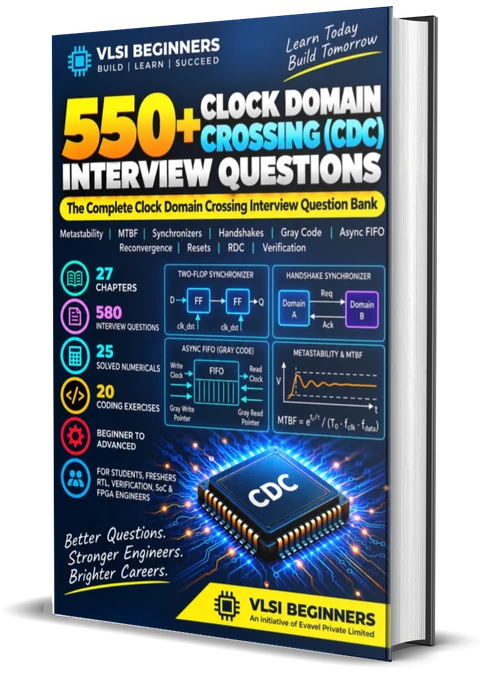
CDC Interview Questions ebook cover
PAIRS WELL WITH

CDC Interview Questions

This book asks about CDC; that one answers it. 580 questions with answers on synchronisers, handshakes, async FIFOs and reset-domain crossing, the topic RTL interviewers dig into most.

See the CDC ebook

550+ RTL Design Interview Questions

550 questions across 11 chapters, including 100 coding problems. The PDF downloads as soon as you check out.

Get the ebook now
QUESTIONS ABOUT THE BOOK
Does the book include answers?

No. It is a 550-question bank with no answer key, so you practise producing answers rather than recognising them. For worked examples, the free RTL Design Interview Questions page has 18 answered questions with Verilog code and 8 solved problems.

What exactly do I get?

A 37-page PDF. You check out on Topmate and download it straight away.

I'm a fresher. Where do I start?

Chapter 1. The first three chapters cover what RTL is, how it differs from gate-level design, and Verilog for RTL in 175 questions before the circuits and coding chapters start.

Is it Verilog or SystemVerilog?

Verilog, as used for synthesisable RTL. A few questions touch SystemVerilog design types such as logic. For the verification side of SystemVerilog, see the SystemVerilog ebook.

How much of it is coding?

Chapter 7 is 100 coding questions, and scenario questions in Chapter 11 ask you to design or fix RTL. The rest are conceptual questions you should be able to answer aloud in a minute or two.

Can I read some pages first?

Yes. Eight real pages are on this page, including both index pages, so you can see every topic before you buy.

What's your refund policy?

Because this is a digital product delivered instantly, sales are generally final. If you hit a technical issue with your download, contact us within 7 days. See our Refund Policy for details.

Preparing for another round too? Browse all ebooks →