SYSTEMVERILOG & UVM INTERVIEW PREP

From logic to UVM RAL. 1,527 questions, and you supply the answers.

The biggest question bank on the site: 24 sections that run from data types and arrays through classes, randomisation, coverage and assertions, into UVM, and end with debugging, company-style and expert corner-case rounds. Built for design verification interviews, from first job to senior.

77-PAGE PDF · INSTANT DOWNLOAD · 8 FREE PREVIEW PAGES BELOW
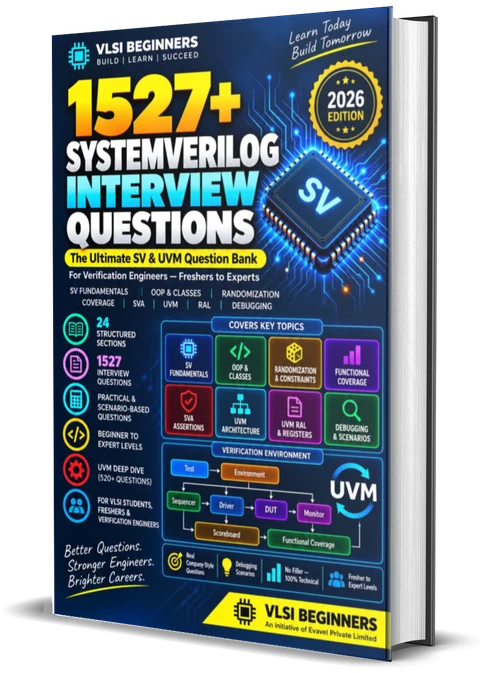
1527+ SystemVerilog Interview Questions ebook cover — VLSI Beginners
1,527
QUESTIONS, NO ANSWERS
24
SECTIONS, LANGUAGE TO UVM
323
UVM QUESTIONS
170
DEBUG, COMPANY & EXPERT
THE PROBLEM

DV interviews go wide, then suddenly very deep

One round can cover a dozen topics. Queues, then virtual methods, then a constraint that won't solve, then a covergroup, then an assertion, then how a sequence item reaches the driver. Gaps in any one of them show quickly.

Then the follow-ups go deep. Why is your static task corrupting data? Why does coverage sit at 0% for a bin that should be trivial? Why did an assertion stop checking at gate level? Those are the questions that separate a fresher from a working DV engineer.

This book is built for both: broad sections that map the whole language and methodology, and late sections full of debugging, real interview-style and corner-case questions that make you think before you speak.

WHAT'S INSIDE

Every topic a verification round can reach

Use it as a self-test. If you can answer a section aloud without notes, move on; if you can't, you know exactly where to study next.

QUESTIONS ONLY

1,527 prompts, no answer key

Nothing to skim. You answer aloud or in a simulator, then check against the LRM, the UVM reference or the free worked answers.

THE LANGUAGE

400 questions on SV itself

Why SV over Verilog, data types, packed and unpacked arrays, queues and associative arrays, always_comb/always_ff, operators, casting, streaming, tasks and functions.

TESTBENCH CORE

Classes, interfaces, IPC

121 OOP questions, plus interfaces, modports, clocking and program blocks, mailboxes, semaphores, events, fork-join, packages and DPI-C.

CRV, COVERAGE, SVA

290 questions on the verification trio

Constraints, dist, solve…before, randc, soft constraints and solver performance; covergroups, bins and crosses; immediate and concurrent assertions.

UVM

323 questions across six sections

Architecture and phasing, components, sequences and virtual sequences, factory and config DB, the register layer (RAL), objections and TLM.

THE HARD ROUNDS

Debug, company-style, expert

65 debugging scenarios, 70 company-style questions, 35 expert corner cases, and 21 career and behavioural questions for verification roles.

LOOK INSIDE

Eight pages from the real PDF

Not mock-ups. Tap any page to open it full size.

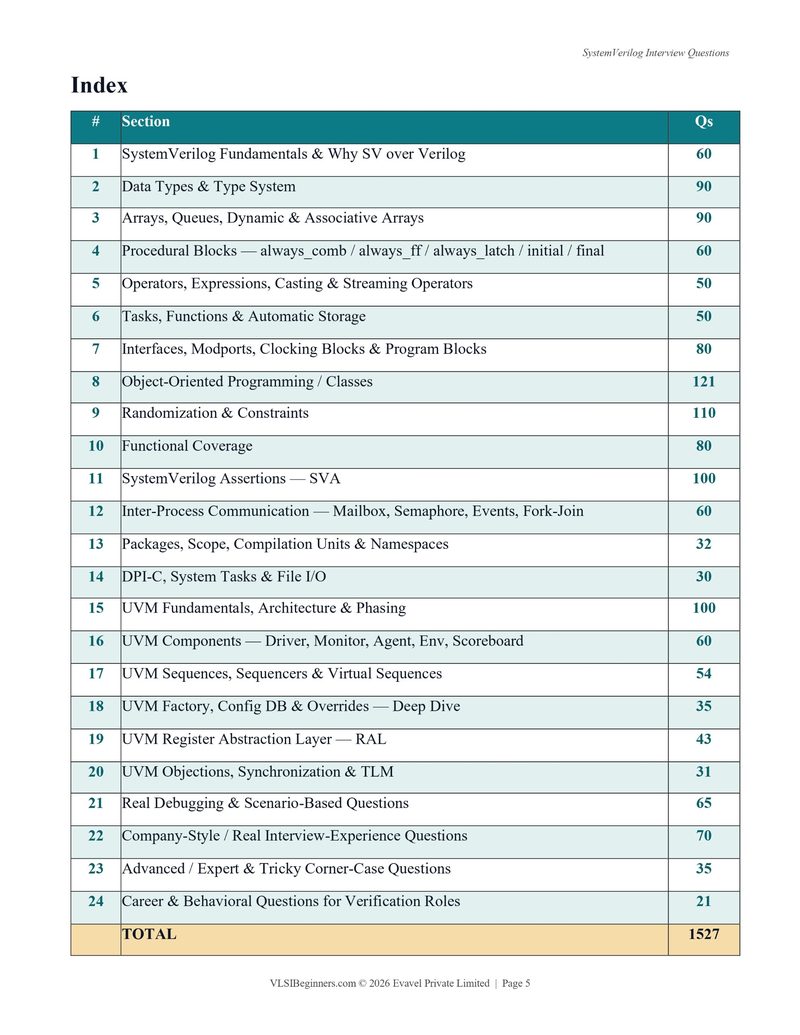
Index listing all 24 sections with question counts, totalling 1527
PAGE 5All 24 sections and counts
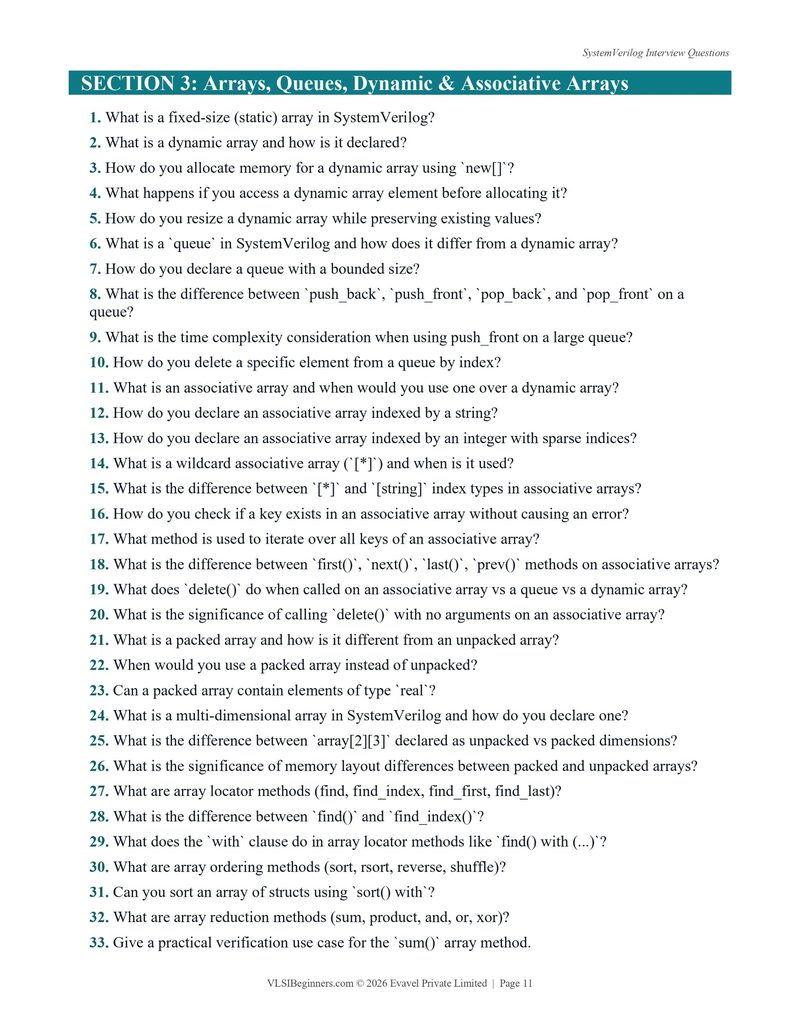
Section 3 opening page with questions on dynamic arrays, queues, associative arrays and packed arrays
SECTION 3Arrays, queues, associative
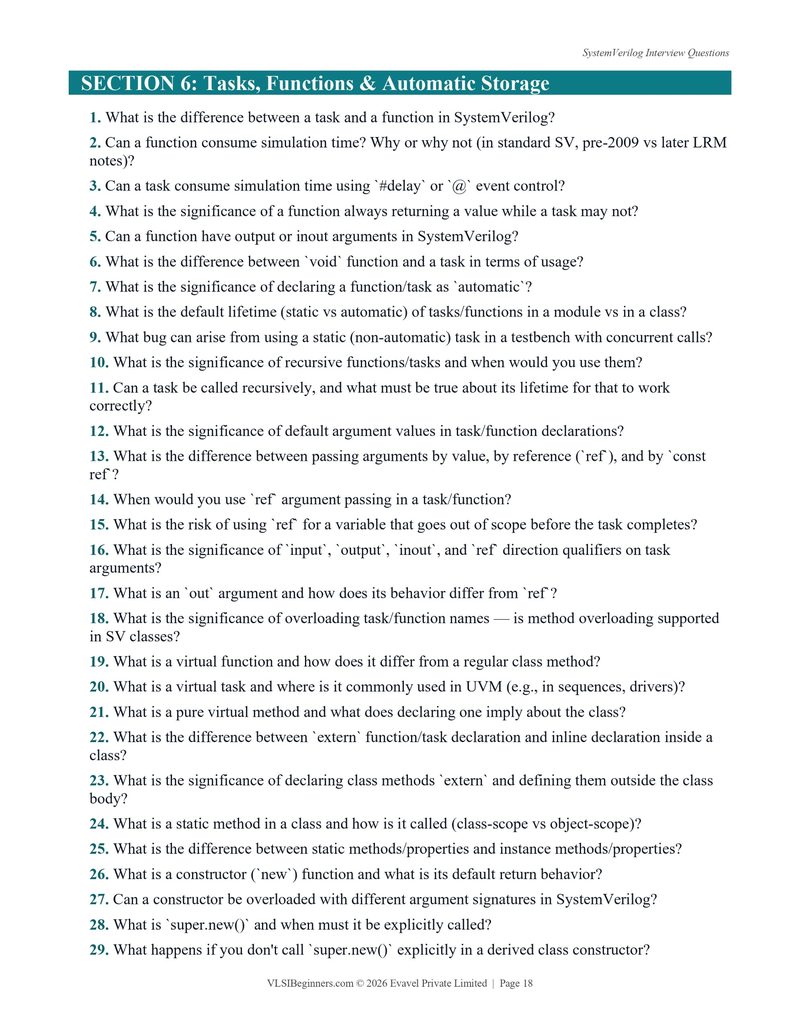
Section 6 opening page on tasks, functions, automatic lifetime, ref arguments and virtual methods
SECTION 6Tasks, functions, lifetimes
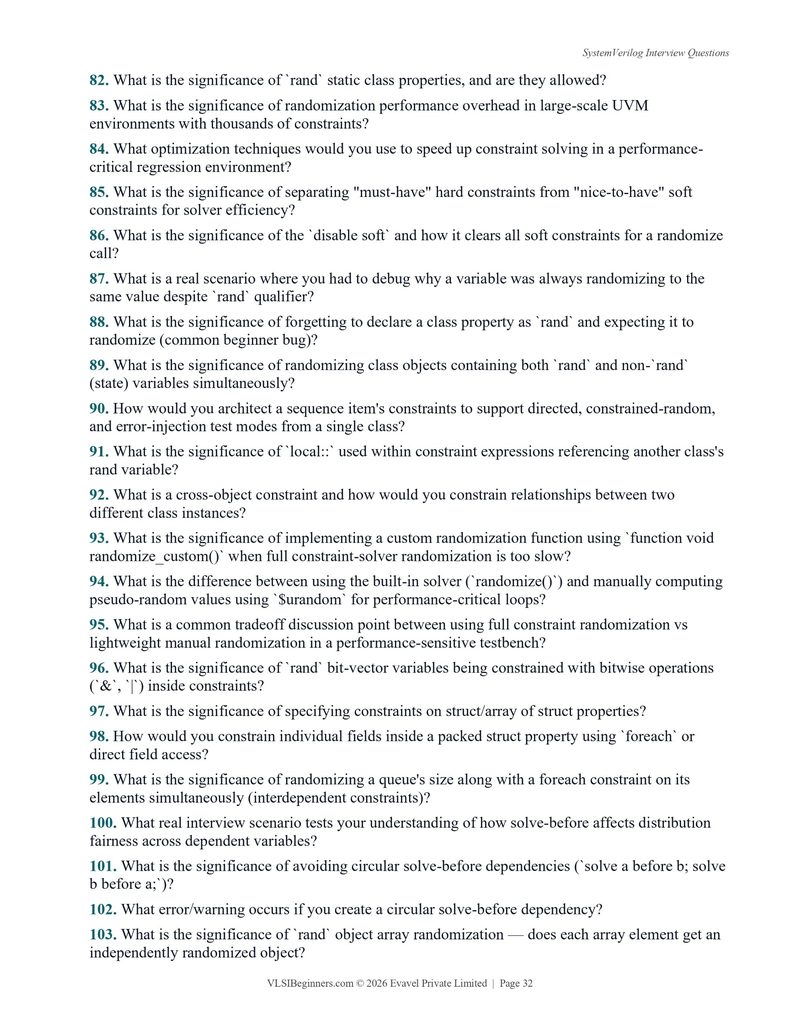
Section 9 page with questions 82 to 103 on solver performance, soft constraints and solve-before
SECTION 9Solver performance, solve-before
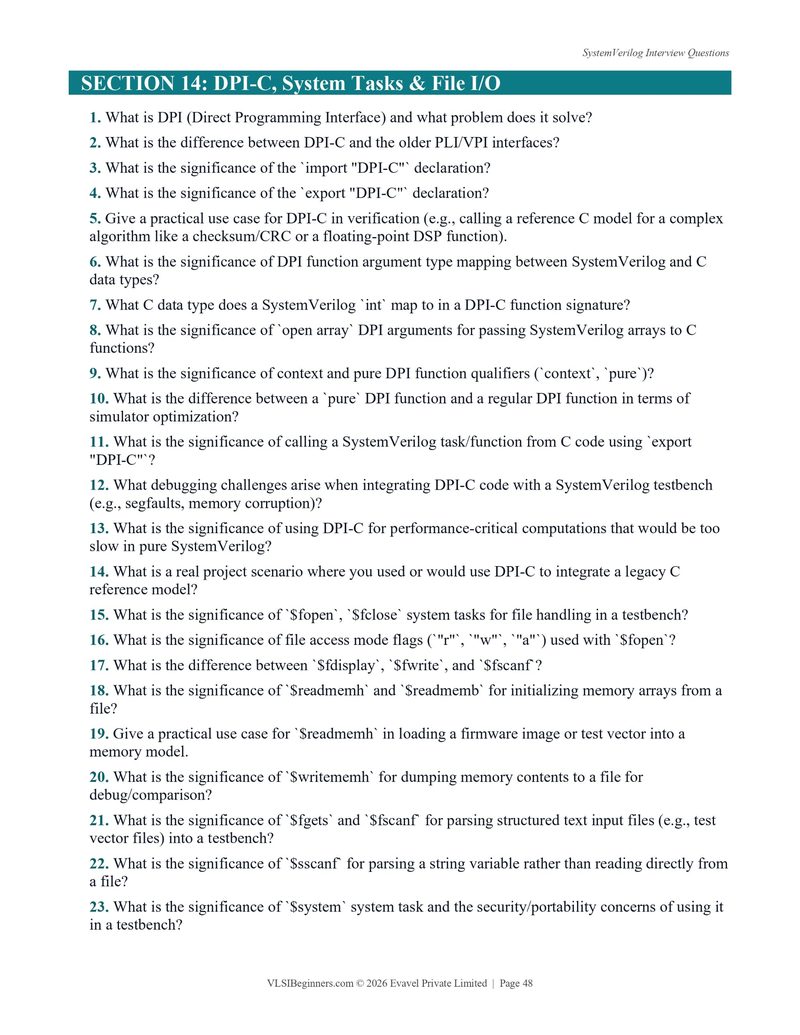
Section 14 opening page on DPI-C import and export, type mapping and file I/O system tasks
SECTION 14DPI-C and file I/O
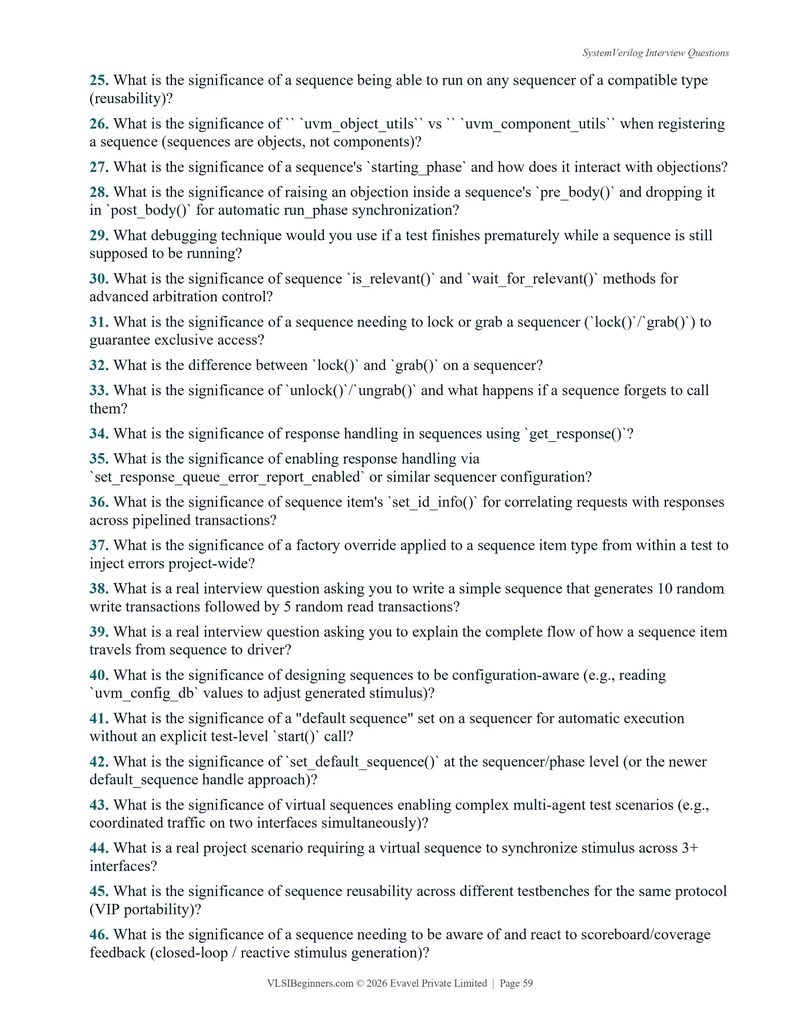
Section 17 page with questions 25 to 46 on lock and grab, responses, default sequences and virtual sequences
SECTION 17Lock, grab, virtual sequences
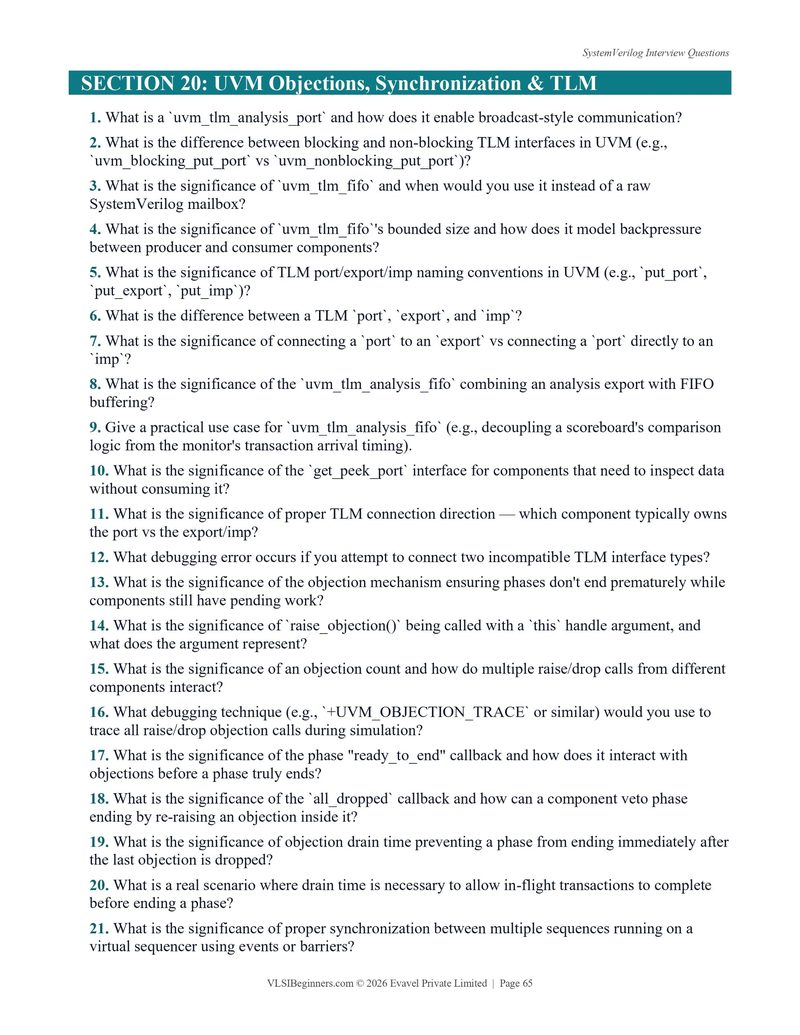
Section 20 opening page on analysis ports, TLM FIFOs, ports, exports and imps, and objections
SECTION 20TLM ports and objections
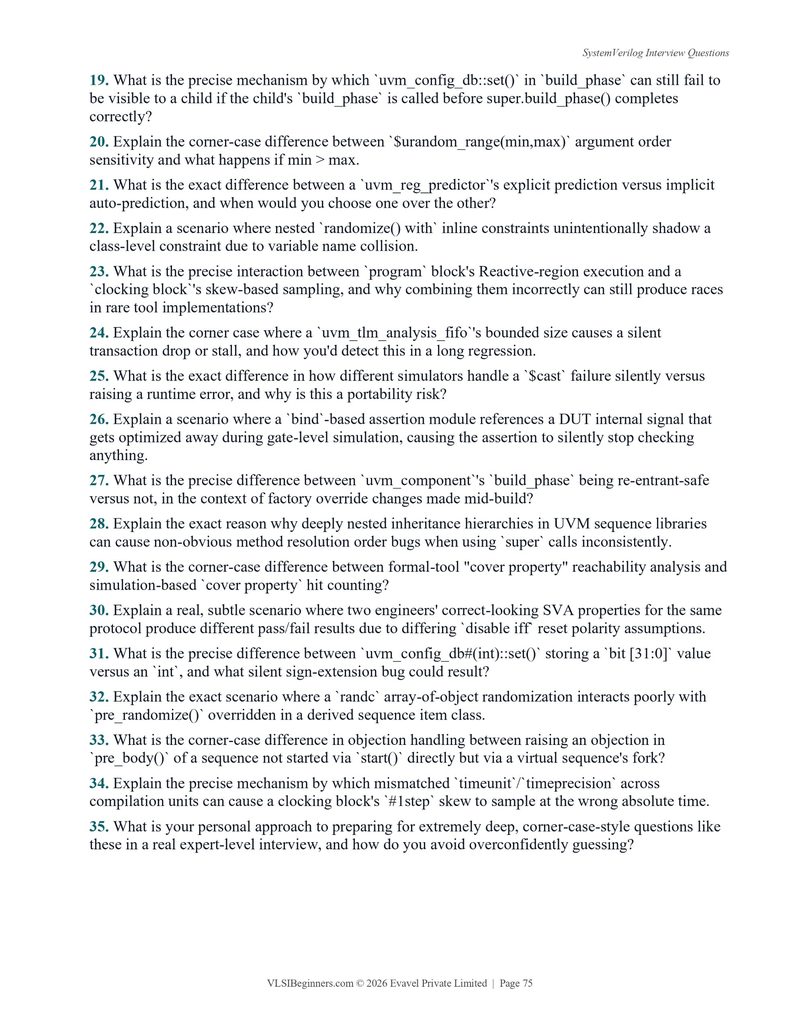
Section 23 page with expert corner-case questions 19 to 35 on config DB, scheduling regions, bind and portability
SECTION 23Expert corner cases
HOW IT'S STRUCTURED

Six parts, in the order a DV engineer learns

The language, then the testbench building blocks, then the three verification techniques, then the plumbing, then UVM, and finally the rounds where interviews get hard.

PART I — THE LANGUAGE
Types, arrays and procedural code
SEC 1–6Why SV over Verilog, data types, arrays and queues, always_* blocks, operators and casting, tasks, functions and automatic storage
400QUESTIONS
PART II — CONNECTING & MODELLING
How a testbench talks to the DUT
SEC 7–8Interfaces, modports, clocking blocks and program blocks; classes, inheritance, polymorphism, copying and parameterised classes
201QUESTIONS
PART III — CRV, COVERAGE & ASSERTIONS
The three techniques of modern DV
SEC 9–11Randomisation and constraints, functional coverage, SystemVerilog assertions
290QUESTIONS
PART IV — PROCESSES & PLUMBING
Concurrency, scope and the outside world
SEC 12–14Mailboxes, semaphores, events and fork-join; packages, scope and compilation units; DPI-C, system tasks and file I/O
122QUESTIONS
PART V — UVM
The methodology on top
SEC 15–20Architecture and phasing, components, sequences and virtual sequences, factory and config DB, RAL, objections and TLM
323QUESTIONS
PART VI — THE HARD ROUNDS
Debugging, real interviews, expert depth
SEC 21–24Debugging and scenario questions, company-style and interview-experience questions, expert corner cases, career and behavioural questions
191QUESTIONS
TOTAL ACROSS 24 SECTIONS 1,527 questions
SEE ALL 24 SECTIONS
#SECTIONQUESTIONS
PART I · THE LANGUAGE
01SystemVerilog Fundamentals & Why SV over Verilog60
02Data Types & Type System90
03Arrays, Queues, Dynamic & Associative Arrays90
04Procedural Blocks: always_comb, always_ff, always_latch, initial, final60
05Operators, Expressions, Casting & Streaming Operators50
06Tasks, Functions & Automatic Storage50
PART II · CONNECTING AND MODELLING
07Interfaces, Modports, Clocking Blocks & Program Blocks80
08Object-Oriented Programming / Classes121
PART III · CRV, COVERAGE AND ASSERTIONS
09Randomization & Constraints110
10Functional Coverage80
11SystemVerilog Assertions (SVA)100
PART IV · PROCESSES AND PLUMBING
12Inter-Process Communication: Mailbox, Semaphore, Events, Fork-Join60
13Packages, Scope, Compilation Units & Namespaces32
14DPI-C, System Tasks & File I/O30
PART V · UVM
15UVM Fundamentals, Architecture & Phasing100
16UVM Components: Driver, Monitor, Agent, Env, Scoreboard60
17UVM Sequences, Sequencers & Virtual Sequences54
18UVM Factory, Config DB & Overrides35
19UVM Register Abstraction Layer (RAL)43
20UVM Objections, Synchronization & TLM31
PART VI · THE HARD ROUNDS
21Real Debugging & Scenario-Based Questions65
22Company-Style / Real Interview-Experience Questions70
23Advanced / Expert & Tricky Corner-Case Questions35
24Career & Behavioral Questions for Verification Roles21
FROM THE BOOK

Five questions to try right now

Taken word for word from the book, from five different parts. The book doesn't answer them; the one-line nudge under each is ours, so you know what a complete answer covers.

Get the ebook now
S6 · Q9TASKS & FUNCTIONS What bug can arise from using a static (non-automatic) task in a testbench with concurrent calls? Cover: one shared copy of arguments and locals, so parallel calls overwrite each other; fix with automatic.
S11 · Q40ASSERTIONS What is the significance of $assertoff, $asserton, and $assertkill system tasks? Cover: disabling checks during reset or known-bad windows, kill vs off for in-flight attempts, and the risk of forgetting to re-enable.
S17 · Q39UVM SEQUENCES What is a real interview question asking you to explain the complete flow of how a sequence item travels from sequence to driver? Cover: start_item, randomize, finish_item, sequencer arbitration, get_next_item, drive, item_done, and the optional response.
S21 · Q5DEBUGGING A randomize() call keeps returning 0 in a specific test only — how do you isolate the failing constraint? Cover: what that test adds (inline constraints, overrides, state values), constraint_mode() bisection, and the solver's conflict report.
S23 · Q26EXPERT Explain a scenario where a bind-based assertion module references a DUT internal signal that gets optimized away during gate-level simulation, causing the assertion to silently stop checking anything. Cover: synthesis renaming or removing internal nets, vacuous or unbound checks, and checking assertion attempt counts.
ONE WEEK LEFT?

A 7-day plan through the book

Our suggested pace, about 220 questions a day. Answer aloud, and for anything about randomisation, coverage, assertions or fork-join, write a few lines and run them. Mark what you miss and come back to it on day 7.

DAY 1Sec 1–4SV vs Verilog, data types, arrays and queues, procedural blocks
DAY 2Sec 5–8Operators and casting, tasks and functions, interfaces, classes and OOP
DAY 3Sec 9–10Constraints and the solver, covergroups, bins and crosses
DAY 4Sec 11–14Assertions, fork-join and IPC, packages, DPI-C and file I/O
DAY 5Sec 15–17UVM architecture and phasing, components, sequences
DAY 6Sec 18–21Factory and config DB, RAL, objections and TLM, debugging scenarios
DAY 7Sec 22–24Company-style, expert and career questions, then everything you marked
WHO THIS IS FOR

Anyone heading into a design verification round

Freshers aiming for DV

Start from why SV exists and work through types, arrays and classes before the verification sections, at your own pace.

RTL engineers moving to verification

You know the design subset. Sections 8 to 20 cover the testbench half: OOP, constraints, coverage, assertions and UVM.

Working DV engineers

Use the debugging, company-style and expert sections as a mock round before a switch or a senior-level interview.

Interviewers

1,527 questions sorted by topic and depth make it quick to build a fair, structured question set for a DV candidate.

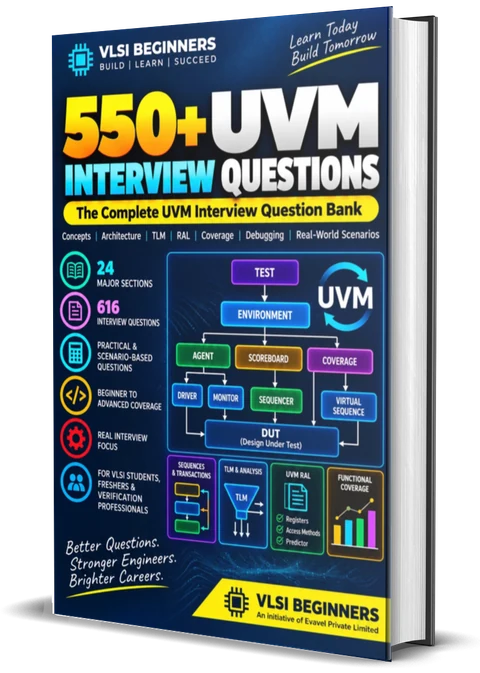
UVM Interview Questions ebook cover
PAIRS WELL WITH

UVM Interview Questions

323 of this book's questions are on UVM. The UVM ebook has 616 more, for roles where the methodology is most of the interview.

See the UVM ebook

1527+ SystemVerilog Interview Questions

1,527 questions across 24 sections, from the language to UVM and expert corner cases. The PDF downloads as soon as you check out.

Get the ebook now
QUESTIONS ABOUT THE BOOK
Does the book include answers?

No. It is a 1,527-question bank with no answer key, so you practise producing answers rather than recognising them. For worked examples with code, see the free SystemVerilog Interview Questions page: 18 answered questions and 8 solved problems.

What exactly do I get?

A 77-page PDF. You check out on Topmate and download it straight away.

How much UVM does it cover?

Six sections and 323 questions: architecture and phasing, components, sequences, factory and config DB, RAL, objections and TLM. Many debugging and company-style questions in sections 21 and 22 also involve UVM.

Is it only for verification roles?

It's written for DV interviews. RTL designers will find sections 1 to 7 and the assertion section useful too; for design-focused prep, see the RTL Design ebook.

I'm a fresher. Where do I start?

Section 1, then straight through to section 12. The UVM sections assume you're comfortable with classes, constraints and fork-join first.

Can I read some pages first?

Yes. Eight real pages are on this page, including the full index with every section and its question count.

What's your refund policy?

Because this is a digital product delivered instantly, sales are generally final. If you hit a technical issue with your download, contact us within 7 days. See our Refund Policy for details.

Preparing for another round too? Browse all ebooks →