UVM & DESIGN VERIFICATION INTERVIEW PREP

616 UVM questions, one testbench layer at a time.

Factory and config DB, then every component from sequencer to scoreboard, then RAL, phasing and objections, then the debugging and architecture questions senior DV rounds are built on. 24 chapters, written the way interviewers actually ask, with no answer key to lean on.

41-PAGE PDF · INSTANT DOWNLOAD · 8 FREE PREVIEW PAGES BELOW
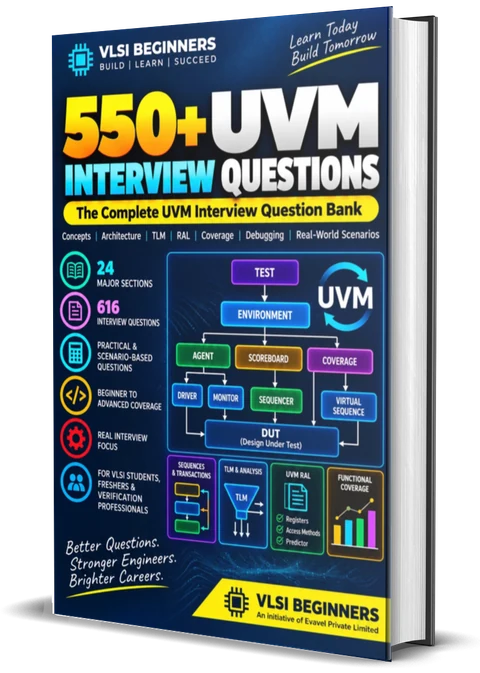
550+ UVM Interview Questions ebook cover — VLSI Beginners
616
QUESTIONS, NO ANSWERS
24
CHAPTERS
195
ON TESTBENCH COMPONENTS
95
DEBUG, ARCHITECTURE & SCENARIOS
THE PROBLEM

Knowing the class names isn't knowing UVM

Most candidates can list driver, monitor, agent, scoreboard. Fewer can say why the driver never calls item_done() in their bug, why the factory override did nothing, or why the test ended before the stimulus did.

Interviewers know this. After two definitions they move to "how would you…" and "what would you check if…": reuse an agent unchanged, connect one monitor to three scoreboards, debug a scoreboard that silently drops transactions.

This book asks those questions chapter by chapter, from why UVM exists to real verification scenarios such as FIFOs, bridges, interrupt controllers and reset, so you can find the gaps before the interview does.

WHAT'S INSIDE

The whole UVM testbench, as interview questions

Each chapter is one layer of a real environment. If you can answer it aloud and sketch the code, move on; if not, that's tonight's topic.

QUESTIONS ONLY

616 prompts, no answer key

No pre-written answers to skim. You answer aloud or in a simulator, then check against the UVM reference or the free worked answers.

FOUNDATIONS

Factory and config DB in depth

Why UVM, architecture, uvm_object vs uvm_component, 30 factory questions and 25 on config DB and virtual interfaces.

COMPONENTS

195 questions, TLM to scoreboard

Analysis ports, sequencer arbitration, sequences and virtual sequences, driver, monitor, agent, environment, scoreboard and reference model.

CONTROL

RAL, phasing, objections

35 RAL questions (adapters, predictors, mirrors), phasing, objections and drain time, callbacks and reporting.

STIMULUS & CHECKS

Items, constraints, coverage, SVA

Sequence item design, randomisation in a UVM context, coverage models in UVM environments, and assertions alongside monitors and scoreboards.

SENIOR ROUNDS

Debug, architecture, scenarios

35 debugging-methodology questions, 25 on scalable UVM architecture and 35 real-world scenarios: FIFOs, bridges, interrupts, reset, sign-off under pressure.

LOOK INSIDE

Eight pages from the real PDF

Not mock-ups. Tap any page to open it full size.

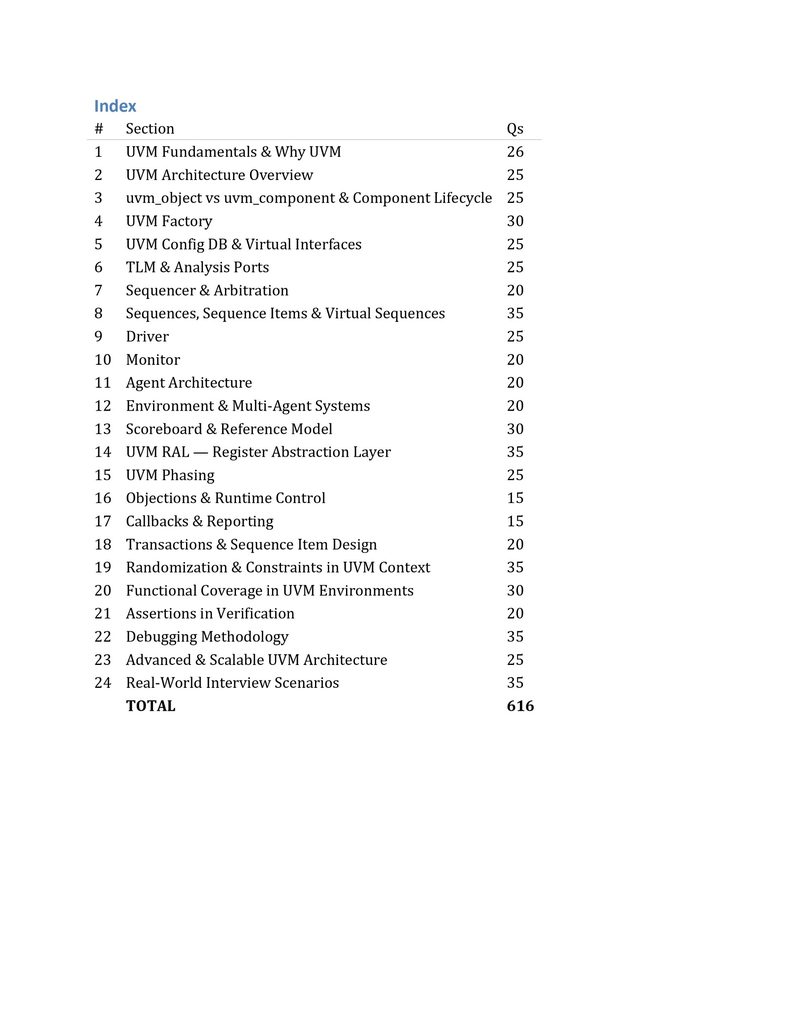
Index listing all 24 chapters with question counts, totalling 616
INDEXAll 24 chapters and counts
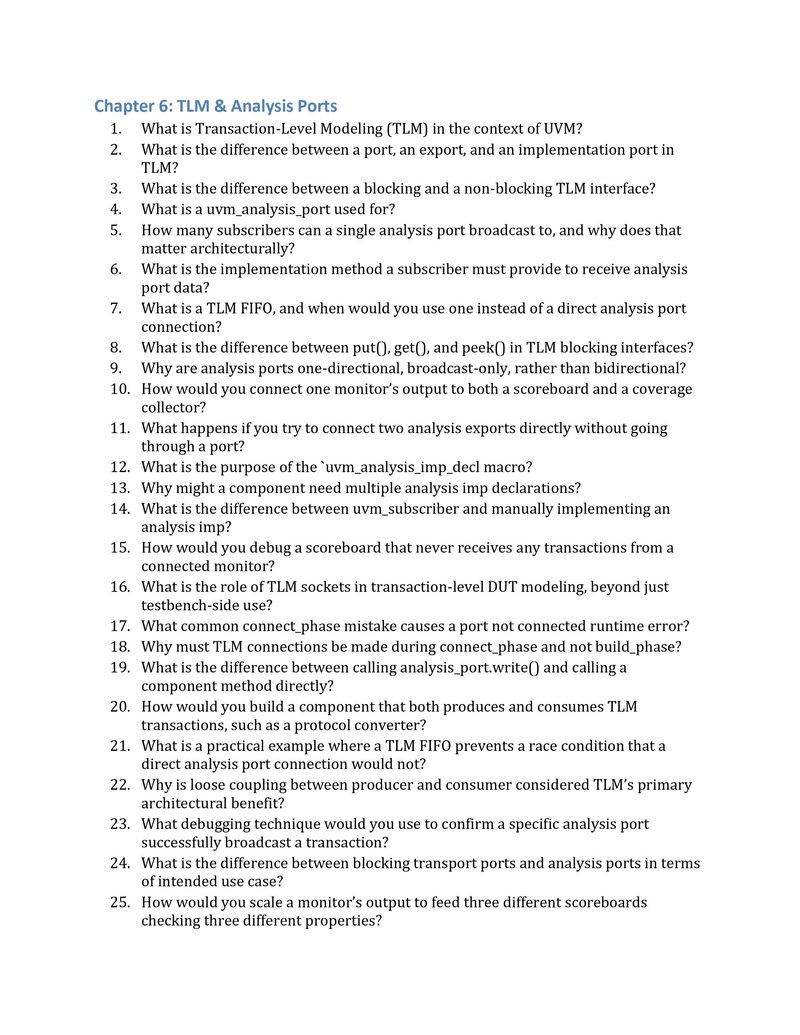
Chapter 6 page with all 25 questions on TLM ports, exports, imps, analysis ports and TLM FIFOs
CHAPTER 6TLM and analysis ports
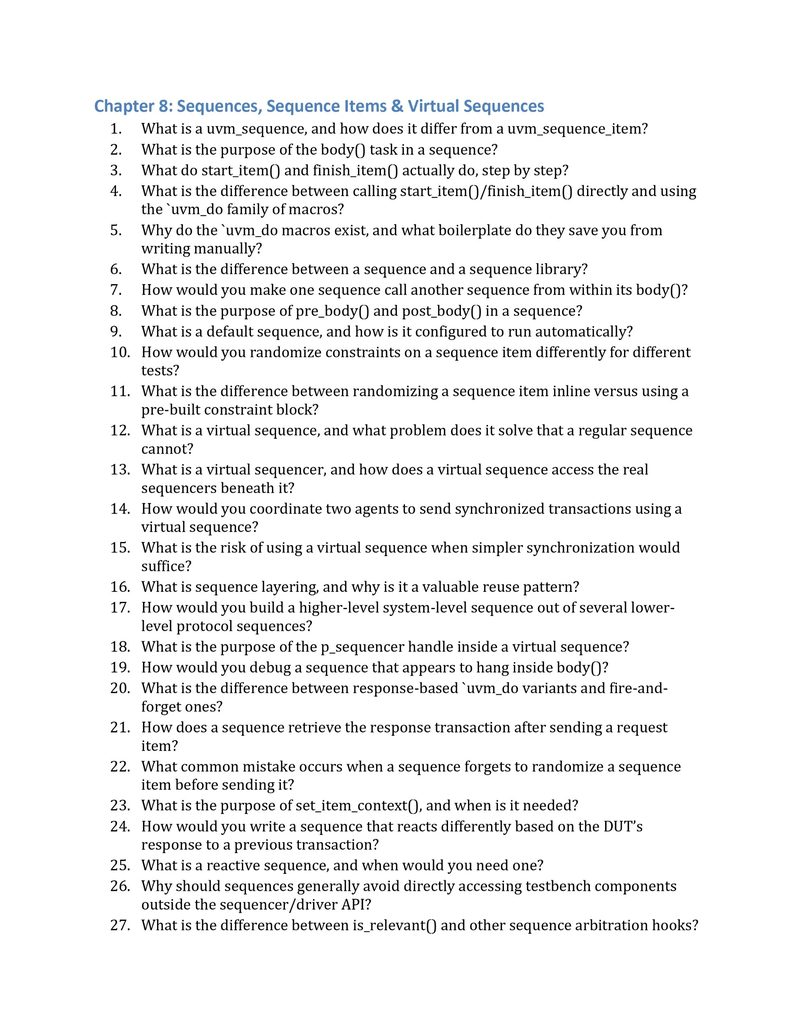
Chapter 8 page with questions 1 to 27 on sequences, start_item and finish_item, virtual sequences and layering
CHAPTER 8Sequences and virtual sequences
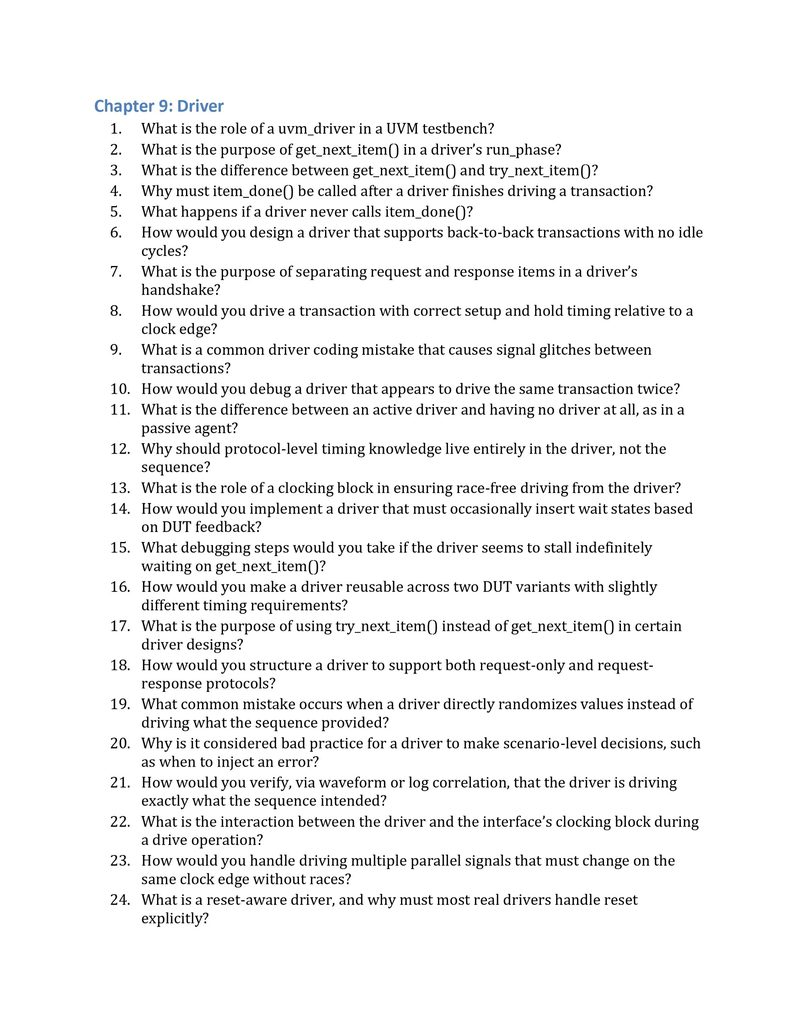
Chapter 9 page with questions 1 to 24 on driver handshakes, item_done, try_next_item and reset-aware drivers
CHAPTER 9Driver handshakes and timing
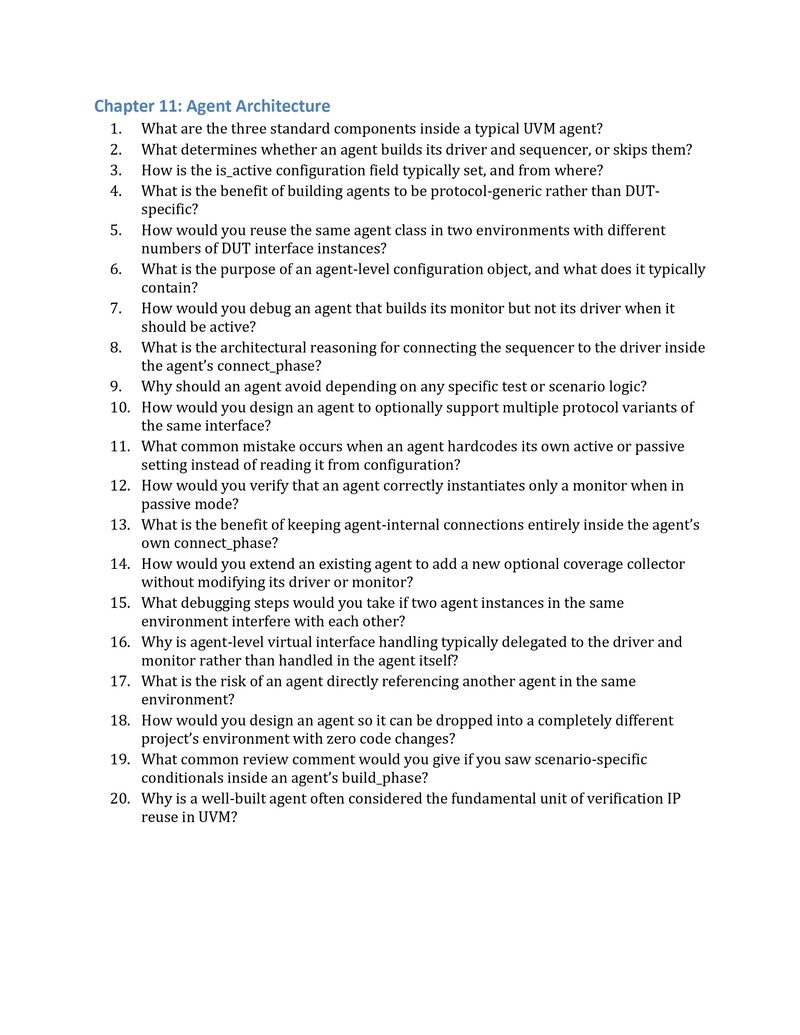
Chapter 11 page with all 20 questions on active and passive agents, configuration and reuse
CHAPTER 11Active, passive and reusable agents
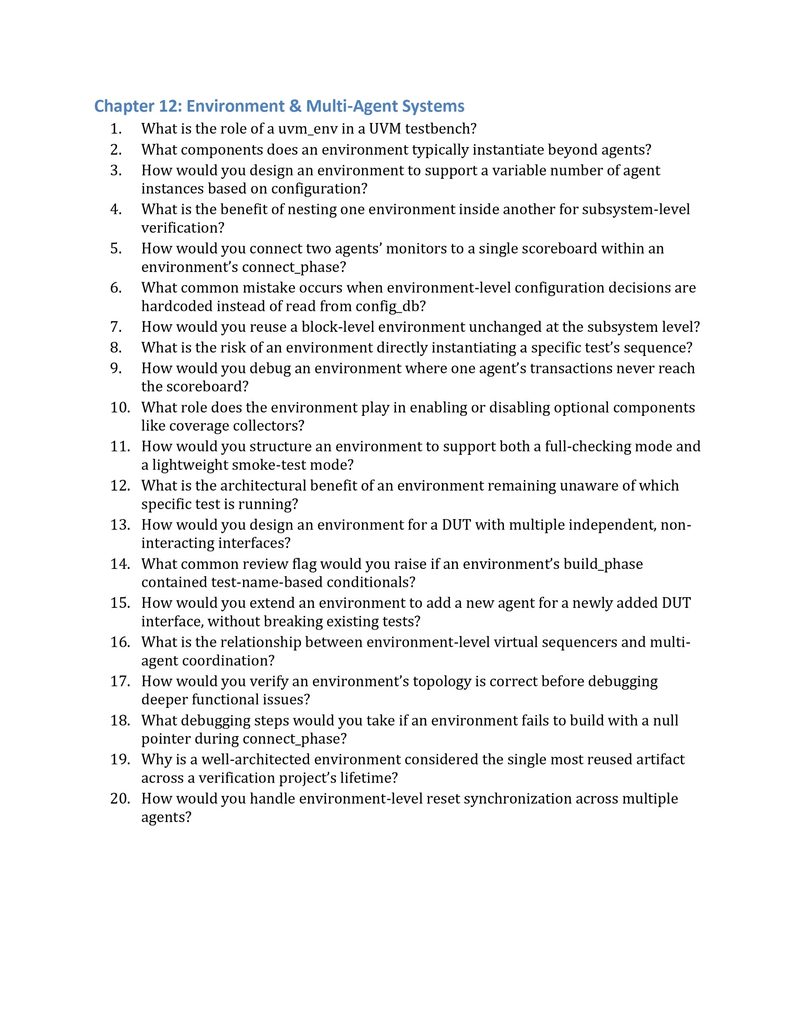
Chapter 12 page with all 20 questions on environments, nesting, multi-agent coordination and reset
CHAPTER 12Environments and multi-agent systems
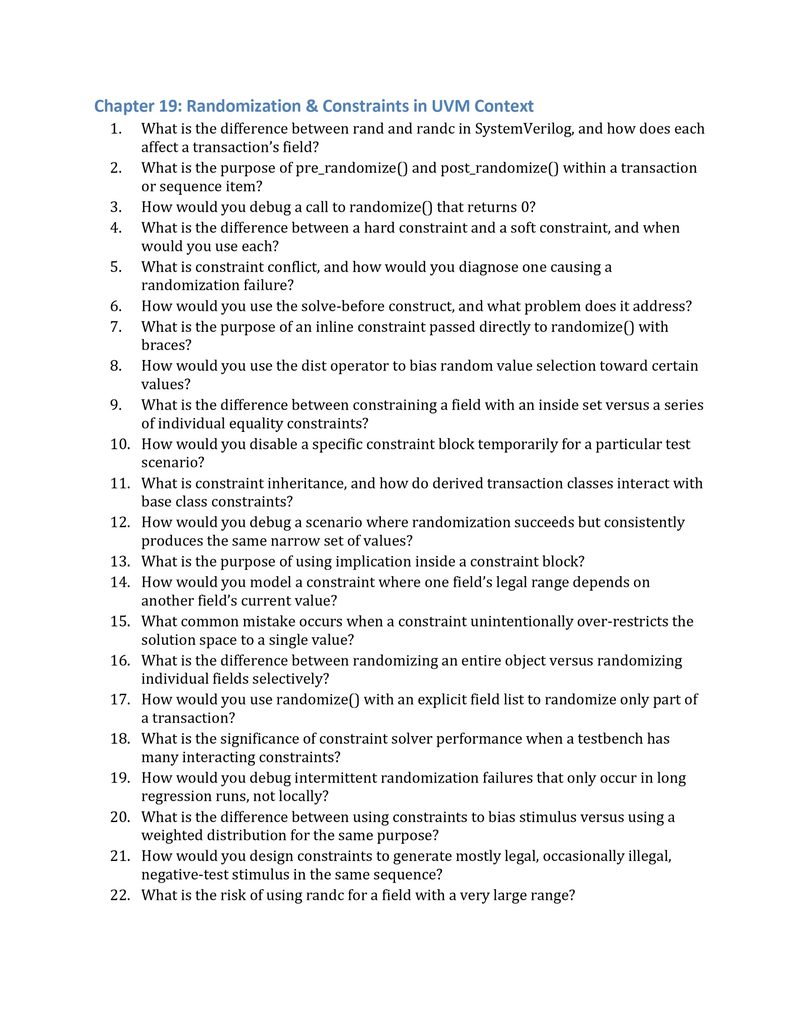
Chapter 19 page with questions 1 to 22 on rand and randc, soft constraints, solve-before and constraint debugging
CHAPTER 19Constraints in a UVM context
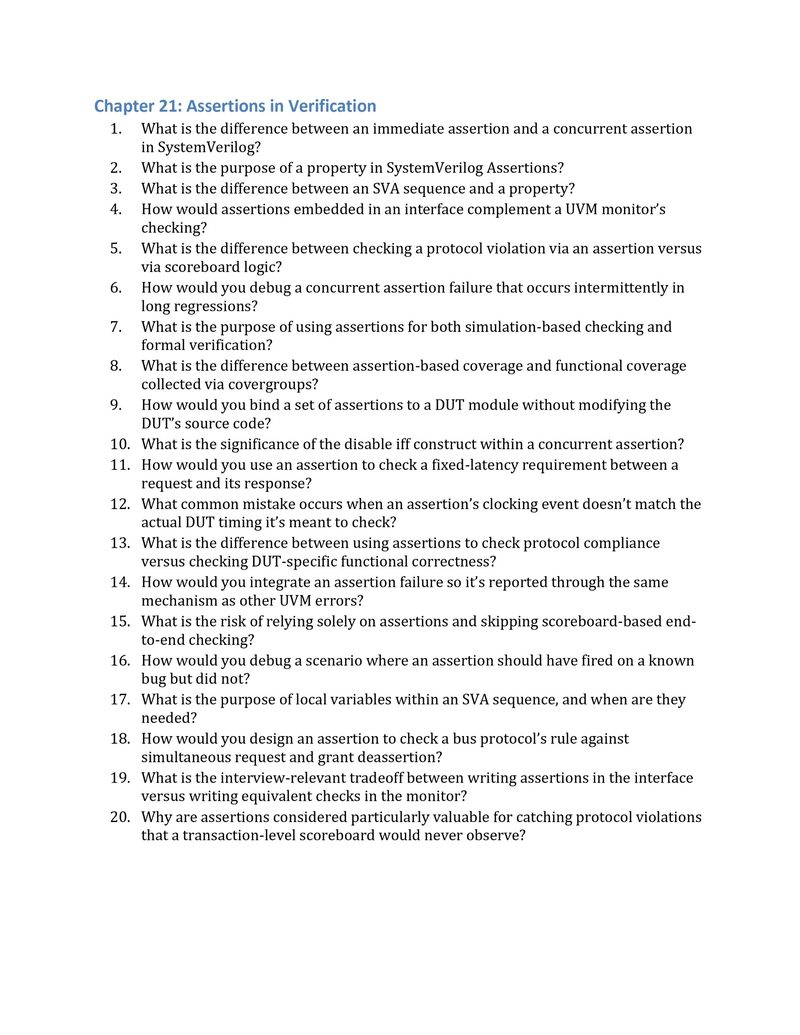
Chapter 21 page with all 20 questions on assertions alongside monitors and scoreboards
CHAPTER 21Assertions vs scoreboards
HOW IT'S STRUCTURED

Five parts, from the base classes to sign-off

Understand what UVM gives you, build each component, control the run, generate and check stimulus, then debug and scale it. The order you'd build a real environment in.

PART I — FOUNDATIONS
What UVM gives you before you write a component
CH 1–5Why UVM, architecture overview, uvm_object vs uvm_component and the component lifecycle, the factory, config DB and virtual interfaces
131QUESTIONS
PART II — TESTBENCH COMPONENTS
Every box in the block diagram
CH 6–13TLM and analysis ports, sequencer and arbitration, sequences and virtual sequences, driver, monitor, agent, environment, scoreboard and reference model
195QUESTIONS
PART III — REGISTERS & RUN CONTROL
What keeps a test running, and ending, correctly
CH 14–17RAL, UVM phasing, objections and runtime control, callbacks and reporting
90QUESTIONS
PART IV — STIMULUS & CHECKING
Generating the right traffic and proving it was right
CH 18–21Transaction and sequence item design, randomisation and constraints, functional coverage, assertions in verification
105QUESTIONS
PART V — DEBUG, SCALE & SCENARIOS
What senior DV rounds are made of
CH 22–24Debugging methodology, advanced and scalable UVM architecture, real-world interview scenarios
95QUESTIONS
TOTAL ACROSS 24 CHAPTERS 616 questions
SEE ALL 24 CHAPTERS
#CHAPTERQUESTIONS
PART I · FOUNDATIONS
01UVM Fundamentals & Why UVM26
02UVM Architecture Overview25
03uvm_object vs uvm_component & Component Lifecycle25
04UVM Factory30
05UVM Config DB & Virtual Interfaces25
PART II · TESTBENCH COMPONENTS
06TLM & Analysis Ports25
07Sequencer & Arbitration20
08Sequences, Sequence Items & Virtual Sequences35
09Driver25
10Monitor20
11Agent Architecture20
12Environment & Multi-Agent Systems20
13Scoreboard & Reference Model30
PART III · REGISTERS AND RUN CONTROL
14UVM RAL (Register Abstraction Layer)35
15UVM Phasing25
16Objections & Runtime Control15
17Callbacks & Reporting15
PART IV · STIMULUS AND CHECKING
18Transactions & Sequence Item Design20
19Randomization & Constraints in UVM Context35
20Functional Coverage in UVM Environments30
21Assertions in Verification20
PART V · DEBUG, SCALE AND SCENARIOS
22Debugging Methodology35
23Advanced & Scalable UVM Architecture25
24Real-World Interview Scenarios35
FROM THE BOOK

Five questions to try right now

Taken word for word from the book, one from each part. The book doesn't answer them; the one-line nudge under each is ours, so you know what a complete answer covers.

Get the ebook now
CH 4 · Q5FACTORY What happens if you call create() on a class that was never registered with the factory? Cover: the missing utils macro, the compile or run-time error you'd see, and why overrides can never reach that class.
CH 9 · Q5DRIVER What happens if a driver never calls item_done()? Cover: finish_item() never returns, the sequence and the sequencer stall, and the next get_next_item() errors out.
CH 14 · Q8RAL What is a register adapter, and why is it needed to connect RAL to a bus-level agent? Cover: reg2bus and bus2reg, converting generic register operations to the agent's sequence items, and the predictor.
CH 16 · Q10OBJECTIONS What is the purpose of set_drain_time(), and when would you use it? Cover: letting in-flight transactions reach the scoreboard after the last objection drops, and why a fixed delay is fragile.
CH 24 · Q25SCENARIO How would you debug a discrepancy where waveform inspection shows correct DUT behavior but the scoreboard still reports a failure? Cover: the monitor's sampling point, the reference model, ordering and ID matching, and shallow copies stored in queues.
ONE WEEK LEFT?

A 7-day plan through the book

Our suggested pace, about 90 questions a day. Answer aloud, and sketch the code for anything about the factory, config DB, sequences or phasing. Mark what you miss and redo it on day 7.

DAY 1Ch 1–5Why UVM, architecture, objects vs components, factory, config DB
DAY 2Ch 6–8TLM and analysis ports, sequencer arbitration, sequences and virtual sequences
DAY 3Ch 9–13Driver, monitor, agent, environment, scoreboard and reference model
DAY 4Ch 14–17RAL, phasing, objections, callbacks and reporting
DAY 5Ch 18–21Sequence item design, constraints, coverage, assertions
DAY 6Ch 22–23Debugging methodology and scalable UVM architecture
DAY 7Ch 24Real-world scenarios, then every question you marked
WHO THIS IS FOR

For anyone whose interview will include "draw your testbench"

Freshers aiming for DV roles

Chapters 1 to 5 explain why UVM exists and how its base classes work, before the component chapters start.

SystemVerilog users new to UVM

You know classes and constraints; this book maps them to factories, sequences, phases and TLM the way interviewers expect.

Working DV engineers

Chapters 22 to 24 are a ready-made senior round: debugging method, environment architecture and real verification scenarios.

Engineers preparing to lead

Reuse, scalability, configuration and sign-off questions help you talk about how a team's environment should be built, not just your part of it.

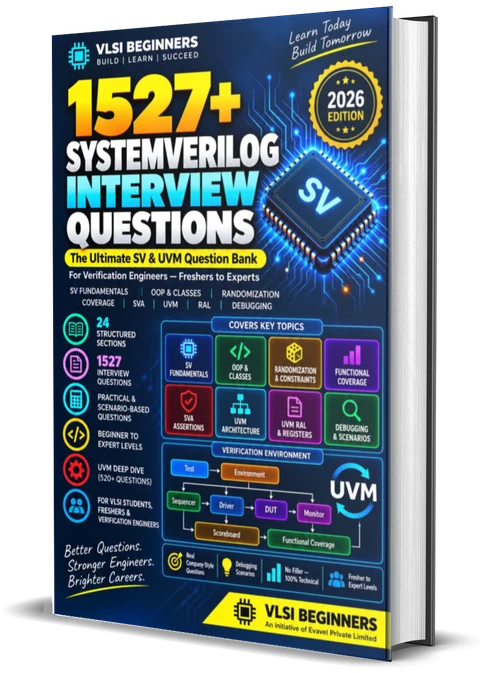
1527+ SystemVerilog Interview Questions ebook cover
PAIRS WELL WITH

1527+ SystemVerilog Interview Questions

UVM rounds start with SystemVerilog: classes, constraints, coverage, assertions and fork-join. The SystemVerilog ebook covers the language in 24 sections.

See the SystemVerilog ebook

550+ UVM Interview Questions

616 questions across 24 chapters, from the factory to real-world scenarios. The PDF downloads as soon as you check out.

Get the ebook now
QUESTIONS ABOUT THE BOOK
Does the book include answers?

No. It is a 616-question bank with no answer key, so you practise producing answers rather than recognising them. For worked examples with code, see the free UVM Interview Questions page: 18 answered questions and 8 solved problems.

What exactly do I get?

A 41-page PDF. You check out on Topmate and download it straight away.

Do I need to know SystemVerilog first?

Yes, at least classes, inheritance, virtual methods and constraints. UVM is written in SystemVerilog, and the book assumes you can read class-based code.

Is it tied to a particular simulator or UVM version?

No. The questions are about the methodology and the standard UVM class library, not a vendor tool or a specific release.

How is this different from the SystemVerilog ebook?

The SystemVerilog ebook covers the language, with six shorter UVM sections. This one is all UVM: 24 chapters on the components, the factory, RAL, phasing, debugging and real verification scenarios.

Can I read some pages first?

Yes. Eight real pages are on this page, including the index with every chapter and its question count.

What's your refund policy?

Because this is a digital product delivered instantly, sales are generally final. If you hit a technical issue with your download, contact us within 7 days. See our Refund Policy for details.

Preparing for another round too? Browse all ebooks →