PHYSICAL DESIGN INTERVIEW PREP

Netlist to tapeout. 616 questions, each one answered.

The whole physical design flow in 26 sections, in the order a block is actually built. Every question has an answer, the reasoning behind it, and an interview tip. The last four sections are pure debugging, signoff and real-world scenarios.

140-PAGE PDF · INSTANT DOWNLOAD · 8 FREE PREVIEW PAGES BELOW
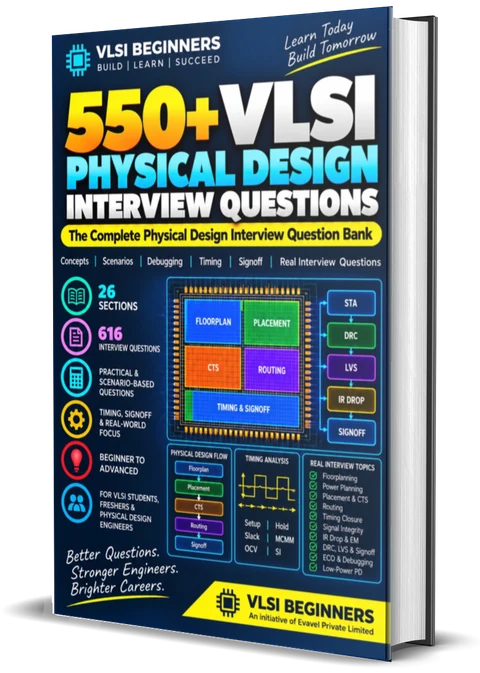
550+ VLSI Physical Design Interview Questions ebook cover — VLSI Beginners
616
QUESTIONS WITH ANSWERS
26
SECTIONS IN FLOW ORDER
112
TIMING-CLOSURE QUESTIONS
115
DEBUG, SIGNOFF & SCENARIOS
THE PROBLEM

PD interviews test judgment, not vocabulary

Knowing what CTS or IR drop means gets you through the first ten minutes. After that, interviewers want to hear what you'd check when one region is congested, why hold breaks after CTS, or what to do with a violation that appears in only one corner two days before tapeout.

Most preparation is scattered. Forum answers at different depths, notes that skip power planning or physical verification, and no way to tell whether you've covered the flow from netlist to GDS.

This book follows the flow itself: inputs and floorplan, placement and clock, routing and timing closure, integrity and verification, then optimisation, debugging and signoff. Each answer explains why the concept matters and what goes wrong without it.

WHAT'S INSIDE

Answers built for "why" and "what would you check"

The book trains the three things PD interviewers listen for: whether you know where a problem comes from in the flow, how you'd find it, and what a fix would cost.

THREE-PART ANSWERS

Answer, explanation, tip

Each of the 616 questions has a direct answer, an explanation of the reasoning or consequence, and an Interview Tip on how to say it or what to add next.

FLOW ORDER

26 sections, netlist to GDS

Fundamentals, libraries and inputs, floorplan, power, placement, congestion, CTS, clock optimisation, routing, timing, SI, IR/EM, DRC/LVS, DFM, PPA, ECO, low power and hierarchy.

TIMING CLOSURE

112 questions on STA for PD

Timing paths and reports, setup closure, hold closure after CTS, delay cells, useful skew, MCMM scenarios, OCV, CPPR and cross-corner optimisation.

INTEGRITY & SIGNOFF

Where real chips fail

Crosstalk delay and noise, shielding and spacing, static and dynamic IR drop, electromigration, DRC and LVS debug, antenna rules, metal fill and tapeout readiness.

DEBUGGING

60 debug and scenario questions

Hypothesis-driven debug for timing, congestion, CTS, routing and IR, plus 32 real-world scenarios: IR hotspots, DRC explosions, corner-only failures and late ECO decisions.

REVISION

Checklists and a final prep chapter

A revision checklist after every section, plus how to answer "why" and debugging questions, how to explain your PD project, and ten questions to answer before any interview.

LOOK INSIDE

Eight pages from the real PDF

Not mock-ups. Tap any page to open it full size.

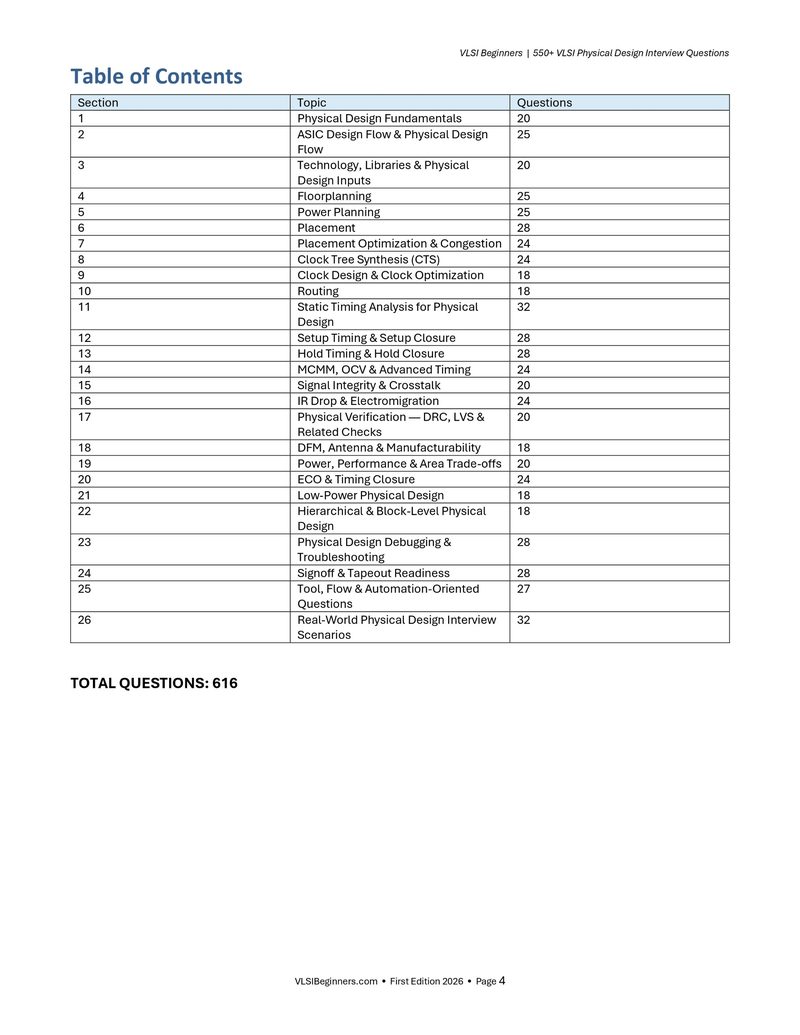
Table of contents listing all 26 sections with question counts, totalling 616
PAGE 4All 26 sections and counts
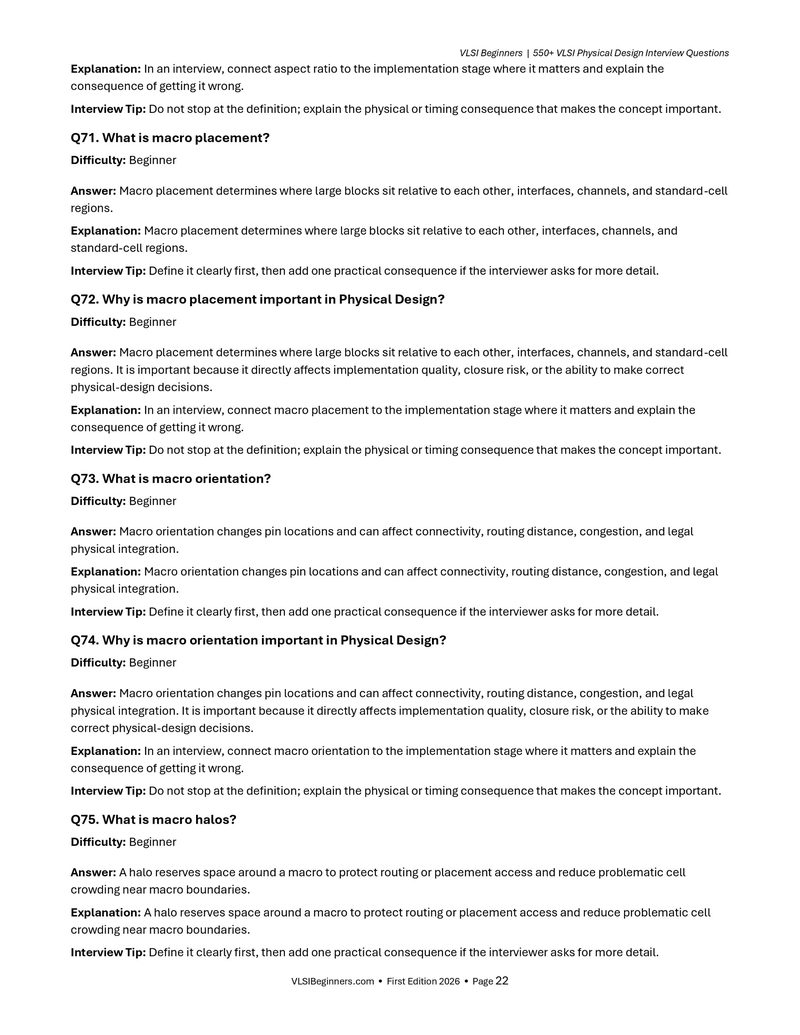
Section 4 page on macro placement, macro orientation and macro halos, each with answer, explanation and tip
SECTION 4Macros, orientation and halos
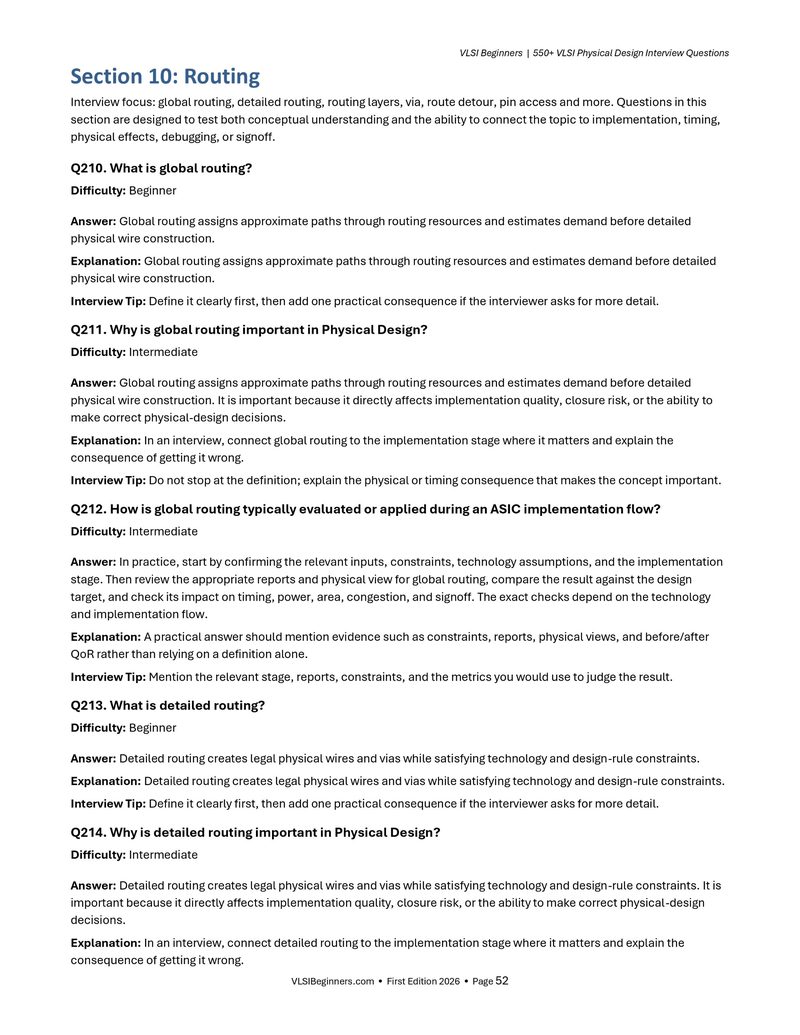
Section 10 opener on global and detailed routing, and how routing is evaluated in an ASIC flow
SECTION 10Global and detailed routing
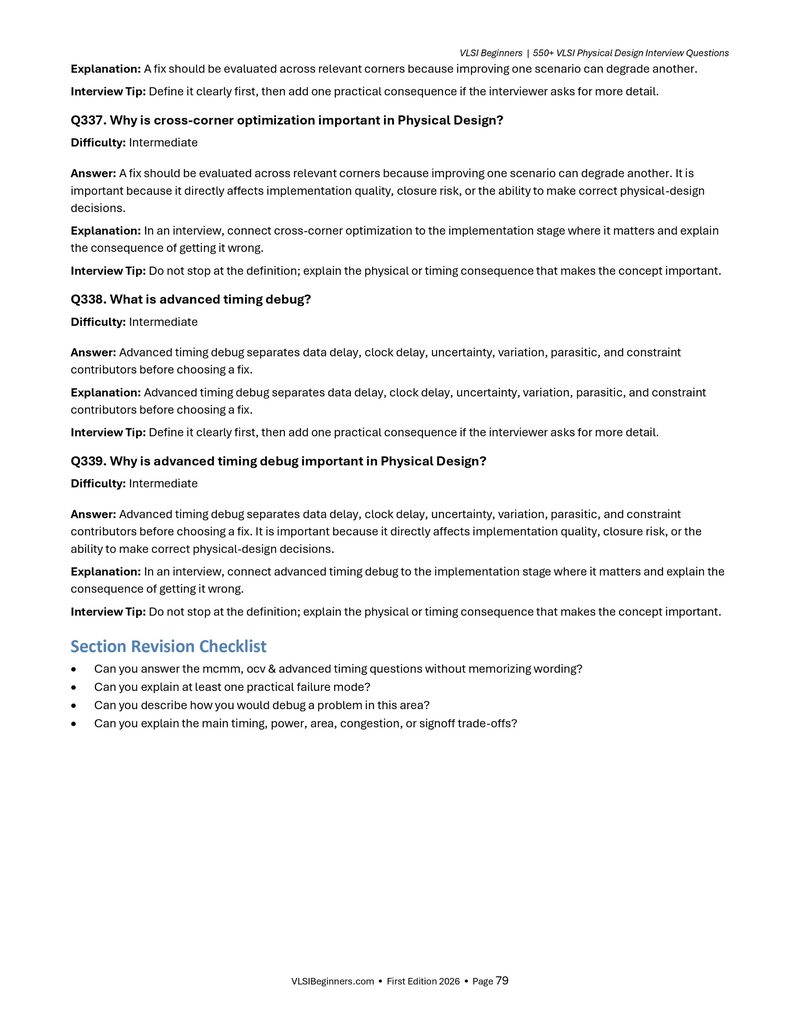
Section 14 page on cross-corner optimisation and advanced timing debug, ending with the section revision checklist
SECTION 14Cross-corner timing and checklist
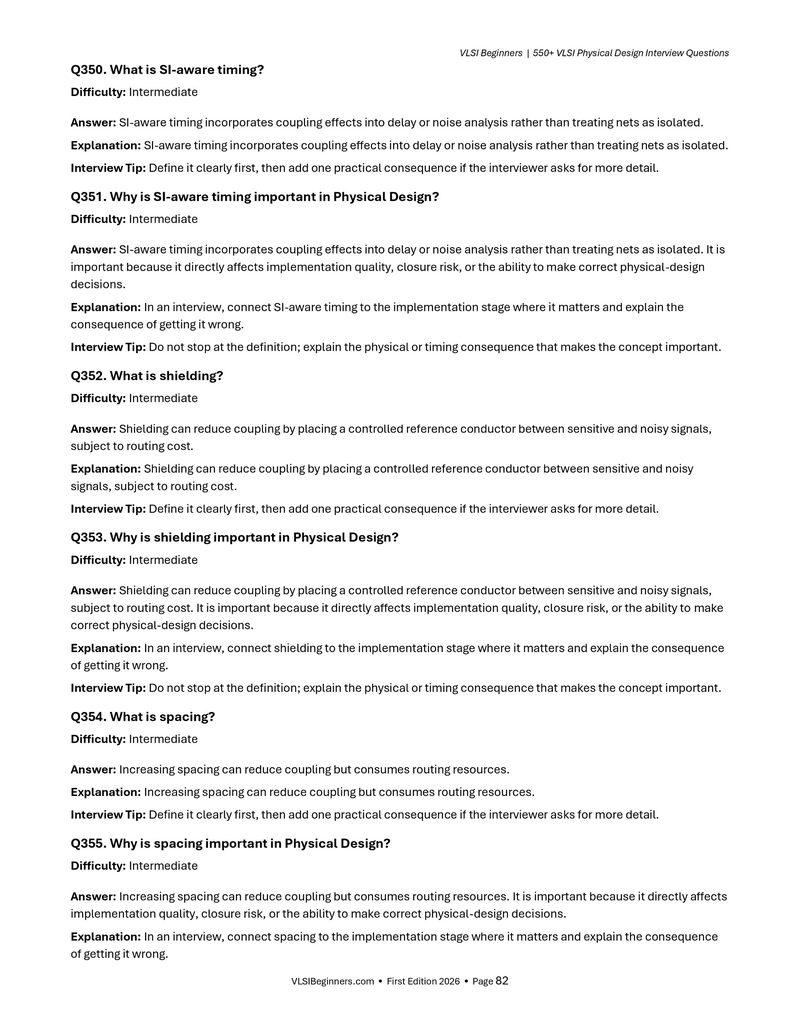
Section 15 page on SI-aware timing, shielding and spacing
SECTION 15SI-aware timing, shielding
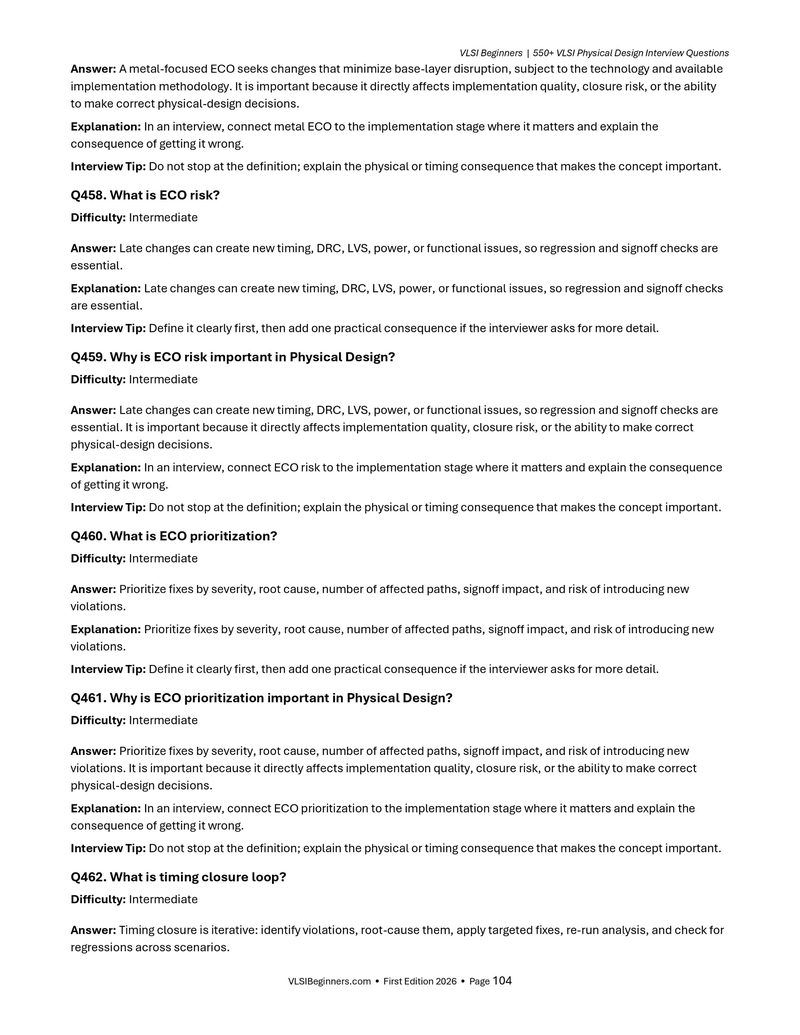
Section 20 page on metal ECOs, ECO risk, ECO prioritisation and the timing closure loop
SECTION 20ECO risk and prioritisation
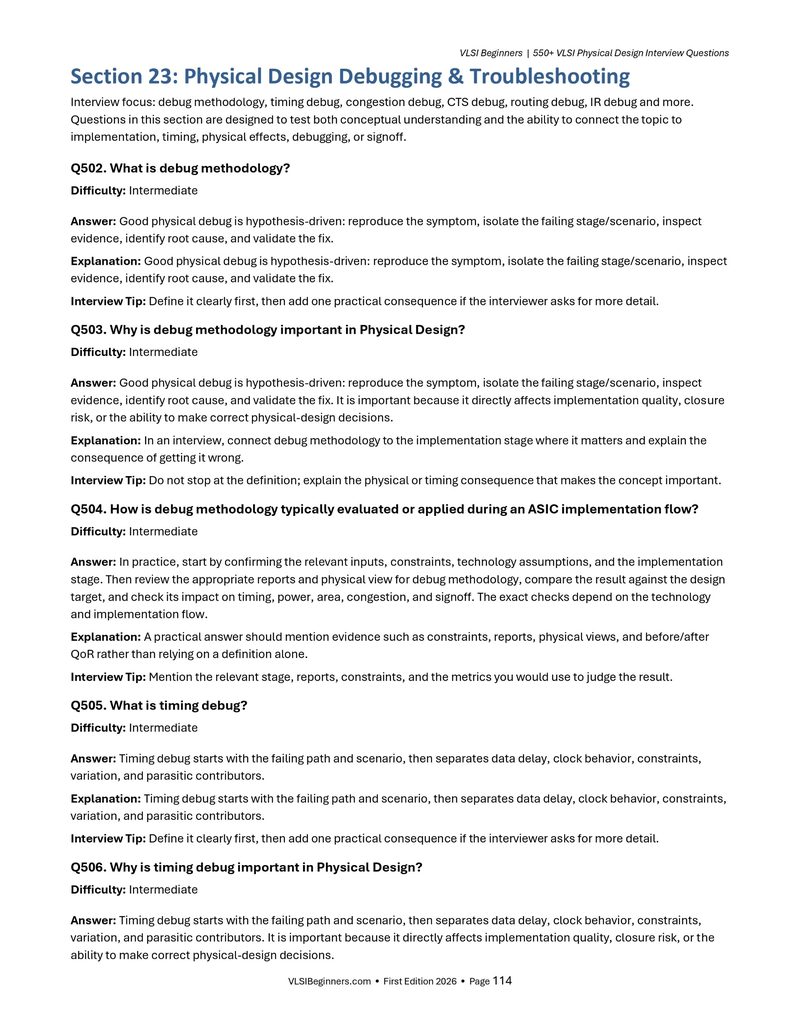
Section 23 opener on debug methodology and timing debug
SECTION 23Debug methodology
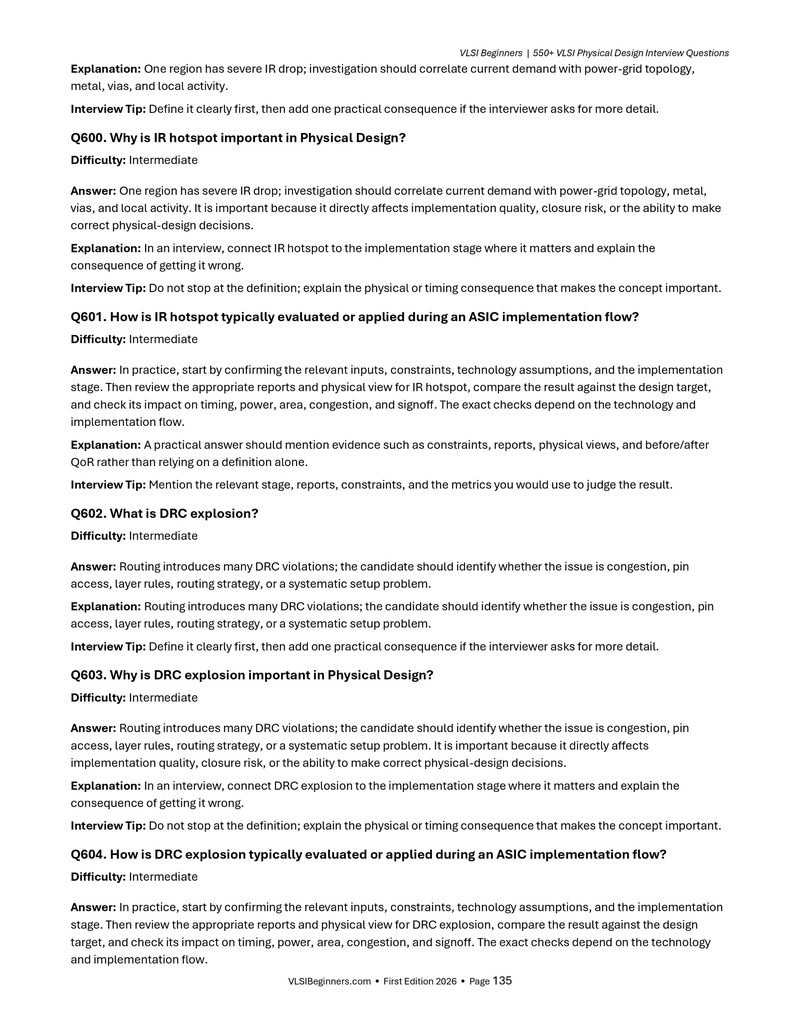
Section 26 page on IR hotspots and DRC explosions after routing
SECTION 26IR hotspots, DRC explosions
HOW IT'S STRUCTURED

Five parts that follow a block through implementation

Set up the floorplan, place and clock it, close timing, prove it's manufacturable and reliable, then debug and sign it off. The same order a real block moves through the flow.

PART I — FOUNDATIONS & FLOORPLAN
Before a single cell is placed
SEC 1–5PD fundamentals, ASIC and PD flow, technology, libraries and inputs, floorplanning, power planning
115QUESTIONS
PART II — PLACEMENT, CLOCK & ROUTING
Building the physical netlist
SEC 6–10Placement, placement optimisation and congestion, clock tree synthesis, clock design and optimisation, routing
112QUESTIONS
PART III — TIMING CLOSURE
Where most interview depth lives
SEC 11–14STA for physical design, setup timing and closure, hold timing and closure, MCMM, OCV and advanced timing
112QUESTIONS
PART IV — INTEGRITY, VERIFICATION & OPTIMISATION
Making it correct, reliable and efficient
SEC 15–22Signal integrity and crosstalk, IR drop and EM, DRC and LVS, DFM and antenna, PPA trade-offs, ECO and timing closure, low-power PD, hierarchical design
162QUESTIONS
PART V — DEBUGGING, SIGNOFF & SCENARIOS
What senior rounds are made of
SEC 23–26PD debugging and troubleshooting, signoff and tapeout readiness, tool, flow and automation questions, real-world interview scenarios
115QUESTIONS
TOTAL ACROSS 26 SECTIONS + FINAL PREP CHAPTER 616 questions
DIFFICULTY SPLIT
176 Beginner: definitions and the flow438 Intermediate: why it matters, how it's checked and debugged2 Advanced
SEE ALL 26 SECTIONS
#SECTIONQUESTIONS
PART I · FOUNDATIONS AND FLOORPLAN
01Physical Design FundamentalsQ1–Q20
02ASIC Design Flow and Physical Design FlowQ21–Q45
03Technology, Libraries and Physical Design InputsQ46–Q65
04FloorplanningQ66–Q90
05Power PlanningQ91–Q115
PART II · PLACEMENT, CLOCK AND ROUTING
06PlacementQ116–Q143
07Placement Optimization and CongestionQ144–Q167
08Clock Tree Synthesis (CTS)Q168–Q191
09Clock Design and Clock OptimizationQ192–Q209
10RoutingQ210–Q227
PART III · TIMING CLOSURE
11Static Timing Analysis for Physical DesignQ228–Q259
12Setup Timing and Setup ClosureQ260–Q287
13Hold Timing and Hold ClosureQ288–Q315
14MCMM, OCV and Advanced TimingQ316–Q339
PART IV · INTEGRITY, VERIFICATION AND OPTIMISATION
15Signal Integrity and CrosstalkQ340–Q359
16IR Drop and ElectromigrationQ360–Q383
17Physical Verification: DRC, LVS and Related ChecksQ384–Q403
18DFM, Antenna and ManufacturabilityQ404–Q421
19Power, Performance and Area Trade-offsQ422–Q441
20ECO and Timing ClosureQ442–Q465
21Low-Power Physical DesignQ466–Q483
22Hierarchical and Block-Level Physical DesignQ484–Q501
PART V · DEBUGGING, SIGNOFF AND SCENARIOS
23Physical Design Debugging and TroubleshootingQ502–Q529
24Signoff and Tapeout ReadinessQ530–Q557
25Tool, Flow and Automation-Oriented QuestionsQ558–Q584
26Real-World Physical Design Interview ScenariosQ585–Q616
FINAL CHAPTER
—Final Physical Design Interview Preparationp. 139
FROM THE BOOK

Five answers from the book

A clock basic, a hold-fixing tool, a manufacturing rule, a closure metric and a routing scenario. Every question gets a direct answer, an explanation and a tip; here are the answers and tips.

Get the ebook now
Q174BEGINNER · CTS What is clock latency? Clock latency is the time taken for the clock to propagate from its defined source/reference point to a sink. Tip: Define it clearly first, then add one practical consequence if the interviewer asks for more detail.
Q295INTERMEDIATE · HOLD Why are delay cells important in Physical Design? Dedicated delay cells can add delay to data paths while providing more controlled physical impact than arbitrary logic changes. It is important because it directly affects implementation quality, closure risk, or the ability to make correct physical-design decisions. Tip: Do not stop at the definition; explain the physical or timing consequence that makes the concept important.
Q410INTERMEDIATE · DFM What is an antenna fix? Common fixes include adding protection structures or changing routing so that manufacturing exposure is reduced, subject to technology rules. Tip: Define it clearly first, then add one practical consequence if the interviewer asks for more detail.
Q440INTERMEDIATE · PPA What is QoR? Quality of results is a multi-dimensional assessment of implementation metrics such as timing, power, area, congestion, and physical violations. Tip: Define it clearly first, then add one practical consequence if the interviewer asks for more detail.
Q602INTERMEDIATE · SCENARIO What is DRC explosion? Routing introduces many DRC violations; the candidate should identify whether the issue is congestion, pin access, layer rules, routing strategy, or a systematic setup problem. Tip: Define it clearly first, then add one practical consequence if the interviewer asks for more detail.
ONE WEEK LEFT?

A 7-day plan through the book

Our suggested pace. Answer each question aloud before reading, tick off each section's revision checklist, and on the last day work through the final preparation chapter.

DAY 1Sec 1–5Flow, inputs, floorplanning and power planning
DAY 2Sec 6–10Placement, congestion, CTS, clock optimisation, routing
DAY 3Sec 11–12STA for PD and setup closure
DAY 4Sec 13–14Hold closure, MCMM, OCV and advanced timing
DAY 5Sec 15–18Crosstalk, IR drop and EM, DRC and LVS, DFM and antenna
DAY 6Sec 19–22PPA trade-offs, ECOs, low power, hierarchical design
DAY 7Sec 23–26Debugging, signoff, tool questions, scenarios and the final prep chapter
WHO THIS IS FOR

From first PD interview to senior rounds

Freshers and M.Tech students

Start from the flow and the inputs, then build up to floorplanning, CTS and timing, with beginner questions marked throughout.

Design or STA engineers moving to PD

Learn to think in floorplans, congestion maps, clock trees and signoff checks, not only RTL or timing reports.

Working PD engineers

A structured refresh before a switch or promotion round: MCMM, SI, IR/EM, ECO strategy, hierarchy and signoff.

Self-learners

Every question is answered and explained, and each section ends with a checklist, so you can test yourself without a mentor.

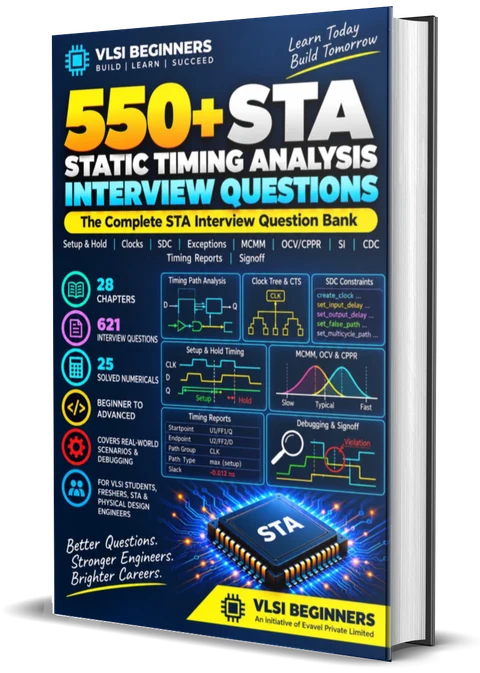
550+ STA Interview Questions ebook cover
PAIRS WELL WITH

550+ STA Interview Questions

PD rounds always turn to timing. The STA ebook goes deeper: 621 answered questions with 25 solved numericals, SDC constraints and annotated timing reports.

See the STA ebook

550+ VLSI Physical Design Interview Questions

616 answered questions across 26 sections, from floorplan to tapeout. The PDF downloads as soon as you check out.

Get the ebook now
QUESTIONS ABOUT THE BOOK
Does every question come with an answer?

Yes. Each of the 616 questions has an answer, an explanation of the reasoning and an interview tip. Every section ends with a short revision checklist.

What exactly do I get?

A 140-page PDF. You check out on Topmate and download it straight away.

I'm a fresher with no tape-out experience. Will I follow it?

Yes. 176 questions are marked Beginner, and the first three sections cover the flow, the inputs (LEF, Liberty, DEF, SDC) and the core vocabulary before floorplanning starts.

Is it tied to one EDA tool?

No. It is vendor-neutral and explains concepts, reports and debugging steps that apply to any commercial or open-source flow. Section 25 covers tool, flow and automation questions in general terms.

Does it include solved numericals or coding exercises?

No. This book is a question bank focused on reasoning, trade-offs and debugging. For timing numericals, pair it with the STA ebook; the free Physical Design page also has 8 solved PD numericals and a floorplan and IR-drop calculator.

Can I read some pages first?

Yes. Eight real pages are on this page, and the free Physical Design Interview Questions page has 90+ sample questions with worked answers.

What's your refund policy?

Because this is a digital product delivered instantly, sales are generally final. If you hit a technical issue with your download, contact us within 7 days. See our Refund Policy for details.

Preparing for another round too? Browse all ebooks →